The remains of the Castle can be visited
CastleLöhnberg
Laneburg Castle (Ruin) (Löhnberg)
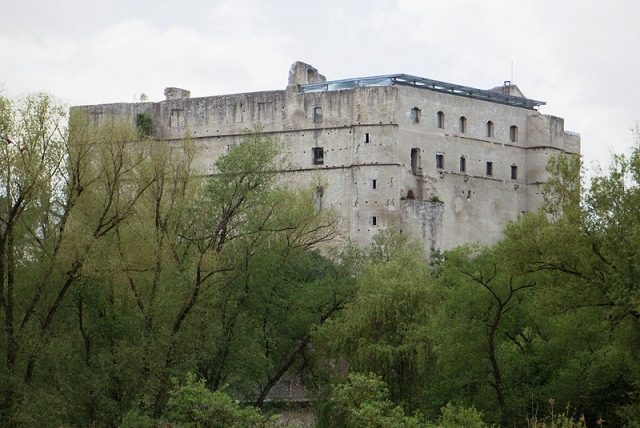
The Laneburg ruin in Löhnberg is a structure in the central Lahn Valley that once played a role in the dominion of the Ottonian line of the House of Nassau. It stands on a rocky spur above the Lahn, where the river transitions from a wide valley into a narrow rocky gorge. The Laneburg also gained recognition through a coin discovery in 2000.
History+
The origins of Laneburg trace back to a Frankish settlement called “Heimau,” which existed as early as 500 AD and was first documented in 1254. After 1100, the site came into the possession of the Counts of Nassau. During the Nassau fraternal division of 1255, the Heimau court fell to Otto I of Nassau. His son Johann with the Hood had Laneburg built between 1321 and 1324 on the Schletsberg. As early as 1324, the name “Laneburg” appeared in a document. After Johann's death in 1328, the castle passed to his brother Heinrich of Nassau-Siegen, who mortgaged it in 1344. In the late 16th century, the Counts of Nassau-Beilstein/Dillenburg began converting it into a Renaissance castle, leading to conflicts with co-owners.
Source: Wikipedia · Licence: CC BY-SA 4.0
This description draws on the facts documented in the linked Wikipedia article; Wikipedia content is licensed under CC BY-SA 4.0. Wording and editing: Mobile History.
Location: 50.5115, 8.2767