The remains of the Castle can be visited
CastleLieli
Lieli Castle (Ruin)
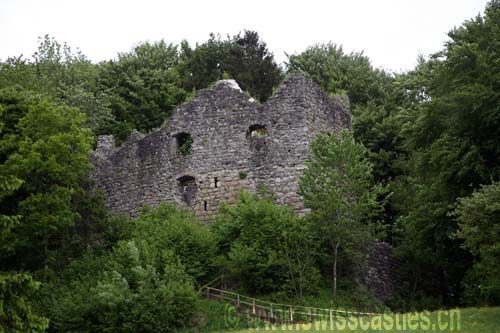
Lieli Castle, on the edge of a wooded stream gorge above the village of Lieli in the canton of Lucerne, was once the center of a small clearing lordship and is now primarily known for its unusual, nonagonal layout, which earned it the popular name “Nünegg.”
History+
Lieli Castle was likely built in a single construction phase in the first half of the 13th century. It served as the ancestral seat of the Lords of Lieli, a ministerial family of the Counts of Kyburg, first documented in 1223. After the Kyburg family died out, the Lords of Lieli entered the service of the Habsburgs. Around 1400, the Lieli lineage died out, after the castle had passed through marriage to the von Grünenberg family and later to Rudolf von Schönau, known as Hürus. In the spring of 1386, Lieli Castle was conquered and burned down by the Lucerners and Confederates, after which it was not rebuilt. In 1431, Wilhelm von Grünenberg sold the castle site to the owners of Heidegg Castle.
Location+
The Lieli ruin is located at an altitude of approximately 702 m above sea level in the municipality of Lieli, in the district of Hochdorf, Canton Lucerne, Switzerland.
On site+
The visible remains of the castle today include a keep and a curtain wall with attached buildings. The complex features an asymmetrical, nonagonal floor plan. In the 19th century, the ruin became the property of the Canton of Lucerne, which had it restored in the 1930s.
Take Mobile History with you
You are reading this text for free. Premium adds what matters on the road: descriptions read aloud, sites found through your camera, whole regions taken offline.
- Every description, including the ~17,700 Premium sites
- Audio guide: have descriptions read to you on location
- AR finder: see sites through your camera, with distance and bearing
- Unlimited saved sites
14 days free, then from €2.99 a month. Cancel anytime.
Source: swisscastles.ch
Text and/or image for this object come from the linked site and are used with the permission of its operators; the linked page remains the copyright of its authors. The legacy catalogue kept text source and image source in a single field, so which part came from there can no longer be told apart entry by entry.
Location: 47.2088, 8.3038