To be privately owned
Lienzer Klause

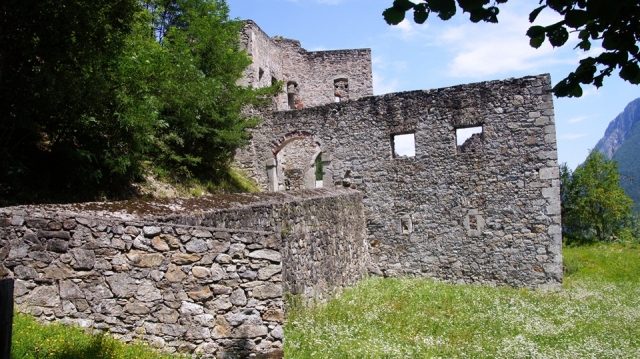
The Lienz Klause is a hermitage in East Tyrol. The hermitage was never besieged or stormed, as the surrounding area was mostly under constant rule. However, it only gained historical significance after its abandonment during the French Wars.
Location+
The hermitage is located at a narrow point in the Drau Valley south of Lienz (municipality of Leisach) and forms the eastern end of the Puster Valley. It lies on the old post road, which was formerly the only road along the valley, and is situated at what was then the narrowest point of the Drau Valley on the left bank of the Drau.
The Lienz Klause is first mentioned in documents in 1241 and 1253, together with Neuenburg Castle, near Lienz. Both fortifications belonged to the then Bishops of Brixen, who had them built due to armed conflicts with the Counts of Görz. To protect their possessions near Anras and Assling from hostile takeover, they erected the Lienz Klause at the narrowest point of the Drau Valley. In the following decades, the Counts of Görz vehemently tried to incorporate the fortifications into their possession. They eventually succeeded, although the exact time is unknown. Neuenburg Fortress was left to decay, while the Klause was maintained to secure the surrounding area. The Lienz Klause was not a border fortress, but an inland fortress of the Görz and later also Tyrolean possessions.
From the 14th century, the complex was not only a defensive structure but also the seat of a court. The latter remained there until 1806, before being moved to Lienz.
Due to the persistent threat from the Ottomans, the Klause was continuously expanded in the 15th and 16th centuries. Most of the medieval buildings were demolished in the process. In 1661, the armistice between the Archduchy of Austria and the Ottomans was terminated. For this reason, the Klause was expanded by the master builders Christoph and Elias Gumpp according to the most modern findings of the time. In 1664 and 1665, the Klause was extended into a fortress facing east with extensive bastions.
Five years later, the masonry was reinforced again. However, farmers and citizens were also deployed as defenders. According to a decree from 1599, they were obliged in times of need to leave their families and homes and to be ready to save and protect the Klause. In return, they were exempt from the market compulsion of the city of Lienz and had permission to sell their self-produced goods anywhere in the County of Tyrol. However, when the danger from the Ottomans was averted, the Lienz Klause slowly lost its importance.
In the 1760s, a new road was built in the valley. The old high post road thus lost its importance, and with it, the Klause. At this time, the walls of the Klause reached down to the Drau, which amounted to a complete valley barrier. The walls below the Klause were eventually removed during the construction of the Puster Valley Railway. In 1782, the fortress was finally abandoned by the state and offered for sale to private individuals.
Although the Klause fell into great disrepair over time, it was to play a significant strategic role once again in the French Wars and the Tyrolean popular uprising in 1809. The Austrian military had abandoned the Tyrolean Landsturm, who were therefore left to their own devices. The Landsturm established the Lienz Klause as a defensive and retreat line. At the beginning of August, French troops under General Rusca advanced from Carinthia into East Tyrol. The French tried to get into the interior of the country. On August 8, a battle finally took place at the Lienz Klause. There, the Tyrolean and Sexten Landsturm succeeded in defending the heavily threatened Klause against a twentyfold superior force of French and Italians and stopping the advance of the attackers. General Rusca was thus denied access to the Puster Valley and eventually had to retreat. Even today, a memorial column in Burgfrieden with an inscription commemorates this battle.
In 1879, Franz Huber acquired the Klause. He was the owner of an inn in Burgfrieden and financed the purchase by selling this business. Huber initially wanted to demolish the fortress and sell its stones, but the Klause was placed under monument protection. Thus, the first renovation works began in the 1970s. Today, the Lienz Klause is a ruin. Its complete decay is prevented by private and public funds. The Lienz Klause is currently privately owned by Anton Huber, who is very committed to preserving the ruin and has since been awarded for it by the monument office.
Take Mobile History with you
You are reading this text for free. Premium adds what matters on the road: descriptions read aloud, sites found through your camera, whole regions taken offline.
- Every description, including the ~17,700 Premium sites
- Audio guide: have descriptions read to you on location
- AR finder: see sites through your camera, with distance and bearing
- Unlimited saved sites
14 days free, then from €2.99 a month. Cancel anytime.
Source: Wikipedia · Licence: CC BY-SA 4.0 · Image: http://www.wehrbauten.at
This description draws on the facts documented in the linked Wikipedia article; Wikipedia content is licensed under CC BY-SA 4.0. Wording and editing: Mobile History.
Location: 46.7957, 12.7232