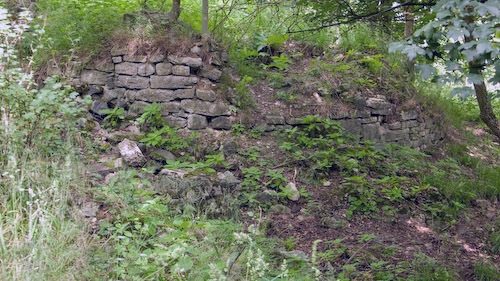
The remains of the Castle can be visited
Malsburg Castle (Ruin) (Zierenberg)

The Malsburg castle ruin is a castle ruin northwest of the core town of Zierenberg in the district of Kassel, North Hesse (Germany). The castle was once the ancestral seat of the family von der Malsburg. The remains of the former Malsburg castle are located in the northern part of the Habichtswald Nature Park on the high Malsberg, a densely wooded basalt cone that rises about 5.25 km northwest of Zierenberg or about 1.7 km southwest of Zierenberg-Hohenborn.
East of the Malsberg, the terrain slopes down to the Warmetal. Approximately 3.8 km southeast of the Malsburg castle ruin, beyond the Warme, lies the Schartenberg castle ruin, about 2.8 km south-southeast the Falkenberg castle ruin, and approximately 1.6 km south-southwest stands Escheberg Castle.
Layout+
The Malsburg was a relatively small complex with an elongated rectangular main building. Today, remnants of walls are preserved, as well as remains of a tower with a diameter of 6.5 m with a spiral staircase and a well.
The Malsburg was first mentioned in 1123, but built earlier. In 1124, Volkold/Folkold and Udalrich von Warthbeche, sons of Volkold I, enfeoffed the Malsburg and the neighboring Schartenberg castle, inherited from their father, to Archbishop Adalbert I of Mainz. Volkold had already moved to Nidda, where his family owned property and he founded the short-lived lineage of the Counts of Nidda from the House of Malsburg. Mainz enfeoffed the Counts of Dassel with Schartenberg Castle, but occupied the Malsburg with its own castellans after Udalrich's death. In 1143, the ministerials Stephan and Dietrich von Malsburg were mentioned there, members of a lower noble family who were probably a branch of the Schartenberg family and now named themselves "von der Malsburg" after their castle seat. In 1213, the castle was a Mainz fief of a branch of the Groppe von Gudenberg family.
Landgrave Heinrich I of Hesse conquered the Malsburg in 1260 (?) during the Thuringian-Hessian War of Succession, but had to return it to Mainz. It then became part of the Mainz office of Hofgeismar.
In 1329, the noble squires Stephan and Hermann von der Malsburg, also on behalf of their sons and other brothers, pledged a castle seat on the Malsburg to the knight Rabe von Pappenheim and his brothers; however, the Pappenheimers were not allowed to cause any damage to the Malsburg's liege lords, the Archbishop of Mainz and Duke Otto of Braunschweig-Göttingen, from the Malsburg. In 1337, the Malsburg family opened their castle to the Archbishop of Mainz, his officials, and the city of Hofgeismar. They also enfeoffed him with their village of Esebecke and received it back as an hereditary castle fief.
In 1353, the Malsburg and Sababurg were transferred to Bishop Balduin of Paderborn for castle guard during a pledge, so that he would protect them and preserve them as open houses for the Archbishopric of Mainz.
After the decisive military defeats of Archbishop Konrad III von Dhaun of Mainz against the Hessian Landgrave Ludwig I near Fritzlar and Fulda in 1427, with which Ludwig finally secured territorial supremacy in Lower and Upper Hesse for the Landgraviate, the Malsburg also fell to the Landgraves of Hesse.
Take Mobile History with you
You are reading this text for free. Premium adds what matters on the road: descriptions read aloud, sites found through your camera, whole regions taken offline.
- Every description, including the ~17,700 Premium sites
- Audio guide: have descriptions read to you on location
- AR finder: see sites through your camera, with distance and bearing
- Unlimited saved sites
14 days free, then from €2.99 a month. Cancel anytime.
Source: Wikipedia · Licence: CC BY-SA 4.0
This description draws on the facts documented in the linked Wikipedia article; Wikipedia content is licensed under CC BY-SA 4.0. Wording and editing: Mobile History.
Location: 51.4106, 9.2597