CastleMuttenz

Middle Wartenberg Castle (Ruin)
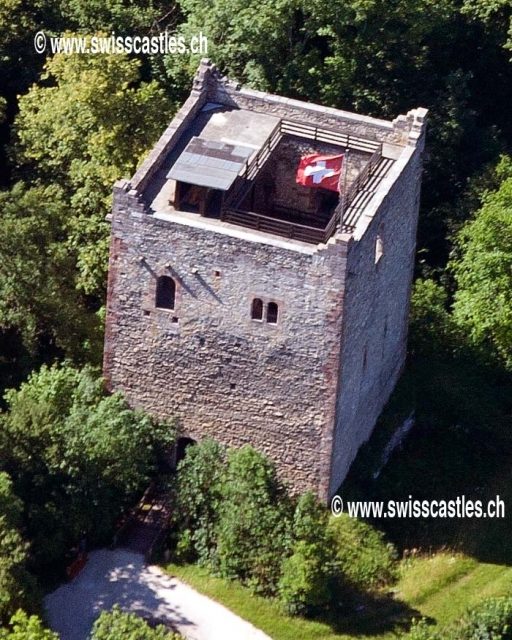
Middle Wartenberg Castle (Ruin)

The remains of the Castle can be visited

The Wartenberg is a striking landmark of the Basel-Landschaft municipality of Muttenz. On the mountain stand the ruins of three medieval castles, which also bear the name Wartenberg.

The Wartenberg is an elevation southeast of the municipality, is part of the Tabular Jura and an offshoot of the Gempen plateau. Its highest point is at a certain height and towers over the village by a good 200 meters.

The height and design of the Wartenberg were excellently suited for representative and defensive purposes, and a Bronze Age complex, which had been used as a refuge, was discovered at the highest point. Arrowheads, a spear, knives and sickles, various ornaments, thousands of sling stones, and various stone tools were found. No remains of the complex itself were found due to the construction of the subsequent castles.

The three castle ruins of Wartenberg+

All three castles were 'cleared out' (loss of many archaeological findings) and 'restored' (loss and falsification of historical building fabric) during the castle romantic phase in the 1930s to 1950s. This should not be lamented here, however, as castle romanticism did lead to broad public interest in the Middle Ages. The fortifications built during the Second World War also disturbed the historical building fabric.

Until the end of the 13th century, the three castles were a single unit. The Cathedral Chapter of Strasbourg appears as the first historically verifiable owner of the three Wartenberg castles and the village of Muttenz. How the Strasbourg acquired these lands can no longer be ascertained. Presumably, the three castles were already passed on as fiefs by the Strasbourg archbishops to the Counts of Homberg in the 11th century. The castles were inhabited not only by the Hombergers or, after 1250, by their successors from the House of Frohburg, the Neu-Hombergers, but also by their vassals, the Marschalk von Frohburg, who after 1250 also called themselves Marschalk von Wartenberg.

The House of Habsburg-Austria took over all three castles in 1306 and gave them as sub-fiefs first to the Basler zer Sunnen and then to Johann I von Habsburg-Laufenburg.

Middle Castle+

The Middle Wartenberg is located at the highest point of the Wartenberg. It was always easily accessible from the north and south and was therefore protected all around by a ditch: however, this was never filled with water (no inflow, rapid drainage through the karstic limestone).

Layout

The castle presumably consisted only of a keep, has a floor area of 14.3 by 13.2 meters, and its wall thickness in the lower part is 3 meters. Eugen Probst (see Häring) claims that a small (possibly wooden) outer bailey stood on a leveled area north of the ditch: however, this assumption is supported neither by finds nor by sources.

The tower had four stories, and the original entrance was 10 meters above the ground on the fourth story of the north wall (the current entrance on the ground floor was created by a wall breakthrough during the 'restoration' in the years 1932 to 1934). How access to this high-lying entrance was gained is a matter of speculation: Eugen Probst's vision is a wooden bridge from his presumed outer bailey to the high entrance, while Alfred Leu and Hans Häring propose a staircase built against the tower wall - stone at the bottom and wood at the top - as an alternative.

The visible installations in the window openings (benches) and the window reveals do not represent a historical state and practically do not correspond to medieval architecture. The remains of a fireplace and oven in the southeast corner of the tower, however, are authentic remains of the Middle Wartenberg.

How the upper finish or the roof of the tower looked is not known. However, it is presumed that the tower had a battlement with merlons and an inwardly set wooden roof. Since the renovation in 1955/1956, an 85-step block staircase leads up to the castle terrace at a height of 15 meters, offering a magnificent view of the Rhine Valley.

The castle was probably built in the late 12th century (i.e., by the Hombergers) and was - according to the preserved floor finds - used from the 13th to the 15th century. The history of the Middle Wartenberg runs parallel to that of the Front Wartenberg.

Image source: www.swisscastles.ch

Take Mobile History with you

You are reading this text for free. Premium adds what matters on the road: descriptions read aloud, sites found through your camera, whole regions taken offline.

  • Every description, including the ~17,700 Premium sites
  • Audio guide: have descriptions read to you on location
  • AR finder: see sites through your camera, with distance and bearing
  • Unlimited saved sites

14 days free, then from €2.99 a month. Cancel anytime.

Source: Wikipedia · Licence: CC BY-SA 4.0

This description draws on the facts documented in the linked Wikipedia article; Wikipedia content is licensed under CC BY-SA 4.0. Wording and editing: Mobile History.

Location: 47.5189, 7.6548