CastleMurist

Moliere Castle (Ruin) (Murist)
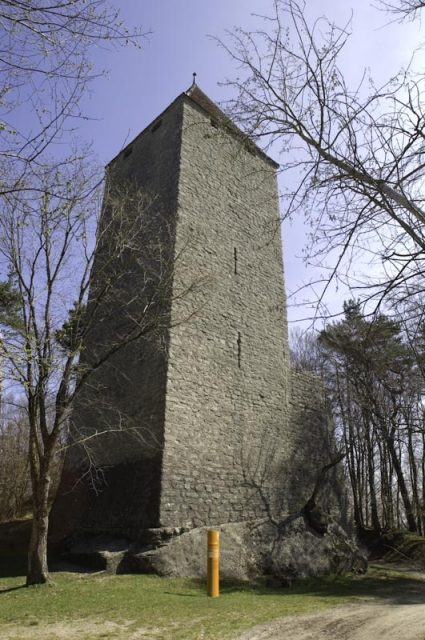
Moliere Castle (Ruin) (Murist)

The remains of the Castle can be visited

On a high hill in the enclave of Estavayer in the Fribourg Broye, Molière Castle dominated the villages of Franex, Murist, and Granges-de-Vesin.

The tower bears great similarities – in multiple ways – to another in the region: the St Martin Tower near Chavannes le Chêne. Both tall and square, they each protected a fortified village. Today, no houses, doors, drawbridges, or enclosure walls, which were already mentioned in Molière in 1317, remain; only some undulations in the terrain and the towers are the last witnesses to the lively life in these places.

The two twins were part of the first stone-built towers in the Middle Ages, dating from the same period as the towers of Gourze and St Tryphon. However, Molière has preserved its pavilion framework, which led Viollet-le-Duc to mention it in his "Archaeological Dictionary" as one of the most interesting buildings of the 10th century. From the top of Molière Tower, one has a magnificent panorama overlooking the Swiss Plateau and the summit of the Jura. The view is as it was in Roman times, when they undoubtedly erected a watchtower there. It is called the Eye of Switzerland (Oculus Helvetiae). Paradoxically, the tower was not built on the highest part of the hill, which is located a little further south; the reason for this is strategic. From this higher point, Gourze Tower could not be seen. But it was then necessary for Molière Tower to be able to communicate with Gourze, which was in sight of St Tryphon Tower near Bex, visible from Valais. This communication and alarm system continued until the end of the siege from Bern.

The first stone structure was undoubtedly realized during the second Kingdom of Burgundy, around the year 900, at the time when the abbey church of Payerne was founded very close by. Moreover, the old road that supplied the village still bears the name "Queen Berthe's Road" today. From Granges-de-Vesin, this picturesque sunken path led to the foot of the tower in 30 minutes.

In 1513, the lordship was an appanage of the Counts of Gruyère, who, heavily indebted, were forced to sell. The new master of the places was a certain Jacques de Pesmes, considered in legends to be a cunning villain. About thirty years later, the land was conquered by the city of Fribourg, then allied with Bern, and the village, as well as Molière Castle, were destroyed. Only the watchtower and a tower on the wall remained after the departure of the Confederates. Consequently, the site was never reoccupied.

In the 19th century, the inhabitants of Murist received permission from the State of Fribourg to dismantle the smaller of the two remaining towers to take the stones necessary for the construction of a spa and some houses in the village. Until the beginning of the 20th century, there was indeed very little interest in these witnesses of the past; the only interest in them was as a reserve of construction material. Since Molière consisted of large stones of dark shelly sandstone, which was very durable, the site was literally plundered over the centuries for the value of its stones. "Stones of Molière" can be found in every surrounding village, taken from buildings of the 16th and 19th centuries. This also explains why the village of Molière has virtually disappeared, and why a quarry at its foot was always in operation.

Fortunately, public opinion became aware of the value of its cultural heritage in the mid-20th century, and thus the canton was moved to change policy. The tower was then classified as a historical monument and was restored at great expense by the canton. Since then, it once again offers the curious a view of our region. This does, however, mean a small detour to the Hotel des Turmes in Murist, where you can obtain the key to protect the tower from vandalism.

Take Mobile History with you

You are reading this text for free. Premium adds what matters on the road: descriptions read aloud, sites found through your camera, whole regions taken offline.

  • Every description, including the ~17,700 Premium sites
  • Audio guide: have descriptions read to you on location
  • AR finder: see sites through your camera, with distance and bearing
  • Unlimited saved sites

14 days free, then from €2.99 a month. Cancel anytime.

Source: Wikipedia · Licence: CC BY-SA 4.0

This description draws on the facts documented in the linked Wikipedia article; Wikipedia content is licensed under CC BY-SA 4.0. Wording and editing: Mobile History.

Location: 46.7975, 6.8213