The remains of the Castle can be visited
Mosburg Castle (Ruin) (Wiesbaden-Biebrich)
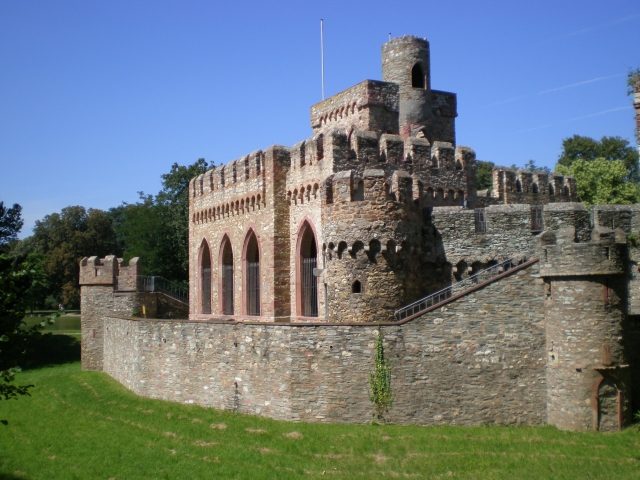
The Mosburg (formerly also Moosburg) is an artificial ruin on the edge of the Mosburgweiher in Biebrich Palace Park in Wiesbaden. It is built on the remains of the old royal palace Biburc.
With high probability, the former royal palace was initiated by the East Frankish Roman-German King Louis the German and existed until the beginning of the 11th century. Building on this, a moated castle is said to have existed in the 13th century.
In 1462, a comital Nassau castle house with a moat and castle wall outside the village is mentioned in the Mosbach court book. From 1654, the castle was owned by the Swedish envoy Penz von Penzau.
At the beginning of the 19th century, Duke Friedrich August of Nassau enlarged Biebrich Palace Park and acquired the remains of the buildings attributed to the Imperial Palace Biburc (also Biburk). He commissioned Carl Florian Goetz to build a neo-Gothic residential castle on the ruins. The artificial ruin was completed between 1805 and 1806. Demolition material from Mainz's Liebfrauenkirche was used for this purpose. In the nascent 19th century, the castle was intended to embody the romantic idea of the Middle Ages. The sham ruin, which contrasts with the baroque Biebrich Palace, was used by the Nassau dukes as a retreat.
After its completion, several epitaphs from the Eberbach Monastery, secularized in 1803, were brought to the castle for decoration. Among them were the tomb slabs of Johann II and Johann IV von Katzenelnbogen. They were returned to the monastery in 1936. The tomb slab of Diether V von Katzenelnbogen, which also stood in the Mosburg at the same time, is now in the Wiesbaden Museum (Collection of Nassau Antiquities).
In the mid-19th century, the sculptor Emil Alexander Hopfgarten set up his studio in the Mosburg (see also: Wiesbaden painters and sculptors in the 19th century). After his death in 1856, his models and works were exhibited in the castle hall for another 18 years.
From 1909 to 1945, the castle (in the so-called Knight's Hall) housed the Biebrich Local History Museum. The permission and a large part of the initial furnishings were provided by Wilhelm IV of Nassau-Weilburg.
In World War II, the artificial ruin became an actual ruin. In 1979, the castle was voluntarily cleaned by the Biebrich local history enthusiasts and the vegetation that had damaged the masonry was removed. Due to its poor structural condition, the Mosburg is no longer accessible to the public.
Restoration+
In 2005, the Architects' and Engineers' Association Wiesbaden (AIV) coordinated a student competition on the future of the Mosburg. The redesign of the Brandweiher and its connection with the Mosburgweiher was awarded, but its implementation is questionable. The renovation of the Mosburg is coordinated by Hessian Real Estate Management. The restoration of the access bridge and the large tower with cabinet and belvedere has been completed. Since summer 2010, the third of five construction phases has been implemented. The historic Zischelbrücke has already been restored in accordance with monument protection, and in the future, the Mosburgweiher is to be enlarged again up to the Zischel (small waterfall).
Mosburgfest+
Since 1979, the Working Group of Biebrich Associations and Federations has organized the annual Mosburgfest. This was originally intended to "bring the long-forgotten and neglected Mosburg back into public interest." Today, it serves to finance the restoration work. Commercial service providers are excluded from the festival.
Take Mobile History with you
You are reading this text for free. Premium adds what matters on the road: descriptions read aloud, sites found through your camera, whole regions taken offline.
- Every description, including the ~17,700 Premium sites
- Audio guide: have descriptions read to you on location
- AR finder: see sites through your camera, with distance and bearing
- Unlimited saved sites
14 days free, then from €2.99 a month. Cancel anytime.
Source: Wikipedia · Licence: CC BY-SA 4.0
This description draws on the facts documented in the linked Wikipedia article; Wikipedia content is licensed under CC BY-SA 4.0. Wording and editing: Mobile History.
Location: 50.0460, 8.2371