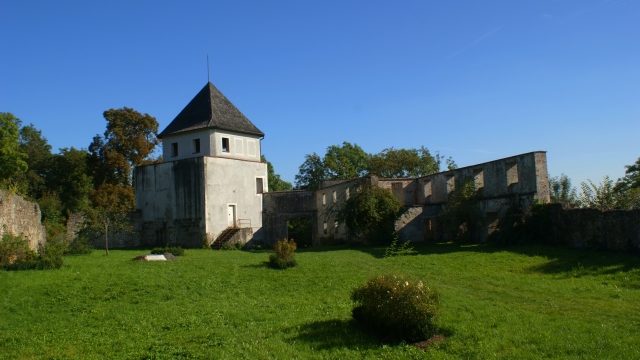
The remains of the Castle can be visited
Natternberg

The history of Natternberg Castle begins in 1145 as the noble seat of Hartwig von Natternberg, a member of the Counts of Bogen. After the extinction of this lineage (1242), ownership passed to the Wittelsbach family. They made the castle the seat of a steward. Bavarian Duke Heinrich der Natternberger grew up here and died here in 1333 at the age of 21. The Wittelsbachs then enfeoffed Peter von Egg with Natternberg. After falling into disgrace, he was besieged for a year in 1337 until he returned Natternberg to the Duke.
In 1430, Natternberg received its own jurisdiction. A painting by Hans Donauer the Elder from about 1590 in the Munich Antiquarium shows the castle's appearance at that time. During the Thirty Years' War and the War of the Austrian Succession, the castle was severely damaged. In 1802, the mountain was sold by the Bavarian State. The new owners were the Counts of Preysing at Moos Castle. In 1836, they sold the castle to a Baron Berger, who in 1838 handed it over to the innkeeper of Natternberg. After several changes of ownership, the Preysings reacquired the castle. From the end of the 19th century until World War II, the castle was again inhabited, and its last resident even cultivated wine ("Natternberger Teufelskralle"). The mountain and castle ruins, with their excellent view, are now freely accessible and are located on the Via Danubia cycle path.
Legends and Sagas
There is a legend about the origin of Natternberg in the landscape, which people in the Deggendorf district have been telling since ancient times.
It claims that one day at noon, the devil wanted to throw a huge rock into the Danube to flood Deggendorf.
But when he heard the bells of the nearby Metten Monastery, he dropped it in fright just before the Danube. From this, Natternberg then emerged.
Another saga revolves around the Count and Countess of Natternberg. They are said to have badly devastated the surrounding fields during their hunts, and as punishment, they are said to still roam restlessly today.
Another saga reports that Charlemagne, during his campaign against the Avars in 791, had a Danube bridge built between Metten and the "Mettenufer" (Metten bank) located in front of Natternberg. This bridge must have been located quite precisely at the current site of the A3 motorway bridge.
Take Mobile History with you
You are reading this text for free. Premium adds what matters on the road: descriptions read aloud, sites found through your camera, whole regions taken offline.
- Every description, including the ~17,700 Premium sites
- Audio guide: have descriptions read to you on location
- AR finder: see sites through your camera, with distance and bearing
- Unlimited saved sites
14 days free, then from €2.99 a month. Cancel anytime.
Source: Wikipedia · Licence: CC BY-SA 4.0
This description draws on the facts documented in the linked Wikipedia article; Wikipedia content is licensed under CC BY-SA 4.0. Wording and editing: Mobile History.
Location: 48.8257, 12.9109