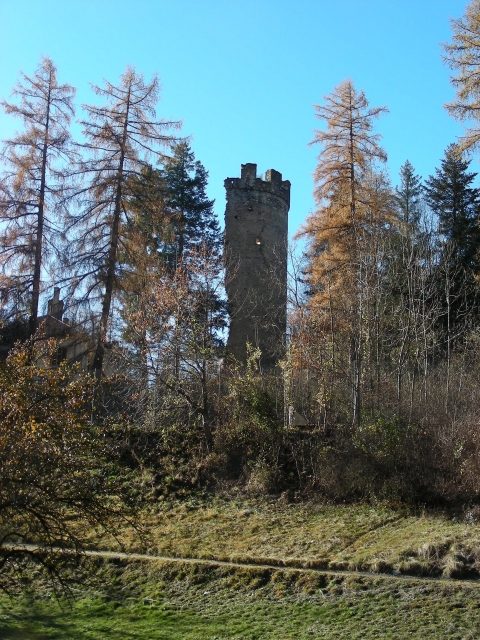
The remains of the Castle can be visited
New-Süns Castle (Ruin) (Paspels)

The ruins of Neu-Süns Castle, also known as Canova, are located between the villages of Almens and Paspels in Domleschg in the Swiss canton of Graubünden. The old Canova Castle was situated on a low and wooded hill above an estate of the same name in the current municipality of Paspels. Its remains are now on private land, but a brief visit is still possible. The ruin can be reached on foot from either Paspels or Almens in about fifteen minutes (no car access).
The castle area was on a plateau, surrounded by a ring wall. A neck ditch served as an obstacle. The exact location of the access gate is not known; it may have been on the south side, where a breach now opens. In the western corner of the ring wall, heavily weathered windows suggest a building. In the northern section, there are remains of a cistern carved into the rock, now filled with rubble. It was probably fed by rainwater.
At the top of the plateau stand the remains of the round residential tower, of which the northern half has been preserved up to its original height of five stories. Why the unusual round shape was chosen here is not known. The stories were separated by wooden intermediate floors; the living quarters were on the third and fourth floors. Two latrine bays, windows with seating niches, and smoke vents from an open fireplace and an oven have been preserved. The high entrance was on the second floor. The wall thickness is consistently about 1.5 meters.
The tower was topped with a slightly protruding battlements with a narrow parapet walk. A gently sloping gable roof was hung inside the tower to protect it from enemy fire arrows. Only minor traces remain of the outer bailey, which once surrounded the tower at a distance of three meters.
The round floor plan and other structural details suggest a construction in the second half of the 13th century. In a document from 1392, Canova is called Neu-Süns (..uff der Nüwen Sünns...), which indicates a more recent foundation by the House of Vaz in Domleschg. The name 'Canova' (= new house) is likely a later Romanization.
At that time, ministeriales of the Barons of Vaz probably resided in the castle. It is not clear whether the lords "de Canofa", first mentioned in 1271, can be associated with the complex; their possessions were rather in Oberhalbstein and Chur. In 1295, the "Canofa" appear as servants of the Vaz family.
Upon the death of Donat von Vaz, the last of his line, the castle fell to the Counts of Werdenberg after 1338. Towards the end of the 14th century, Anna von Rhäzüns, married to Johann von Werdenberg-Sargans, lived at Canova. According to an arbitration award by Ulrich Brun von Rhäzüns between his sister Anna and her husband Johann Werdenberg-Sargans, Anna was to ..uff der Nuwen Sunss hushablich sin und da wesen. Man soll ihr buwen ein stuben, ain kammer, ain kuchi und die stegan bessern. (Anna should be at the New Sunss and live there. They should build her a room, a chamber, a kitchen and improve the stairs).
In 1452, it was destroyed in the Schams Feud. Later, the name of Canova Castle was only used in connection with the designation of estates. In 1574, Andreas von Salis bought the Canova estate and with it the ruins of the castle.
Take Mobile History with you
You are reading this text for free. Premium adds what matters on the road: descriptions read aloud, sites found through your camera, whole regions taken offline.
- Every description, including the ~17,700 Premium sites
- Audio guide: have descriptions read to you on location
- AR finder: see sites through your camera, with distance and bearing
- Unlimited saved sites
14 days free, then from €2.99 a month. Cancel anytime.
Source: Wikipedia · Licence: CC BY-SA 4.0
This description draws on the facts documented in the linked Wikipedia article; Wikipedia content is licensed under CC BY-SA 4.0. Wording and editing: Mobile History.
Location: 46.7441, 9.4477