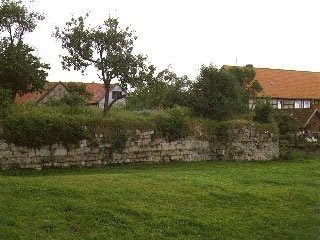
The remains of the Castle can be visited
Oberense Castle (Ruin)
The former Ober-Ense Castle, also known as Oberense or Ense Castle, is a vanished moated castle on the southern edge of Ober-Ense, a district of Korbach in the North Hessian district of Waldeck-Frankenberg. Today, only remnants of two corner towers and the eastern wall of the former castle complex remain.
The castle was first mentioned in 1350 as a fief of Corvey Abbey to the Lords of Engern. By whom and when it was built cannot be definitively determined. Later, it came into the possession of the Lords of Padberg. They pledged it in 1410 to Archbishop Friedrich of Cologne. The Counts of Waldeck, Count Heinrich IX of Waldeck, did not tolerate Cologne's possessions on his territory, and after numerous feuds, the Padbergers finally had to relinquish Ober-Ense (Oberense) in 1454, and the castle came into his possession. Count Heinrich then granted it as a fief to Philipp von Grafschaft in 1457 (1454). Subsequently, the castle was renovated and reinforced with two corner towers. In 1521, after the death of Philipp von Grafschaft, the von Viermünden family laid claim to the castle, but they only received compensation. With the extinction of the Grafschaft family in 1572, the fief reverted to the County of Waldeck. Count Heinrich and his wife Anna von Viermünden zu Nordenbeck made Oberense their residence.
At the beginning of the 17th century, from 1599, Countess Magdalene Lucia von Waldeck (* February 16, 1561/62; † April 10, 1621), a daughter of Count Wolrad II von Waldeck, lived in the castle until her death. She called herself "Burgfräulein von Ober-Ensa" (Castle Maiden of Ober-Ensa).
At the beginning of the 18th century, Prince Friedrich Anton Ulrich von Waldeck had the now dilapidated buildings demolished. The still usable stones were used for the construction of the comital manor house in Korbach.
Current State+
Of the castle's square outline, a base approximately three to five meters high is still preserved. Originally, it was surrounded by a moat, which is still recognizable in the east. The moat was fed by springs located above. Of the two defensive towers located on the east side, only minor remnants are still found. The remains of the northern tower still show loopholes. A cellar on the northwest side is also preserved, which, however, may have belonged to a mill already mentioned in 1505.
Take Mobile History with you
You are reading this text for free. Premium adds what matters on the road: descriptions read aloud, sites found through your camera, whole regions taken offline.
- Every description, including the ~17,700 Premium sites
- Audio guide: have descriptions read to you on location
- AR finder: see sites through your camera, with distance and bearing
- Unlimited saved sites
14 days free, then from €2.99 a month. Cancel anytime.
Source: Wikipedia · Licence: CC BY-SA 4.0
This description draws on the facts documented in the linked Wikipedia article; Wikipedia content is licensed under CC BY-SA 4.0. Wording and editing: Mobile History.
Location: 51.2351, 8.8384