The remains of the Castle can be visited
CastleObermurach
Obermurach Castle (Ruin)
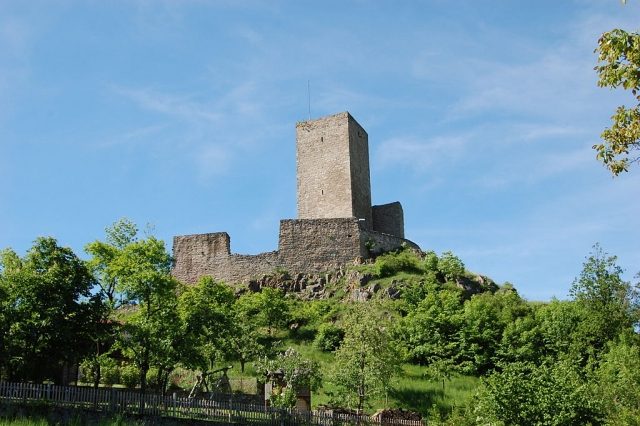
Obermurach Castle, also known as Murach Castle, was first mentioned in the early 12th century and was built to monitor trade routes from Bavaria to Prague and to protect the Bavarian-Bohemian border in the Upper Palatinate Forest. Today, the complex, located near Oberviechtach in the Upper Palatinate district of Schwandorf, is only preserved as a ruin. It lies at an altitude of 585 meters on a hill, southeast of the village of Obermurach. In the Middle Ages, numerous trade routes, known as the Golden Road, led through the surrounding area across the Bohemian border, from where attacks on the newly developed areas of the Bavarian Nordgau repeatedly occurred.
Obermurach Castle served both to protect and control trade routes and to defend against attacks from the east.
The name Haus Murach, as Obermurach Castle is also called, comes from the fact that at the end of the Middle Ages, many castles were used as residential castles, i.e., as a house (hus). This emphasized the permanent residence.
The castle was first mentioned around 1110, with the Count of Sulzbach named as its builder. The Murachers were in the service of the Sulzbachers. The name Murach is historically traceable for the first time in connection with Berengar of Sulzbach. "Gerunch de Mourach" was a companion of Berengar I of Sulzbach in 1110. After the male line of the Sulzbachers died out in 1188, the property was divided among the heiresses. Haus Murach, along with surrounding possessions extending to the Bohemian border, came into the possession of the Counts of Ortenburg through the marriage of Elisabeth of Sulzbach to Rapoto I of Ortenburg. Their youngest son, Heinrich I of Ortenburg, bequeathed the castle in 1238 to his second wife, Richgard of Hohenburg, and his three younger sons, who from then on called themselves Ortenburg-Murach. Heinrich's son from his first marriage, Heinrich II, feared for his inheritance due to this donation and began a years-long conflict with his stepmother and half-brothers. The brothers Gebhard, Diepold, and Rapoto IV consequently found themselves increasingly in financial difficulties. Even after Heinrich II's death in 1257, their situation did not improve, so they were forced to pledge Haus Murach to Ludwig the Strict in 1268. In 1271, they sold numerous possessions around the fortress in the Upper Palatinate for 675 pounds of Passau pfennigs. A year later, they finally sold further estates around the castle. After the death of his siblings in 1285, Rapoto IV finally sold Haus Murach definitively to Ludwig the Strict.
In 1329, the castle passed to the Palatine line of the Wittelsbachs and in 1353 finally to Emperor Charles IV. During the Hussite Wars, Murach was unsuccessfully besieged by Hussite armies in 1428 and 1433.
In 1628, the castle returned to Bavaria and was incorporated into Electoral Bavaria in 1633 along with the occupied Upper Palatinate.
Source: Wikipedia · Licence: CC BY-SA 4.0
This description draws on the facts documented in the linked Wikipedia article; Wikipedia content is licensed under CC BY-SA 4.0. Wording and editing: Mobile History.
Location: 49.4468, 12.3896