RuinGrevenbrück

Peperburg Castle (Ruin) (Grevenbrück)
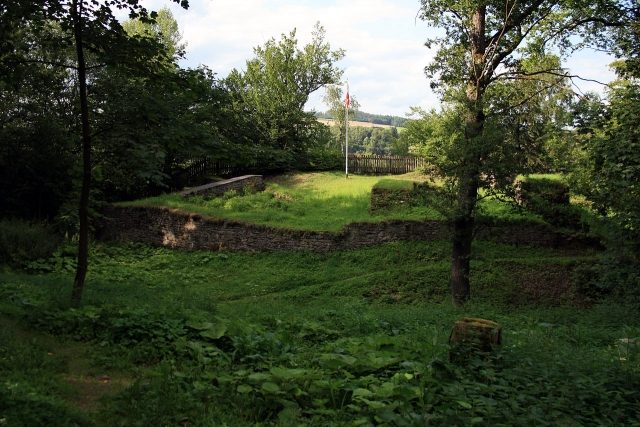
Peperburg Castle (Ruin) (Grevenbrück)

The remains of the Castle can be visited

The Peperburg (also Pepperburg) is the ruin of a hilltop castle in the Grevenbrück district (formerly: Förde) of the town of Lennestadt in the Olpe district.

Above Grevenbrück, the noble lords of Gevore built their ancestral seat, today called Peperburg. It was used from the first half of the 12th century and remained inhabited until the last decades of the 13th century, even after the commander of Gevore moved to Bilstein. The main part was destroyed in the 19th century during quarrying. Today, only the foundations of the southern part of the castle remain.

The original size of the core castle is unknown, but it must have been at least three times the size of the area preserved today. The core castle was surrounded by a two-meter-wide ring wall. In front of it was a 14-meter-wide moat dug into the rock. The buildings connected to the ring wall on the inside are repeatedly rebuilt utility buildings and towers, which were only erected in the second half of the 12th century.

The excavated walls were reinforced, partially supplemented, and left in that state, even if this means that walls appear next to each other that originally did not exist at the same time.

Archaeological Findings+

As archaeological excavations have shown, only one-third of the former core castle remains. The remaining wall and building remnants are probably attributable to the most recent expansion phase. All components and buildings such as walls and towers have been rebuilt and overlaid multiple times. The freestanding tower still visible in the masonry was probably not the keep and can be dated to the middle of the 12th century. The oldest part of the castle probably fell victim to the quarrying work of the 19th century. The use of the preserved part of the core castle could be made probable until the last quarter of the 13th century based on ceramic evaluations. The archaeological findings of the uppermost layer of the preserved part of the Peperburg suggest that it was abandoned without prior destruction.

As can be seen from the archaeologists' excavation reports, the castle ruin consists of at least four construction phases with partially well-recognizable fire patterns. This means that the castle was destroyed and rebuilt several times.

A new county emerged in the southern Sauerland from parts of the territories of the Counts of Werl and the Rhenish Palatinate Counts. The administrative and manorial seat of this county is the castle "Gevore", later called "Peperburg", near the Lenne ford of Heidenstraße and Römerweg. After Henry the Lion was outlawed by Emperor Barbarossa, Archbishop Philipp of Cologne successfully tried to seize the Duchy of Westphalia. For this purpose, he sent Frankish armies through the Duchy to conquer it. Pope Alexander II confirmed to Archbishop Philipp of Cologne on June 19, 1177, all rights he had acquired in Westphalia.

12th and 13th Century

The first written document mentioning a castellan, Henricus nobilis de gevore, dates from 1141. Heinrich I von Gevore, who died in 1172, was married to the daughter of Count Konrad von Rüdenberg.

He had distinguished himself in the Second Crusade. Between 1172 and 1220, Heinrich II von Gevore, son of Heinrich I von Gevore, was married to Irmgard von Arnsberg, a daughter of Count Heinrich I von Arnsberg, and was mentioned in numerous documents, always in connection with the Counts of Westphalia, the noble lords of Rüdenberg, and the Archbishop of Cologne. The county had been held by the Lords of Rüdenberg, who enfeoffed it to the noble lords of Gevore, later Bilstein. Heinrich II von Gevore was married to the daughter of Hermann von Rüdenberg (* 1090) and thus received part of the county as a fief.

Around 1220, the noble lord of Gevore, as Dietrich von Förde, seems to have moved his residence to Bilstein Castle. An uncle of his, Bernhard von Förde, remained at Peperburg, who had two sons, Dietrich and Reimbold von Förde, with the daughter of Vogt Reimbold von Grafschaft. These were mentioned in a Geseke document in 1220. In 1225, Theodoricus called himself noble lord of Bilstein for the first time.

The Lords of Hundem, called Pepersack, seem to descend from Reimbold von Förde and an heiress of Vogt Widekind von Hundem, whose confirmed lineage only begins with the brothers Widekind and Reimbold Pepersack, traceable since 1292.

14th Century

At the beginning of 1352, a new feud began between Count Engelbert III von der Mark and Count Gottfried IV von Arnsberg, as the former asserted claims to Fredeburg. Thereupon, Count Gottfried IV fortified Gevore Castle again in 1354. This presumably displeased Count Engelbert III von der Mark, and he destroyed Gevore Castle again in 1355.

After the lordship of Bilstein came into the possession of the Count von der Mark, they further impoverished the Lords of Pepersack. Their power in the Lenne region was broken, and they gradually sold their remaining possessions.

From 1381-1402, Johan Pepersack lived, as he signed as a witness in 1381 and 1384 the sale of half of the Free County of Hundeme to the brothers Wilhelm and Heinrich Vogt von Elspe by Wilhelm von Ole. The Lords of Rüdenberg had apparently previously enfeoffed the branch line of Hundem with the Peperburg and part of its property.

The brothers Conrad and Hinrik von Rüdenberg, sons of Goswin, sold all their enfeoffable property in the Free County of Hundem to Wilhelm Vogt von Elspe and Johann von Plettenberg, called "Hedemolen", in 1384. The previous enfeoffed tenants, including Hinrik von Drolshagen and "de Pepersecke", were referred to the buyers. Thus, the ownership of the Free County of Hundem changed, but the Lords of Pepersack and also Hinrik von Drolshagen, who was possibly their bailiff, remained in their offices.

Only in 1385, on "vigilia nativitatis b. Joannis Baptiste" (VI. 23), did the brothers Konrad and Heinrich von Rügenberg release Heinrich von Heygen, who was presumably the successor of the aforementioned bailiff, and Wilm Pepersack, who had received the County of Hundem from them as a fief, from their oaths and referred them to Johann von Plettenbert, also called Heydemolle, and Wilhelm von Elsepe Voget for new enfeoffment. With this release, both von Heygen and Pepersack were relieved of their offices in the Free County.

From numerous changes of ownership, it is evident that the family became increasingly impoverished and the political shift against the von Pepersack family was initiated. Even the Palatine Count Ruprecht II secured the house Bamenohl as an open house through a contract in 1395 and did the same with the Vogts von Elspe, Heydenreich von Heggen and Heinrich von Duseschuren regarding Borghausen Castle.

15th Century

The heiress daughter Alheid von Hundemen, called Pepersack zu Pepperburg, married Fr. Wilm Vogt von Elspe in 1432, who, according to the document, still lived at Peperburg and later moved to the neighboring Borghausen Castle. From this marriage came the children Wilhelm, Cord, and Godert, who therefore called themselves Vogt von Elspe, called Pepersack. This line of the Vogts von Elspe then lived in Borghausen, west of Peperburg.

In 1454, the brothers Wilhelm and Herman van Hundem, called Pepersecke, gave Katharine, daughter of Hermann, all their fiefs as a dowry upon her marriage to Johan van Bonslede, namely the farm in Altenhundem, the estate in Hofolpe, where Tilman Kindere lives, the small estate in Vore "bey der bruggen" dat Ploichysern is", the lutgen Kuberge, which dey Heyschoten received, the place of Hans Saut in Hundem, an estate in Heimersberge, where Johannes Man von Snellenberg..., an estate in Altenhundem, where Hesek lives, an estate in Overen Melbecke, which Johan van der Broike received, the farm in Dypenbeke, which Ernst and Herman van Snellenberg received, and another estate in Dypenbeke, which Hennecke van Hanxlede is to receive. The reason was that the dowry agreed upon in the marriage contract for Katharina could not be fulfilled.

16th and 17th Century

The ownership rights of the Bamenohl Kotten passed from the Pepersäcks to the von Plettenberg and to the Vogts von Elspe. In 1694, in the Delineatio of Caspar Christian Vogt von Elspe, Lord of Siedlinghausen and Brunscapell, it says about the Peperburg: olim sed. dom. de Pepersack, diruta (Formerly the residence of the Pepersäcks, now razed to the ground).

Take Mobile History with you

You are reading this text for free. Premium adds what matters on the road: descriptions read aloud, sites found through your camera, whole regions taken offline.

  • Every description, including the ~17,700 Premium sites
  • Audio guide: have descriptions read to you on location
  • AR finder: see sites through your camera, with distance and bearing
  • Unlimited saved sites

14 days free, then from €2.99 a month. Cancel anytime.

Source: Wikipedia · Licence: CC BY-SA 4.0

This description draws on the facts documented in the linked Wikipedia article; Wikipedia content is licensed under CC BY-SA 4.0. Wording and editing: Mobile History.

Location: 51.1433, 8.0111