The remains of the Castle can be visited
CastleWiesbaden
Platte Castle (Ruin) (Wiesbaden)
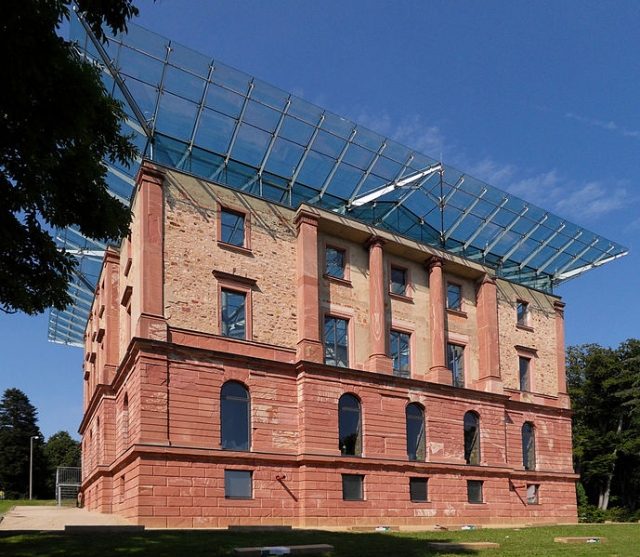
Jagdschloss Platte is an originally Neoclassical former hunting lodge in the Hessian low mountain range Taunus near Wiesbaden, which was built by the Nassau Duke Wilhelm I between 1823 and 1826.
During World War II, it was destroyed down to its outer walls in an air raid on February 3, 1945. Since the late 1980s, it has been rebuilt by a foundation. In 2003, it received a modern glass roof.
Jagdschloss Platte is located in the Rhein-Taunus Nature Park on the northern border of Wiesbaden's city area; directly to the north runs the city limit of Taunusstein. It is situated on the main ridge of the Taunus on the wooded Platte (), a plateau southwest of the summit of the Steinhaufen mountain (). Federal highway 417 runs directly north of the castle.
Wiesbaden became the capital of the Duchy of Nassau in 1806. The Counts of Nassau-Weilburg had already resided in Biebrich Palace on the Rhine since 1741. Wilhelm von Nassau-Weilburg became Duke after the death of Duke Friedrich August in 1816 and the associated extinction of the Nassau-Usingen line.
In 1823, he commissioned court architect Friedrich Ludwig Schrumpf to build a hunting lodge in the Taunus forests northwest of the city. The building was erected on the so-called Platte, a 500-meter-high elevation of the Taunus ridge.
Subsequently, the castle was mainly used during the summer months, and numerous prominent guests visited, including Russian Tsar Alexander II, Tsarina Maria Alexandrovna, and Empress Eugénie of France.
After the construction of the Wiesbaden City Palace and Wilhelm's death, the castle continued to be used by his son Adolf, before Nassau was annexed by Prussia after the defeat in the Austro-Prussian War in 1866 and the Duke was deposed. However, Jagdschloss Platte remained in Adolf's possession, and when he became Grand Duke of Luxembourg in 1890, it passed into the possession of the State of Luxembourg. After Adolf died in 1905, Luxembourg then sold it to the city of Wiesbaden in 1913 for 400,000 Goldmark.
During World War II, an anti-aircraft control center was housed in the strategically located castle high above Wiesbaden, which proved to be the building's undoing on the night of February 2 to 3, 1945: an attack by the British Air Force almost completely destroyed it, leaving only the outer walls standing.
The ruin increasingly decayed in the following years. It was not until 1987 that an initiative, today's Stiftung Jagdschloss Platte e. V., took on the castle and made it usable again. In 1989, the first stabilization works on the ruin began. From 1993, it could be used for weddings, parties, and other events.
However, the foundation aims to completely rebuild the castle with the help of donations. In 2003, a modern glass roof was erected, which spans the building with a wide overhang and quotes the historical forms.
Source: Wikipedia · Licence: CC BY-SA 4.0
This description draws on the facts documented in the linked Wikipedia article; Wikipedia content is licensed under CC BY-SA 4.0. Wording and editing: Mobile History.
Location: 50.1342, 8.2203