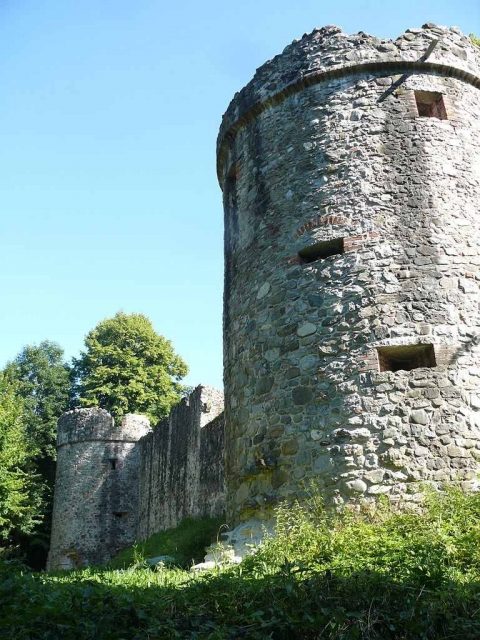
The remains of the Castle can be visited
Ratzenried Castle (Ruin)

The Ratzenried ruin, formerly called Oberes Schloss (Upper Castle), is a castle ruin on a 722.3 m above sea level mountain spur southeast of the village of Ratzenried in the Ravensburg district in Baden-Württemberg.
The castle was probably built at the beginning of the 12th century; in 1145, the Lords of Ratzenried were first mentioned. The reason for its construction was possibly the same as for Praßberg Castle near Wangen im Allgäu, which was started in 1123. It was intended to secure the fiefs of St. Gallen Abbey in the region and to collect the tributes from the farms. The Lords of Ratzenried were also vassals of the abbey.
At the end of the 13th century, the Ratzenried family died out, but the new lords of the castle also called themselves von Ratzenried. They lost the castle again around 1350 and moved to Ostallgäu. From 1353, the Lords of Molpertshausen resided at the castle; in 1369, Hans von Molpertshausen was officially enfeoffed with the lordship by the St. Gallen abbot. About ten years later, the castle had to be sold again. Among other owners, it belonged to the Humpis of Ravensburg from 1453. They also called themselves Humpis of Ratzenried from the 16th century. Jos Humpis of Ratzenried had the castle restored in 1502 for 11,000 guilders, as it had fallen into disrepair except for the walls. The castle belonged to them until 1647.
In 1632, Ratzenried Castle was burned down by the Swedes during the Thirty Years' War and was not rebuilt due to cost reasons. In 1806, the castle passed to the Kingdom of Bavaria, which, however, ceded the lordship of Ratzenried to Württemberg in 1810. From Württemberg, the complex came to the Counts of Beroldingen in 1813, and in 1908, the Counts of Waldburg-Zeil inherited the castle.
Description+
The protruding mountain spur was perfectly suited for a castle and may have been used as a redoubt in pre-Christian times. What the first medieval castle looked like is not known, nor are details about a renovation around 1220, which a Staufer duke is said to have commissioned. It can be assumed that traces of the old keep are still present and that the outwork walls with the loopholes and the palas go back to earlier constructions.
Take Mobile History with you
You are reading this text for free. Premium adds what matters on the road: descriptions read aloud, sites found through your camera, whole regions taken offline.
- Every description, including the ~17,700 Premium sites
- Audio guide: have descriptions read to you on location
- AR finder: see sites through your camera, with distance and bearing
- Unlimited saved sites
14 days free, then from €2.99 a month. Cancel anytime.
Source: Wikipedia · Licence: CC BY-SA 4.0
This description draws on the facts documented in the linked Wikipedia article; Wikipedia content is licensed under CC BY-SA 4.0. Wording and editing: Mobile History.
Location: 47.7129, 9.9009