RuinLichtenau

Reichenbach Castle (Ruin) (Lichtenau)
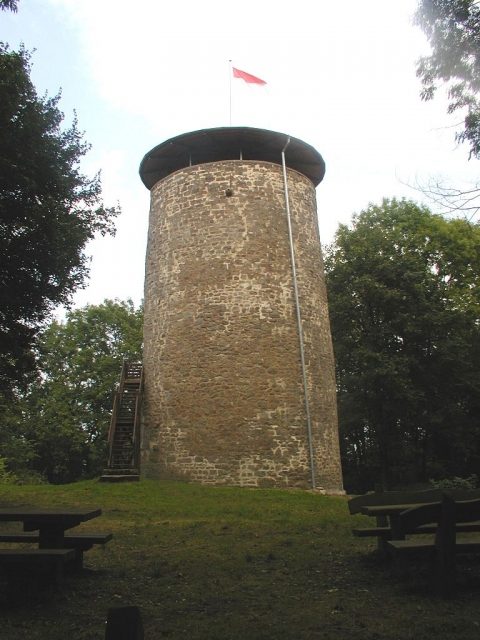
Reichenbach Castle (Ruin) (Lichtenau)

The remains of the Castle can be visited

Reichenbach Castle is a Romanesque castle ruin near Hessisch Lichtenau in the Werra-Meißner district of northern Hesse (Germany). The castle ruin is located almost 4 km southeast of the center of the core town of Hessisch Lichtenau, between the villages and districts of Reichenbach to the east-southeast and Retterode to the west, each about 2 km away. It lies on the "Schlossberg" (Castle Hill), whose landscape slopes down to the northwest into the Losse Valley, to the northeast into the Hollsteine Valley, to the south into the Vockebach Valley, and to the west into the Essebach Valley. The ruin and the hill are located in the Reichenbacher Kalkberge nature reserve, which was founded in 1996 and covers an area of about 1.5 km².

Prehistory and Construction

In the 5th century, the Chatti built a hillfort here against the Hermunduri. The nearby village of Reichenbach is first mentioned in 1098 as Richenbach.

From around 750 to 1219, the fortified hill was probably owned by a branch of the Counts Gozmar, who built a castle there in the middle of the 11th century and called themselves Counts of Reichenbach from 1089 onwards (see also Stammtafel der Grafen von Reichenbach). The ancestors of this family are said to have been appointed as counts on the predecessor castle already at the time of the Frankish conquest of the area, under Pippin the Younger. However, the first confirmed document refers to Count Gozmar II of Reichenbach, who was high bailiff of Fulda Abbey from 1117 to 1139. Members of the Reichenbach family, or later Ziegenhain, held this office until the first half of the 14th century.

In the 11th century, the counts founded the Reichenbach nunnery, which, however, did not exist for long. At a princely diet in Nordhausen in August 1207, Count Heinrich III of Reichenbach and the representatives of all other branches of the Reichenbach-Wegebach-Ziegenhain family jointly donated the monastery complex and all associated possessions to the Teutonic Order, which thus acquired its first settlement in Germany.

Object of Dispute between Thuringia, Mainz and Hesse

The marriage in 1185 of Friedrich, a son of the Ludovingian Landgrave Ludwig II of Thuringia, to the heiress Luitgard (also called Lukardis) of Count Gozmar III of Ziegenhain-Reichenbach meant a significant expansion of Ludovingian influence in Hesse and brought Reichenbach Castle into the possession of the Ludovingians. Archbishop Konrad I of Mainz, who did not welcome this increase in landgravial power, bought half of the castle in 1189/90.

Since the castle was located in the Hessian-Thuringian border region, it was repeatedly the target of disputes for strategic reasons. Around 1220, after inheritance disputes, Landgrave Ludwig III of Thuringia conquered the castle after a long siege. In 1225, Konrad of Thuringia, brother of the Landgrave and Count of Hesse, besieged the castle. In 1233, it then came into his possession by contract. In 1249, during the Thuringian-Hessian War of Succession, the troops of Sophie of Brabant conquered the castle for her son Heinrich, the later first Landgrave of Hesse.

Hessian Hunting Lodge and Office

The castle remained Hessian thereafter, but was repeatedly pledged and redeemed - first by Sophie of Brabant to Thilo von Elben and Eckhard von Kappel, then in 1330 and 1350 to the Teutonic Order, and finally in 1403 once more to the Lords of Hanstein. At least since 1315, the Landgravial-Hessian office of Reichenbach is documented. During this time, the castle was used by the Landgraves as a hunting lodge.

From 1376 to 1380, Landgrave Hermann III of Hesse used the castle in the Sterner War against the coalition of Archbishop Adolf I of Mainz, Abbot Berthold II of Hersfeld, Duke Otto I of Braunschweig-Göttingen, and Landgrave Balthasar of Thuringia.

On November 4, 1471, Landgrave Ludwig II of Hesse died unexpectedly suddenly at the castle, presumably by poisoning.

Decay

Until 1490, when the seat of the office was moved to Hessisch Lichtenau and a landgravial court was established there, the castle was inhabited; thereafter, the buildings were used as a tithe barn until 1540. Landgrave Philipp was the last prince to stay at the castle. Around 1550, it was destroyed by order of Emperor Charles V after the Schmalkaldic War. However, the two towers are still mentioned as intact in 1697. In the 17th century, Daniel Meisner depicted Reichenbach Castle in the "Politisches Schatzkästlein". Thereafter, decay began, accelerated by the inhabitants of neighboring villages, for whom the ruin served as a quarry. On December 12, 1820, the southeast tower collapsed.

Renovation and Current Use

The keep was converted into an observation tower from 1899 to 1901 and inaugurated as such on July 21, 1901, with catering on Sundays and holidays. In 1934/35, the keep was renovated again and the battlements were walled up. The archaeologist Gottfried Ganßauge excavated the castle. In 1948, severe damage to the masonry was discovered, and in 1955/56, extensive frost damage. The tower had to be closed but was reopened on October 26, 1958. On May 9, 1966, the "Burgverein Reichenbach" (Reichenbach Castle Association) was founded, which has since been committed to the preservation of the complex. From 1977 to 1980, the tower was again repaired. On June 22, 1986, the keep was reopened on the occasion of the Reichenbach local festival. On June 15, 1988, a large castle festival was celebrated on the occasion of the twentieth anniversary of the castle association. On August 8, 2004, the new external staircase was inaugurated.

Complex+

In addition to the keep, which serves as an observation tower, remnants of the shield wall and a small and large neck ditch are still preserved today.

Take Mobile History with you

You are reading this text for free. Premium adds what matters on the road: descriptions read aloud, sites found through your camera, whole regions taken offline.

  • Every description, including the ~17,700 Premium sites
  • Audio guide: have descriptions read to you on location
  • AR finder: see sites through your camera, with distance and bearing
  • Unlimited saved sites

14 days free, then from €2.99 a month. Cancel anytime.

Source: Wikipedia · Licence: CC BY-SA 4.0

This description draws on the facts documented in the linked Wikipedia article; Wikipedia content is licensed under CC BY-SA 4.0. Wording and editing: Mobile History.

Location: 51.1688, 9.7534