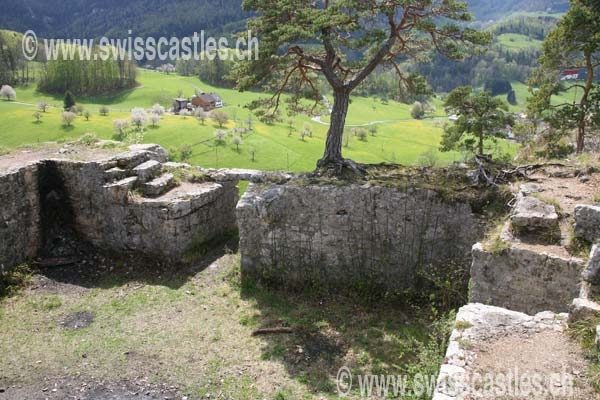
The remains of the Castle can be visited
Rifenstein Castle (Ruin)

The ruin is located between Reigoldswil and Titterten, on a rocky outcrop on the southern slope of the Rifenstein (723 m).
The ruin is divided into three parts by the shape of the rock: the residential tower on the rock peak, a walled terrace to the east, and built-over rock chasms to the west.
Originally, at the entrance from the opposite slope, there was a bridge over a projecting rock pinnacle, which allowed access to the castle. A legend tells that once during a siege, the attacking warriors stormed over the bridge in such numbers that it collapsed under the great load. Although a legend – such a swift attack had to be carried out by the attacker with only 5 to 20 people for economic reasons – the theme nevertheless has a kernel of truth: the neighbors' interest in acquiring even such small properties was quite high.
When you go through the gate, you reach the walled terrace. The wall follows the irregular line of the rock edge. In the lower southern part of the terrace, there was most likely a cistern. Here, the original wall is almost completely destroyed, and what is still visible today has been rebuilt later. The ascent to the residential tower from here is completely new. Originally, there was only a connection to the built-over rock chasms at this point. The narrow path led over a built-up ramp around the rock nose and not over a bridge. On the built-over rock chasms, one finds carved beam bearings and various wall sections on the rock walls, which originate from a covered wooden building complex.
From here, one could originally also enter the residential tower via a staircase. The tower forms an irregular quadrangle with a diameter of 11 to 16 meters and is surrounded by a 2-meter-thick wall. The entrance to the tower was on the opposite side from today's entrance. Many large and unprocessed stones were used for the tower's wall. On the tower, there was a wooden structure with about three upper floors and a wooden roof.
The history of the castle and the Rifenstein family is still very unclear. Excavations were to be continued in 2009 and 2010 to obtain more information and to conserve the ruin, which is threatened by decay. The archaeological finds discovered so far prove the castle's use between approximately 1200 and 1350. In written records, the castle or the knightly Rifenstein family are rarely mentioned, for example, in documents from Schönthal Monastery from 1145. The probability that this document is forged is quite high, because at that time – without a functioning legal system in today's sense – the use of manipulated documents was an essential instrument to acquire further properties. Should the rock on which today's Rifenstein stands have been used for a fortress around or before 1200, this would have to correspond to a vanished predecessor building; the wall remains still visible today cannot be dated before the 13th century.
The mentioned meager source situation suggests that the Rifenstein family owned little land – probably self-cleared property – and was not very influential. Several attempts by the nearby Ramstein family to acquire properties and the associated rights in the Reigoldswilertal can be proven. Presumably, they were successful in the case of Rifenstein, or the Rifenstein family was even affiliated with the Ramstein family, because in 1394, Thüring von Ramstein handed over Rifenstein Castle and some of the still associated rights (e.g., court in Reigoldswil and Lauwil) to Duke Leopold of Austria and received it back as a fief. This procedure corresponded to a common practice at the time to withdraw properties and rights from the access of other territorial lords – in this case, the Bishop of Basel.
There are only conjectures about the demise of the Lords of Rifenstein:
- One states that the knight of the castle did not return from a crusade. Consequently, the family died out, and the castle was left to decay. However, this tradition must be classified as very unlikely, because as mentioned above, there was great interest from other noble families and the bishop in the Reigoldswilertal, so the property would have been taken over immediately.
- Another, much more probable possibility is that the castle suffered damage during the Basel earthquake in 1356. The reconstruction was then either not undertaken due to a lack of funds from the owner or because of the shift in noble interests towards the city of Basel – the decline of castles in the region was already in full swing at that time.
Take Mobile History with you
You are reading this text for free. Premium adds what matters on the road: descriptions read aloud, sites found through your camera, whole regions taken offline.
- Every description, including the ~17,700 Premium sites
- Audio guide: have descriptions read to you on location
- AR finder: see sites through your camera, with distance and bearing
- Unlimited saved sites
14 days free, then from €2.99 a month. Cancel anytime.
Source: Wikipedia · Licence: CC BY-SA 4.0
This description draws on the facts documented in the linked Wikipedia article; Wikipedia content is licensed under CC BY-SA 4.0. Wording and editing: Mobile History.
Location: 47.4008, 7.7016