RuinHarth

Ringelstein Castle (Ruin) (Harth)
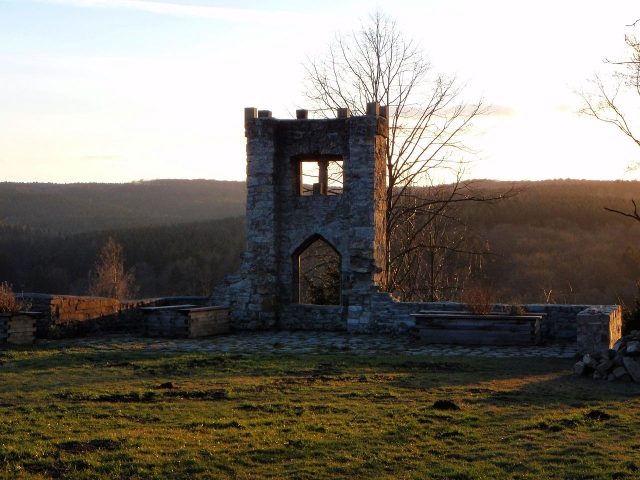
Ringelstein Castle (Ruin) (Harth)

The remains of the Castle can be visited

The castle ruin Ringelstein is located above the Alme valley on a mountain ridge and today belongs to the area of the Büren district Harth. In the ruin, the remains of Ringelstein Castle, built by the noble lords of Büren around 1385, can be visited.

In 1383, the Davensberg line of the noble lords of Büren took a newly built castle as a fief from the Archbishop Friedrich of Cologne "op der stat die genannt is de Nyeburgh boyven Buren vor dem Walde". The castle was thus built on the site that was already mentioned in 1376 as "nyen borch boven Buren". Whether it was a destroyed or an unfinished castle in 1383 is not entirely clear. It was intended to serve as an outpost in the Alme valley and belong half to the Davensberg lords and half to the Archbishop of Cologne.

In 1394, the Davensberg lords pledged their castle to Johann von Scharfenberg, a collateral line of the Padberg family. At the same time, the noble lords of Büren of the Wewelsburg line pledged their half of the castle and town of Alme to Hermann von Padberg. Ringelstein Castle was only redeemed by Berthold von Büren in 1399. During this redemption, Ringelstein Castle was mentioned by name for the first time.

It is often written that this castle served to ward off the Padbergers and their Bengler. The pledging and redemption of the pledge sums of the two castles Ringelstein and Alme are said to be related to this. However, there is no evidence for this.

In 1458, the castle was enfeoffed to the Landgrave of Hesse. Bernd III von Büren was already in the service of Landgrave Ludwig of Hesse in 1430, as were his grandchildren Bernhard and Johann von Büren between 1498 and 1510. Johann was appointed as a lifelong councilor in 1519 by Landgrave Philipp and his mother.

An inventory list of Ringelstein from 1574 indicates that the castle was a hunting lodge of the noble lords residing in Büren at that time. There is also a brief description of the premises: twelve rooms, kitchen, egg cellar, wine cellar, meat cellar, brewery and bakery, stable for riders, and grain loft.

During the Thirty Years' War, the castle was the scene of numerous witch trials. Ringelstein housed a court of the Büren lordship with corresponding dungeon and torture facilities. In 1631, for example, 55 people were condemned and executed as witches within just 30 days. Evidence of these trials can be found in the Hexenkeller (Witches' Cellar) belonging to the castle ruin. After 1802, Ringelstein lost its importance and fell into disrepair.

The castle ruin Ringelstein is located in the area of the Büren district Harth. It was built in an exposed position on the tip of a spur north of the Alme valley and west of the Mumme valley. From the castle, there was an unobstructed view in all directions.

Renovation+

Extensive excavations took place on the grounds of Ringelstein Castle starting in December 2005. Vaulted cellars, underground passages, and a mighty defensive tower, originally 20 meters high, were uncovered. These excavations highlighted the impressive extent of this medieval castle in the Büren region. The castle ruin will be renovated by the end of 2011. Barrel vaults and masonry will be rebuilt.

Take Mobile History with you

You are reading this text for free. Premium adds what matters on the road: descriptions read aloud, sites found through your camera, whole regions taken offline.

  • Every description, including the ~17,700 Premium sites
  • Audio guide: have descriptions read to you on location
  • AR finder: see sites through your camera, with distance and bearing
  • Unlimited saved sites

14 days free, then from €2.99 a month. Cancel anytime.

Source: Wikipedia · Licence: CC BY-SA 4.0

This description draws on the facts documented in the linked Wikipedia article; Wikipedia content is licensed under CC BY-SA 4.0. Wording and editing: Mobile History.

Location: 51.5023, 8.5735