RuinRunding

Runding Castle (Ruin)

Runding Castle (Ruin)

The ruin can be visited

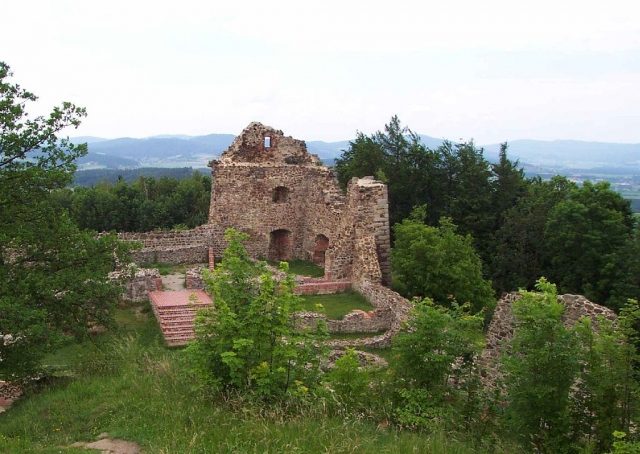
Runding Castle is located on the so-called "Schlossberg" (Castle Hill) above the municipality of Runding in the Upper Palatinate district of Cham. Today, the sad but still imposing remains of what was once the largest castle complex in the Bavarian Forest can be found, with a total built-up area of approximately 15,000 m², including the outer bailey with a manor house and granary. The accessible rampart has a length of almost 400 m.

The founding family of the Runtinger (Roumptinger) served the Margraves of Cham and Vohburg and was first mentioned in a document in 1118. The castle itself, however, was probably built by them before 1100. Although the Runtinger were initially only simple ministeriales (vassals) of their counts, they managed to expand their dominion. They can be continuously traced in Runding until 1413/1415, but then their lineage died out due to lack of offspring.

Heinrich Notthafft, the Vicedom (administrator) of the Duke of Lower Bavaria (Straubing-Holland), managed to bring the dominion and Runding Castle completely into his possession through enfeoffment and purchase in 1415. For over 400 years – with an almost 70-year interruption by the Eyb family during the Reformation – the highly respected and at times very wealthy noble family of Notthafft determined the fate of the castle and the associated villages. In the 15th/16th century, the Notthafft transformed the austere castle into a magnificent "Veste," a sprawling palace complex.

Unfortunate times were brought by the Hussite invasions around 1430 and the turmoil of the Thirty Years' War. Twice – in 1633 and 1641 – the mighty castle and the surrounding villages were mercilessly plundered by the Swedes. The damage suffered amounted to 160,000 guilders, an enormous sum at the time.

Donations and endowments, as well as the general loss of privileges for the nobility, increasingly diminished the available funds of the Notthafft. The numerous, never-repaid loans to the Bavarian ruling family of the Wittelsbachers also contributed to this.

Almost inevitably, a complete economic collapse occurred in 1829. The Bavarian state had to auction off the castle and the extensive Runding dominion for 233,000 guilders from the hands of the debtors. Shortly thereafter, it sold the entire Runding property to the court banker Hirsch from Munich. He did not further concern himself with the buildings, so they gradually fell into disrepair. In 1858, he sold the Schlossberg, along with the severely damaged castle, to a farmer from Runding. "Since only a few rooms of the castle were still habitable, and the owner received so little rent that he couldn't even pay the house tax, he removed the roofs, sold them and the enormous oak roof beams and granite door and window frames, and left the walls to their fate. Anyone in Runding who needed building stones could get them from the castle," reports a local historian. Because the state did not intervene, the fate of the once proud castle was finally sealed. Even private reconstruction attempts in the 1920s of the 20th century contributed more to accelerating the decay than to achieving positive results.

Wind, weather, and the rampant vegetation from 1940 onwards increasingly damaged the masonry. The decay was only halted from 1992 onwards by the preservation measures of the municipality of Runding. Following a concept by architect Rosenbaum from Amberg, the existing remains of the ruin have since been restored and preserved for posterity with funds from public subsidies.

Burgfreunde Runding e. V. (Friends of Runding Castle Association)+

In 1996, the Burgfreunde Runding e. V. association was founded, with Franz Amberger, the son of the former castle owner, as chairman. Teacher Ludwig Biebl was elected as the second chairman. Within a very short time, the association had over 300 members. Efforts to preserve the castle remains received new support from the population. The great interest is shown by the lively attendance from Runding, tourists, and the entire region.

In 1997, the association uncovered the remains of two towers in the eastern part of the castle, which were then conserved by a company on behalf of the municipality of Runding. This preserved another decorative cornerstone of the formerly large castle complex for the public.

In four construction phases, the most important wall remains of the ruin were secured. For the coming years, a new concept for the preservation and further use of the ruin was developed by the association, architect Rosenbaum, and the municipality of Runding. Clearing measures by the owner Josef Amberger and by the association also improved the distant view of the castle hill.

In 1998, the aforementioned association published a book titled "Unter dem Dohlenturm" (Under the Jackdaw Tower) about the Runding castle ruin. In addition to a novel by Mrs. Karoline Wilhelmine von Künsberg (a historical novel about the castle from the last century), it contains several legends, the families of the castle, a treatise on the decline of the castle by Ludwig Biebl, old views and pictures collected by Franz Amberger, a bibliography by Cham archivist Timo Bullemer, and a site plan of the castle around 1750.

In 1997 and 1998, a knight's play and a theater piece (Parzival) were performed on the castle grounds under the direction of the Runding school.

With the help of the Burgfreunde Runding e. V. association, further parts of the complex were uncovered and secured. In 1999, 2000, 2002, and from 2003 to 2011, scientific excavations are being and have been carried out under the direction of medieval archaeologist Dr. Bernhard Ernst from Bamberg as part of a job creation measure. The latest measure, with a bricklayer and several workers, is being conducted under the direction of medieval archaeologist Dr. Bernhard Ernst and with financial support from the European leader program. In 2010, the castle chapel was uncovered and investigated. Human bones, parts of a lower and upper leg, were found under the altar area in the rock. These are presumably relics from the chapel.

After completion of the work, Runding will be the largest extensively excavated castle complex in Bavaria. By 2012, an archaeological open-air museum with a cultural-historical educational trail will be created with co-financing from the European leader project. From the finds (currently around 300,000 individual finds), an archaeological museum in the outer bailey is to be established in the medium term. The association is currently looking for an investor for this. Currently, a selection of finds is presented in the Old Village Church next to the Kopp brewery restaurant. The church is open daily from 8 am to 8 pm. The municipality has now joined the purpose agreement of the museums in the Cham district. Specialists from the Cham district advise the municipality on the establishment of the museum. The open-air museum at the castle ruin and the archaeological museum in the village would then be a major attraction for the village and the entire region.

Take Mobile History with you

You are reading this text for free. Premium adds what matters on the road: descriptions read aloud, sites found through your camera, whole regions taken offline.

  • Every description, including the ~17,700 Premium sites
  • Audio guide: have descriptions read to you on location
  • AR finder: see sites through your camera, with distance and bearing
  • Unlimited saved sites

14 days free, then from €2.99 a month. Cancel anytime.

Source: Wikipedia · Licence: CC BY-SA 4.0

This description draws on the facts documented in the linked Wikipedia article; Wikipedia content is licensed under CC BY-SA 4.0. Wording and editing: Mobile History.

Location: 49.2177, 12.7625