The remains of the Castle can be visited
Schauenberg Castle (Ruin) (Turbenthal)
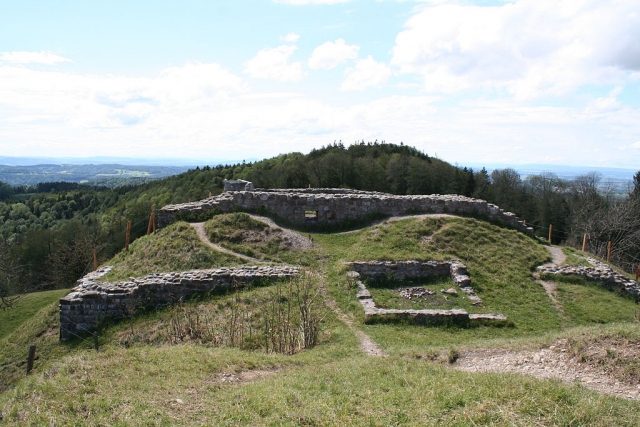
The ruins of Schauenberg are located on the hill of the same name above Turbenthal in the canton of Zurich. From 1976 to 1979, the Cantonal Archaeology of Zurich carried out excavations on the Schauenberg. The investigations concluded with the conservation of the ruins of the medieval castle and the early modern watchtower. Based on the archaeological investigations, it is possible to conclude that the Schauenberg was settled in multiple phases.
The first traces
During the Bronze or Iron Age (2200-15 BC), a rampart-ditch system with palisades encircled the hilltop. Occupation during Roman times (15 BC-400 AD) is possible, as a Roman key was found in the area of the medieval castle.
The first medieval wooden castle
Around 1200, a wooden structure was built on the west side of the Schauenberg above a cellar dug into the rock. On the other side of the hilltop, which was not yet divided at that time, traces of simple wooden buildings were found. The first medieval castle, a simple noble residence, was protected by a rampart and ditch.
Residential tower
Around 1250, the wooden castle was converted into a massive, solidly built residential tower. A neck ditch was dug into the rock across the hilltop. The ditch was overlooked on the west side by a wall, which possibly formed a Zwinger system. The first documented mention of the castle, under the name castro Schowenberc, dates back to 1260. However, the name Rudolf von Schauenberg already appears in written sources in 1242. In 1302, St. Gallen Abbey transferred the feudal lordship over Schauenberg Castle to the ministerialis Walter von Kastell. Thirty years later, Beringer von Hohenlandenberg is named as the subsequent lord of the castle, but he was accused of robbery and counterfeiting in various chronicles.
It remains to be clarified whether this castle is identical to the castle of Heinrich von Schaunberg, who appears in documents as Heinrich de Stoife, Stoitfe or Stouf after 1158.
The end
When Beringer von Hohenlandenberg committed an offense against the Landfrieden (public peace) in 1344, the Austrian officials, together with citizens of Winterthur and Zurich, destroyed the castle. Since only a small number of pottery shards and no mobile objects were found, it is assumed that the castle was already abandoned at the time of its destruction.
Watchtower
After 1622, due to the dangers posed by the Thirty Years' War and the conflict between the Catholic and Protestant cantons, the Zurich authorities were forced to establish a watchtower system. The signals sent from Schauenberg could be seen from the watchtowers of Schnabel (Albiskette near Langnau am Albis), Pfannenstiel, Tämbrig (above Hermatswil), Üetliberg, Lägern, Zürichberg, Mörsburg, Kyburg, Stammheimerberg, and even Hohenklingen.
Take Mobile History with you
You are reading this text for free. Premium adds what matters on the road: descriptions read aloud, sites found through your camera, whole regions taken offline.
- Every description, including the ~17,700 Premium sites
- Audio guide: have descriptions read to you on location
- AR finder: see sites through your camera, with distance and bearing
- Unlimited saved sites
14 days free, then from €2.99 a month. Cancel anytime.
Source: Wikipedia · Licence: CC BY-SA 4.0
This description draws on the facts documented in the linked Wikipedia article; Wikipedia content is licensed under CC BY-SA 4.0. Wording and editing: Mobile History.
Location: 47.4601, 8.8661