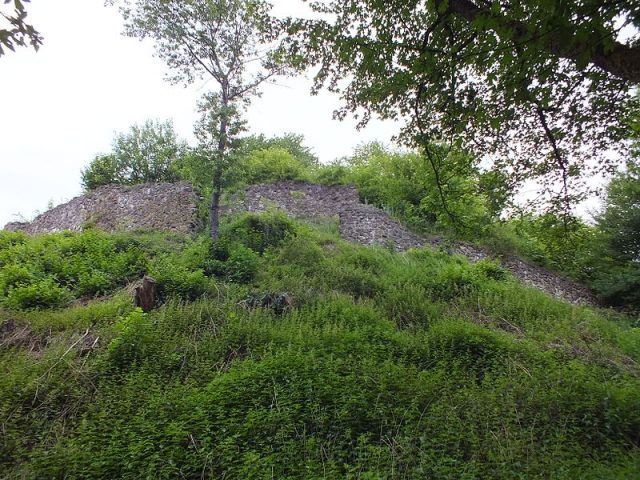
The remains of the Castle can be visited
Schauenburg Castle (Ruin)
The Schauenburg, also known as Scouwenborg, 1143 Scowenburch, 1184 Schowinburc or 1240 Scoenburc, is a castle ruin near Schauenburg in the district of Kassel in North Hesse (Germany).
The Schauenburg castle ruin is located in the Habichtswald Nature Park on the high Schauenburg Castle Hill, which rises in the Hoofer Pforte as the northern foothills of the Langenberge directly west or above Schauenburg-Hoof and southwest of an upper section of the Bauna river.
The Schauenburg was probably built between 600 and 800 AD, when the Hessengau was already part of the Frankish Empire. It probably served as a residence and refuge, but could also have been part of the border fortifications against the Saxons, along with the castles of Numburg (near Badra, Thuringia), Weidelsburg (Ippinghausen, Hesse), Kugelsburg (Volkmarsen, Hesse) and Desenberg (Warburg, North Rhine-Westphalia).
In 1089, the castle "Scouwenburg" was first mentioned in a deed of donation from the Helmarshausen monastery, and Count Adalbert of "Scouwenburg" was also mentioned. The Counts of Schauenburg were at that time in possession of the high court "Ditmelle" (today "Ditmold", this name is preserved in the Kassel district names Kirchditmold and Rothenditmold), which comprised several Zenten. The Schauenburgers owed their count's title to this possession. Furthermore, it can be assumed that the Counts of Schauenburg were patrons of the village of Kirchditmold and the monasteries of Weißenstein and Kaufungen.
The County of Schauenburg was probably consumed in the conflict of interest between the Landgraviate of Thuringia, later the Landgraviate of Hesse, and the Archbishopric of Mainz. This probably explains why the Counts of Schauenburg accepted Wallenstein Castle in the Knüllgebirge as a fief from Hersfeld Abbey, which was on the side of Mainz, in 1223. With Count Berthold, the line of the Schauenburg Counts died out in 1252; it can therefore be assumed that the Schauenburgers sold the Schauenburg and the court to the Diocese of Mainz at the latest in the first half of the 13th century.
In 1250, the Archbishop of Mainz pledged the castle to the knight Hermann Hund von Holzhausen. At the beginning of the 14th century, the castle was pledged to the Knights of Dalwigk, and in 1332 the Dalwigks received it as a hereditary castle fief. However, soon after, at the foot of the castle, the Dalwigks built the New House of Schauenburg, which was called "im Hobe" in 1366 and with which the present village of Hoof began. The court of Schauenburg consisted of the villages Hoof, Breitenbach, Elmshagen and Großenhof (today Martinhagen).
As early as 1543, the castle was probably dilapidated and no longer habitable. A warlike destruction of the castle is not documented; it is therefore likely that it was abandoned as a residence, henceforth served as a quarry and collapsed. Building remains, walls and vaulted cellars are still present, but they are poorly accessible or visible due to the overgrowth and afforestation of the mountain.
Since 1989, work has been carried out by the Habichtswald Nature Park and the municipality of Schauenburg to secure and preserve the remains of the walls and castle complex. The municipality of Schauenburg has taken over the "Burgberg" with the Schauenburg from the von Kieckebusch family in order to be able to carry out safeguarding work. From 2005 to 2007, the castle complex was surveyed and the outer wall and visible remains of the building walls were uncovered in coordination with the Hessian State Office for Monument Preservation.
Take Mobile History with you
You are reading this text for free. Premium adds what matters on the road: descriptions read aloud, sites found through your camera, whole regions taken offline.
- Every description, including the ~17,700 Premium sites
- Audio guide: have descriptions read to you on location
- AR finder: see sites through your camera, with distance and bearing
- Unlimited saved sites
14 days free, then from €2.99 a month. Cancel anytime.
Source: Wikipedia · Licence: CC BY-SA 4.0
This description draws on the facts documented in the linked Wikipedia article; Wikipedia content is licensed under CC BY-SA 4.0. Wording and editing: Mobile History.
Location: 51.2842, 9.3333