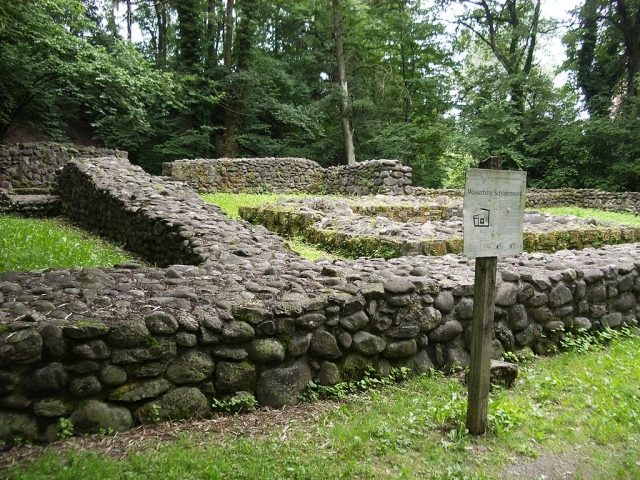
The remains of the Castle can be visited
Schönenwerd (Dietikon)
The moated castle of Schönenwerd is a castle ruin in the area of today's municipality of Dietikon in the canton of Zurich, Switzerland.
The ruins of the moated castle of Schönenwerd are now located approximately 200 meters from the left bank of the Limmat and 600 meters east of the SBB train station Glanzenberg on the Zurich-Baden railway line. On the right bank of the Limmat, approximately 700 meters downstream, are the ruins of the castle and the former town of Glanzenberg.
The castle was probably built at the beginning of the 12th century on a Limmat island with a tower, palas, bailey, and curtain wall. After a fire, the castle was restored and expanded with two utility buildings in the castle courtyard. The Lords of Schönenwerd are first mentioned in documents in 1240. They were vassals of the Habsburgs and exercised the bailiwick rights over Dietikon-Oberdorf, which was then considered a separate bailiwick. The knights owned considerable land on the Reppisch.
As part of the territorial competition between the Regensbergers and the flourishing city of Zurich in the first half of the 13th century, the Regensbergers expanded the old Fahr Castle, built around 1044, into Glanzenberg Castle and probably founded the town of Glanzenberg "across the Limmat near Dietikon" around 1240.
The Regensbergers had chosen the site for a town foundation based on strategic considerations. On the one hand, it was intended to control trade on the Limmat and the road to Baden; on the other hand, the location was well suited for building a bridge over the Limmat and was near the Fahr monastery, also a Regensberger foundation.
However, for a bridge construction, they needed the cooperation of the Knights of Schönenwerd, whose castle stood on the opposite bank of the Limmat. The city of Zurich, on the other hand, did not tolerate the construction of a new bridge and pressured the Lords of Schönenwerd, who in 1257 committed not to sell land on the far bank of the Limmat for a bridge construction. Zurich feared that with the founding of the town of Glanzenberg, a new trade route to Central Switzerland – bypassing the city of Zurich – would be planned. The castle is said to have been plundered by the people of Zurich in 1334 and 1371. The impoverished Heinrich von Schönenwerd was unable to rebuild the ruin. Wettingen Abbey gradually managed to buy the possessions from the impoverished knights. The bailiwick rights of both Dietikons passed to the monastery in 1367.
Hans Hediger von Altstetten bought the ruin from the Zurich family Stagel in 1434. In 1930-35, the castle was excavated by Karl Heid and conserved in 1970/71 by the building department of the city of Zurich. Today, the ruins are owned by the city of Dietikon.
Take Mobile History with you
You are reading this text for free. Premium adds what matters on the road: descriptions read aloud, sites found through your camera, whole regions taken offline.
- Every description, including the ~17,700 Premium sites
- Audio guide: have descriptions read to you on location
- AR finder: see sites through your camera, with distance and bearing
- Unlimited saved sites
14 days free, then from €2.99 a month. Cancel anytime.
Source: Wikipedia · Licence: CC BY-SA 4.0
This description draws on the facts documented in the linked Wikipedia article; Wikipedia content is licensed under CC BY-SA 4.0. Wording and editing: Mobile History.
Location: 47.3985, 8.4283