RuinRötz

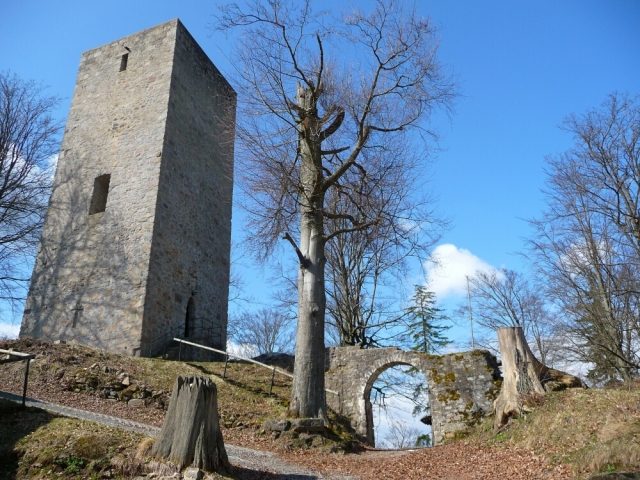
Schwarzenburg Castle (Ruin)

Schwarzenburg Castle (Ruin)

The remains of the Castle can be visited
Restaurant

Schwarzenburg Castle, also known as Schwarzwihrberg or Schwarzwihr, is today a ruin of a high medieval to early modern noble castle on the Schlossberg near the town of Rötz in the Upper Palatinate district of Cham in Bavaria.

The castle was founded during the 11th century, reinforced around 1450, and expanded around 1500 with mighty bastions and a rondel. It was destroyed in 1634 by the Swedes during the Thirty Years' War and subsequently used as a quarry.

Today, the freely accessible castle ruin in the outer bailey area is largely used as a grandstand for the festivals held at the castle. In the main castle area, there is a periodically managed refuge with a beer garden. The accessible keep serves as an observation tower.

The extensive castle ruin is located in the southern part of the Upper Palatinate Forest on the wooded and rocky summit of the Schlossberg. The Schlossberg is the highest elevation of the Schwarzwihrberg at the southeastern end of a small group of hills that rises above the Schwarzach valley and the Eixendorf dam. The ruin is located about 270 meters above the valley and 3,080 meters west-northwest of the Catholic parish church of St. Martin in Rötz, 1,000 meters west above the village of Bauhof, a district of the municipality of Rötz, or about 20 kilometers northwest of Cham.

Nearby are other former medieval castles: a few kilometers north-northwest are the castle ruin Thannstein and the castle site Alter Thanstein. West-northwest of the castle site Warberg near the village of the same name Warberg near Neunburg vorm Wald, and north of the castle site Altenschneeberg.

The first mention of Schwarzenburg occurred between the years 1048 and 1060 with "Heinricus de Swarcenburg," a member of an influential family of free nobles mentioned as a monastic Vogt in a tradition note of the St. Emmeram monastery.

However, no remains from this early period of the castle have been preserved, so it is assumed that a predecessor complex existed on the Alter Schwarzwihrberg a little to the north at that time, or that the first castle was a wooden structure from the 10th century. Both assumptions, however, remain unproven to this day. The oldest parts of the Schwarzenburg family castle, the remains of the castle chapel, the presumably tower-like residential building immediately south of the chapel, the curtain wall, and the remains of a tower with an adjoining residential building in the eastern corner of the lower bailey at the east bastion, date from around the year 1100.

The last member of the Schwarzenburg family is "Bertholdus de Swarcinburch," documented between 1125 and 1147, i.e., Berthold II of Schwarzenburg, a nephew of the Archbishop of Cologne, Friedrich of Schwarzenburg. He did not return from the Second Crusade with King Konrad III. He is likely to be considered the builder of the oldest parts of the complex.

After the extinction of the Schwarzenburg family, the castle presumably passed to the Staufer via the Counts of Mödling. In 1212, King Frederick II transferred it to King Ottokar I Přemysl of Bohemia. Under them, the keep and the younger residential building of the main castle were probably erected. From 1256, Schwarzenburgs are again documented at the castle. "Reinboto I." of Schwarzenburg, however, was probably not related to the older Schwarzenburgs; they were ministeriales from Bohemia, who perhaps emerged from a free noble family.

Since the Bavarian partition of 1255, the dominion of the ministerial family belonged to the Wittelsbach Duchy of Lower Bavaria. From 1300, the decline of the family began, which was also reflected in the mortgaging of Rötz and the "purkh ze Swartzenburch" in 1307 by the feudal lord Duke Stephan I of Lower Bavaria to Konrad von Chamerau, although they still resided at the castle until 1317. The family died out with "Bertha von Schwarzenburg" in 1391.

After the partition of the country in 1331, the dominion came to the Duchy of Heinrich XV, the Natternberger, but he sold the castle in the following year for 3000 pounds of Regensburg pfennigs together with Rötz and Waldmünchen to Landgrave Ulrich von Leuchtenberg. He had to commit to investing 400 pounds of Regensburg pfennigs in the castle.

The Leuchtenbergers owned the dominion of Schwarzenburg-Rötz-Waldmünchen, with the exception of a mortgage between 1364 and 1367 to Georg Auer von Stockenfels, until about 1404, when they sold the dominion to Amalia Kagerin von Störnstein and her sons Hinczik and Hans Pflugk zu Rabenstein. Under the Pflugs, first under Hinczik, who died after 1460, then under his son Sebastian, who died in 1491/92, both of whom were long-time administrators in Cham (Upper Palatinate), and his grandson Hinczik d.J., who died in 1495, they were able to further increase the rights and importance of the dominion. Between 1439 and 1460, unspecified construction measures for 600 guilders are known; it is certain that at this time the three still preserved semi-circular towers, one on the tower-like residential building of the main castle, one within the west bastion, and one next to the preserved inner gate of the outer bailey, were built. Possibly, a second tower also stood on the opposite side of the gate.

The reason for the reinforcement of the fortifications was probably the threat to the region from Hussite attacks from Bohemia. In 1433, Schwarzenburg was the rallying point for the army under Hinczik Pflugk, which prevented a Hussite army group from advancing into Lower Bavaria in the victorious Battle of Hiltersried.

In 1495, the heirs of Hinczik d.J. sold the dominion for 36,000 guilders to Heinrich von Plauen, the Burgrave of Meissen. Heinrich owned the castle and dominion until 1505; he had extensive construction work carried out for 4,000 guilders. At that time, the three bastions, the rondel, the outer gate of the outer bailey, and the bricked-up neck ditch were probably built.

Heinrich von Plauen sold the castle to his brother-in-law, the Bohemian nobleman Heinrich von Guttenstein-Vrtba (noble family) on February 6, 1506, but he is already documented as owner on January 9, 1505; the sale apparently took place before the dating of the sales document. The dominion of Schwarzenburg-Rötz-Waldmünchen, which previously belonged to Lower Bavaria, came to the Young Palatinate on July 30, 1505, through the Cologne arbitration after the Landshut War of Succession. Duke Friedrich II of the Palatinate renounced all claims to reacquisition and left him the dominion as a free allodial property with a five-year right of opening.

Heinrich von Guttenstein-Vrtba repeatedly used the strong castle as a base for his raids, which is why the Swabian League decided in 1509 to take action against him. He had the castle's stability tested by his own bombardment and, due to the poor result, sold it in October 1509 with the entire dominion for 41,000 guilders to Ludwig V and his brother Friedrich II of the Palatinate, even before a siege by the League occurred.

The Wittelsbachs had the castle restored in 1514; it became the seat of an administrator of the Palatine administrative district of Rötz, established in 1509 and also known as the "County of Schwarzenburg." The administrators of the district resided at the castle until 1542, then moved first to the Bauhof, the former farmstead of the castle, and in the mid-17th century to the town castle of Rötz.

In 1634, Schwarzenburg Castle, which was probably only poorly maintained after the administrators left, was destroyed by the Swedes during the Thirty Years' War and subsequently used as a quarry by surrounding residents.

Complex+

Of the former, essentially Romanesque, castle complex, the keep and extensive wall remains of a battery tower, a castle gate of the upper bailey, the curtain wall, and minor remains of a castle chapel are still preserved. Today, the keep serves as an observation tower, and festivals take place on the castle grounds, with the battery tower being used for storing props and as an actors' changing room. Festival visitors and hikers have access to the Schwarzwihrberghütte, a managed refuge for approx. 60 people, open from April 1 to October 31.

Take Mobile History with you

You are reading this text for free. Premium adds what matters on the road: descriptions read aloud, sites found through your camera, whole regions taken offline.

  • Every description, including the ~17,700 Premium sites
  • Audio guide: have descriptions read to you on location
  • AR finder: see sites through your camera, with distance and bearing
  • Unlimited saved sites

14 days free, then from €2.99 a month. Cancel anytime.

Source: Wikipedia · Licence: CC BY-SA 4.0

This description draws on the facts documented in the linked Wikipedia article; Wikipedia content is licensed under CC BY-SA 4.0. Wording and editing: Mobile History.

Location: 49.3541, 12.4907