RuinWiesbaden-Sonnenberg

Sonnenberg Castle (Ruin) (Wiesbaden)
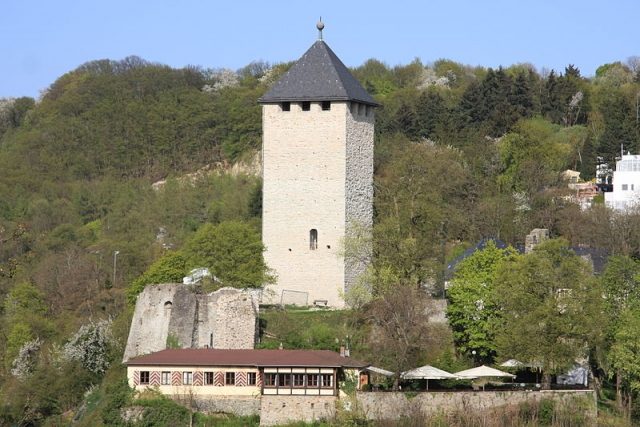
Sonnenberg Castle (Ruin) (Wiesbaden)

The remains of the Castle can be visited

Sonnenberg Castle is a castle ruin in Wiesbaden-Sonnenberg on the slopes of the Vordertaunus in Hesse. It was built from 1200 by the count brothers Heinrich II and Ruprecht of Nassau on a rock to protect Wiesbaden, as a fortress against the neighboring Lords of Eppstein, with whom there were ongoing border disputes. The Nassaus had probably been enfeoffed with the royal court of Wiesbaden by Frederick I as thanks for their support in the Roman campaigns of 1154. The royal court of Wiesbaden first appears in 829 as the administrative seat of the Königssondergau, which was established by Charlemagne. However, the court for the Gau was located in the territory of the Eppsteins. This complicated spatial distribution of property between the two houses gave rise to constant discord.

Inhabitants and Owners+

Although the land did not belong to the Nassaus, but to the Mainz Cathedral Chapter, construction began, and in 1221 the count brothers solemnly acknowledged that they had unlawfully and violently seized the "Castrum Sunneberc". They bought the land from the Cathedral Chapter and took the castle as a fief from the Archbishopric. This connection to Mainz had a long-term negative impact on Sonnenberg, as in the 13th century alone, four Archbishops of Mainz were provided by the Eppsteins, the enemies of the Nassaus.

After Ruprecht joined the Teutonic Order, Count Heinrich II ruled the lordship alone from 1230. Sonnenberg Castle was one of nine castles where the banner of the Nassaus flew.

In 1255, the first Nassau division of property occurred between Walram II and Otto I. The family split into the Ottonian and Walramian lines. Sonnenberg Castle with Wiesbaden now belonged to the Walramian line. Walram's son Adolf of Nassau, the later German king, further expanded the castle after it was severely damaged by the Nassau-Eppstein feud before 1283.

Together with Archbishop Gerhard II of Mainz, the Eppsteins were able to re-occupy and severely destroy the castle in 1298 after Adolf's death. Adolf's son Gerlach I, still a child at the time, was saved. After a tense period, Count Gerlach was able to reconcile with his former enemies in later years and greatly expand the castle. Under him, the most significant period of Sonnenberg Castle began. In 1338, Emperor Louis the Bavarian visited the castle, a testament to the size and security that Sonnenberg Castle offered in those years.

In 1351, Sonnenberg was granted town rights with its own jurisdiction by Emperor Charles IV. Count Gerlach's second wife, Irmengard of Hohenlohe-Weikersheim, who had already received the castle as a widow's residence in 1337, was particularly instrumental in this. The houses at the foot of the castle could now be integrated into the overall complex with a wall, which gave the inhabitants some security. The valley was fortified.

When Count Gerlach died at Sonnenberg Castle in 1361, his son Ruprecht, from his marriage to Irmengard, became Count of the newly founded lordship of Nassau-Sonnenberg in 1355. He became "famous" as the last wandering knight through his numerous feuds over the inheritance of his wife Anna of Nassau-Hadamar, until he solemnly laid down his sword forever in 1384 on the occasion of the endowment of the Catherine altar in the chapel tower. Despite his feuds, he managed to avert damage to his residence.

In 1365, Ruprecht VII assigned Sonnenberg Castle to his wife Anna as a widow's residence. He died childless in 1390. In 1391, Count Diether VIII of Katzenelnbogen, who married Ruprecht's widow Anna, gained co-ownership of the castle. After Anna's death in 1405, the lordship of Nassau-Sonnenberg with Sonnenberg Castle returned to the Idstein and Weilburg counts, who henceforth shared the property. Over the next 200 years, the castle increasingly fell into disrepair, until it experienced glorious days once again under Count Philipp of Nassau-Idstein between 1558 and 1566, who took the castle as his residence. He also died childless, and by the end of the 16th century, the castle was uninhabited. During the Thirty Years' War, war bands quartered in the castle. After the war, the castle served as a quarry for the reconstruction of the houses in the valley. Sonnenberg Castle became a ruin.

Today, the keep houses a museum, and annually, the Cultural Days of Wiesbaden-Sonnenberg take place at the castle near the chapel. A catering establishment has also found a place here.

Architectural Description+

Construction began around 1200, and the keep was completed in 1208. Between 1221 and 1242, the upper part of the castle was expanded. In 1283, the castle was severely damaged for the first time, then repaired and further expanded by Count Adolf. After renewed destruction in 1298, again by the Eppsteins, Count Gerlach was able to enlarge it further by adding the lower castle. With the granting of town rights in 1351, the valley was fortified and the village was provided with a protective wall. In 1384, a chapel was built in the wall tower of the lower castle. The keep was restored after the Second World War. Today there are three entrances to the castle: in the east through the main gate and in the valley via the former town gates.

Take Mobile History with you

You are reading this text for free. Premium adds what matters on the road: descriptions read aloud, sites found through your camera, whole regions taken offline.

  • Every description, including the ~17,700 Premium sites
  • Audio guide: have descriptions read to you on location
  • AR finder: see sites through your camera, with distance and bearing
  • Unlimited saved sites

14 days free, then from €2.99 a month. Cancel anytime.

Source: Wikipedia · Licence: CC BY-SA 4.0

This description draws on the facts documented in the linked Wikipedia article; Wikipedia content is licensed under CC BY-SA 4.0. Wording and editing: Mobile History.

Location: 50.1029, 8.2657