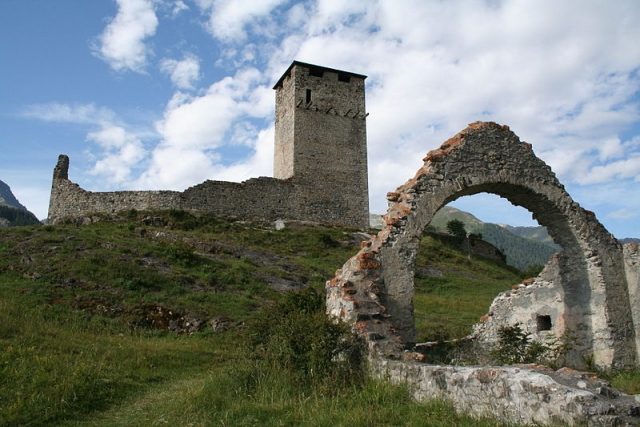
The remains of the Castle can be visited
Steinsberg Castle (Ruin)

The ruin of Steinsberg Castle lies on a mighty rock outcrop to the east of the village of Ardez in the Lower Engadine in the Swiss canton of Graubünden. Like Jörgenberg Castle or Hohenrätien, the complex formed a typical early medieval church castle with a ring wall and a church within the castle grounds.
Layout+
On the highest peak of the castle hill, which is well protected all around by steep rocks, some significant wall remains of the core castle and its interior have been preserved, in addition to the restored keep. Sparse remains of the former outer ring show that the entire hill was once included in the complex.
Access was from the east via a natural ramp; a presumed gatehouse in the northeast corner has disappeared. Near the entrance area stands the ruin of St. Luzius Church, of which the north and west walls, the chancel arch, and part of the apse are preserved. The church is not oriented to the east, but rather north-south.
The main tower with its four stories stands on the northern edge of the rock. The current intermediate floors and the roof, which is too flat for the Middle Ages, date from more recent times. A change in the size of the stones used at the height of the 2nd story could indicate a reconstruction after destruction. A noticeable wall offset of approx. 50 cm at the height of the 1st story is striking. The high entrance was in the south wall at the height of the 2nd story. To the north was a gallery, but the still visible beam remains are of more recent date. Until the 1960s, the tower could be entered through a subsequently broken-in door at ground level, but it was then walled up for safety reasons. The gate to the core castle was probably in the northern ring west of the tower. In the southeast corner, an older, walled-up gate can still be seen.
The first documented owners of the castle appear to be the Lords of Frickingen near Überlingen on Lake Constance. Albert von Frickingen, who died on February 2, 1209, sold all his possessions between Engadine and Bolzano and Ardez Castle to Bishop Reinher della Torre of Chur (1194–1209) before his death.
In 1228, Count Albert of Tyrol renounced his ownership claims to Ardez Castle in a settlement with Bishop Berthold von Helfenstein, and the diocese established an episcopal court at Steinsberg.
Due to financial difficulties caused by the power struggle between the Count and the Bishop, in 1348 the "gotzhus vesti Steinsberg" with its "burgsässe" was pledged by the cathedral chapter to the von Planta family for 15 marks annually.
In 1357, the adversaries reconciled. The bishop committed to assisting the count with the castles of Fürstenburg in Vinschgau and Steinsberg in the event of an attack on the Tyrolean dominion. After further financial problems, the bishop pledged the castle to the Lords of Katzenstein in 1359. They passed on the pledge, and thus Steinsberg came into the possession of the Vögte von Matsch around 1400. In 1421, an arbitration award assigned Steinsberg to the diocese. During the 15th century, the castle was pledged several times. Owners included Georg Scheck in 1436, the Stuppan in 1464, and Balthasar and Jacob Scheck in 1485.
During the Swabian War in 1499, the castle was burned down by imperial troops; the castellan Balthasar Scheck was taken to Merano and murdered there along with other hostages. The castle was subsequently only provisionally repaired. From 1502–1519, Hans Planta was the pledge holder. During the 16th century, the castle was abandoned.
Take Mobile History with you
You are reading this text for free. Premium adds what matters on the road: descriptions read aloud, sites found through your camera, whole regions taken offline.
- Every description, including the ~17,700 Premium sites
- Audio guide: have descriptions read to you on location
- AR finder: see sites through your camera, with distance and bearing
- Unlimited saved sites
14 days free, then from €2.99 a month. Cancel anytime.
Source: Wikipedia · Licence: CC BY-SA 4.0
This description draws on the facts documented in the linked Wikipedia article; Wikipedia content is licensed under CC BY-SA 4.0. Wording and editing: Mobile History.
Location: 46.7743, 10.2048