CastleMalix

Strassberg Castle (Ruin) (Malix)
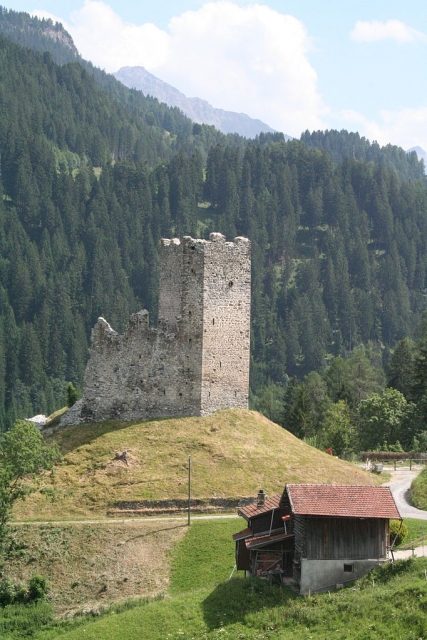
Strassberg Castle (Ruin) (Malix)

The remains of the Castle can be visited

The ruin of Strassberg Castle is located in Malix in the Swiss canton of Graubünden. The ruin lies on a small hill slightly below the road from Chur to Lenzerheide and is easily accessible from the village. From 2008 to 2010, the walls were restored and secured.

The name appears in the 13th century in several spellings: for example, O. de Strazperc is mentioned in 1253, de Straceberch in 1259, and de Strasberch in 1260. The name of the castle already appears in 1275: …castrum dictum Strasceberch. There is no doubt that the name is connected with the road, important since ancient times, connecting Rome and Germany. The castle is also repeatedly mentioned in connection with road tolls, for example in 1413 …ainen zol under dem huse ze Strasberch.

On the terrace below the main castle was a spacious outer bailey with a surrounding wall, of which, however, hardly any remains are left. An outer gate system is to be presumed under the current path.

The main castle on the hill was built in two stages. The remains of an irregularly running curtain wall made of layered masonry of quarry stones and boulders date from an older period. In the wall corner on the mountain side, embrasure windows with an oblique breakthrough direction point towards the road. The window openings also belong to the original building stock. Wall benches and remains of a latrine bay suggest a residential wing, probably added later on the inside.

In a later expansion phase, a square tower was placed in the mountain-side wall corner, its outer walls aligned with the curtain wall. Based on the beam holes, four floors as well as attic space and an intermediate floor can be identified. The high entrance was on the south side on the second floor above the large breach that was broken out later. The living quarters were on the third and fourth floors. In the northwest corner, a latrine with a drain running obliquely through the wall can be seen. On the fourth floor, an exit led to a gallery. The upper end was formed by a battlement with a superimposed tent roof.

In the course of these extensions, the adjoining eastern curtain wall was raised by one storey; the bricked-up battlements are clearly visible. Near the tower was a brick latrine bay on wooden corbels.

Hardly any traces of the other parts of the main castle are still visible. A narrow zwinger system ran around the mountain-side curtain wall, which is probably attributable to a later extension. The structural connections between the main and outer bailey are unclear.

There are no secured documents about the origin of the castle. The oldest building parts probably date from around 1200. The reconstruction and the building of the tower took place in the 13th century. Strassberg Castle was the seat of the Lords of Strassberg, who are first attested in 1253 with Otto.

In 1275, the castle belonged to the Barons of Vaz, as Walter V of Vaz excluded it from the possessions he transferred to the Diocese of Churwalden in the event of heirless death. He had given the castle to his wife Liutgard von Kirchberg as a morning gift. When and how the fortress came into the hands of the Vaz remains uncertain. It is conceivable that the castle was originally the center of a small independent lordship and only later became Vazian. However, it could also have been built by the Vaz and later transferred to a ministerial family who named themselves after the fortress Strassberg. In 1295, the Lords of Strassberg certainly appeared as Vazian ministerials. Due to its location on the pass routes and the nearby monastery of Churwalden, where the Vaz had their burial place, Strassberg played an important role for them.

How long the Lords of Strassberg resided in the castle is uncertain. After the extinction of the Vaz around 1339, the castle passed by inheritance through Kunigunde von Vaz to her husband Friedrich V von Toggenburg. Below the castle was a toll station, which the Toggenburgers had probably established and had transferred to them by Emperor Charles IV on April 30, 1348, against the will of the Bishop of Chur. However, the revocation took place in the same year.

After the death of the last Toggenburger in 1436, Strassberg passed to Count Wilhelm IV of Montfort-Tettnang. Like the Toggenburgers, the Montforts also had the castle administered by bailiffs from the rural upper class of the area. According to the Montfort Charter of Freedom for the Churwalden court of 1441, Strassberg had to be open and available to the country, as well as according to the Charter of Freedom of Gaudenz von Matsch of 1471. In addition, the castle could only be occupied and governed with the will and advice of the country. According to an income register of 1451, the buw ze Strassberg (castle and estates) yielded 30 bushels of grain.

Later, due to financial difficulties, the castle came into the possession of the House of Austria, until it was sold by Duke Sigismund to the Vogt Ulrich von Matsch in 1471. Just six years later, he bought it back from him. In 1491, Strassberg Castle was somewhat "pawuellig" (dilapidated) and was to be repaired by the Vogt. The last Austrian Vogt resided in Strassberg during the Swabian War. Because the Grisons wanted to prevent an Austrian military base in their territory, the fortress was stormed and burned down by them on March 5, 1499.

In the 16th century, the castle was already a ruin, its decay accelerated by exploitation as a quarry. In 2008/2009, extensive restoration work was carried out on the ruin.

Take Mobile History with you

You are reading this text for free. Premium adds what matters on the road: descriptions read aloud, sites found through your camera, whole regions taken offline.

  • Every description, including the ~17,700 Premium sites
  • Audio guide: have descriptions read to you on location
  • AR finder: see sites through your camera, with distance and bearing
  • Unlimited saved sites

14 days free, then from €2.99 a month. Cancel anytime.

Source: Wikipedia · Licence: CC BY-SA 4.0

This description draws on the facts documented in the linked Wikipedia article; Wikipedia content is licensed under CC BY-SA 4.0. Wording and editing: Mobile History.

Location: 46.8063, 9.5338