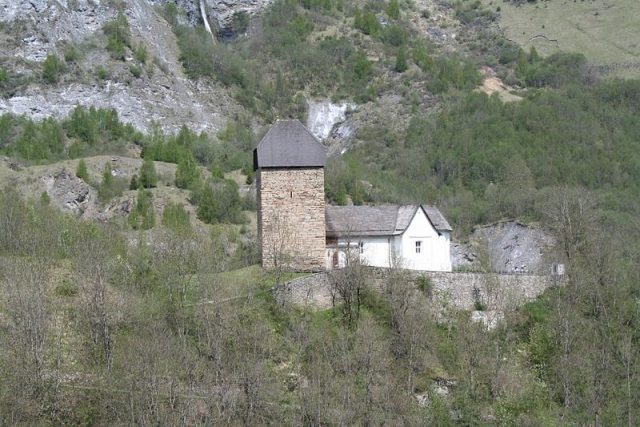
The remains of the Castle can be visited
Surcasti Castle (Ruin)

The tower of the former castle of Surcasti is located on a rocky spur between the Valserrhein and Glenner rivers northeast of the village of Surcasti in the Swiss canton of Graubünden.
The castle area originally extended over the entire spur. Today, the area is largely occupied by the Church of St. Laurentius and the cemetery. Of the original complex, only the square tower with a side length of approx. 8 m has been preserved, which has served as the bell tower of the parish church since 1520. A neck ditch to the south has been partially leveled. The walls consist of rubble stone, partly with strikingly massive ashlar blocks, the cornerstones with chamfered edges are carefully hewn. In the lower part, remnants of rasa-pietra plaster with joint pointing have been preserved.
Originally, the tower had four floors. The current entrance was broken through later; the old high entrance with a round-arched opening was at the height of the 3rd floor in the northwest wall. The current half-hipped roof dates from the 18th century; nothing is known about the original roof shape. Erwin Poeschel suspected a pyramidal roof over a battlements, possibly also a wooden clerestory.
Only fragmentary findings are available for the other buildings of the complex. In the northeast, soundings in 1945 revealed remnants of a rectangular (residential) building. Traces of a curtain wall are missing. The current cemetery wall and gate date from post-medieval times.
Written records about the construction of the castle are missing. A construction period in the early 12th century is suspected. The church of Sogn Luregn is first mentioned in 1345, but a Romanesque predecessor cannot be ruled out. Written testimonies exist from the years 1345, 1515, and 1520. In 1774, during restoration work, a Madonna figure from the second half of the 12th century was found; it is kept in the museum of Disentis Monastery. The connection between the castle and the church remains open; it is also unclear whether Surcasti was actually an early medieval church castle, as is suspected. The current late Gothic church building dates from between 1515 and 1520. Its current appearance dates from alterations in 1774.
The family of Übercastel first appears in a Rhaetian debt register around 1325 as episcopal vassals; Wilhelm and his son Heinrich are mentioned. The last male descendant was named on July 13, 1419, and mentioned as deceased on August 1, 1425. An inscription with the name Conradus was found on a 12th-century wooden sculpture found in the ossuary. Other mentions of names, for example from the Bündner Herrschaft, are doubtful as to whether they have anything to do with Surcasti. The family was of the same lineage or related to those of Castelberg and Löwenstein.
Archaeological finds indicate an occupation of the site in prehistoric and Roman times.
Take Mobile History with you
You are reading this text for free. Premium adds what matters on the road: descriptions read aloud, sites found through your camera, whole regions taken offline.
- Every description, including the ~17,700 Premium sites
- Audio guide: have descriptions read to you on location
- AR finder: see sites through your camera, with distance and bearing
- Unlimited saved sites
14 days free, then from €2.99 a month. Cancel anytime.
Source: Wikipedia · Licence: CC BY-SA 4.0
This description draws on the facts documented in the linked Wikipedia article; Wikipedia content is licensed under CC BY-SA 4.0. Wording and editing: Mobile History.
Location: 46.7014, 9.1803