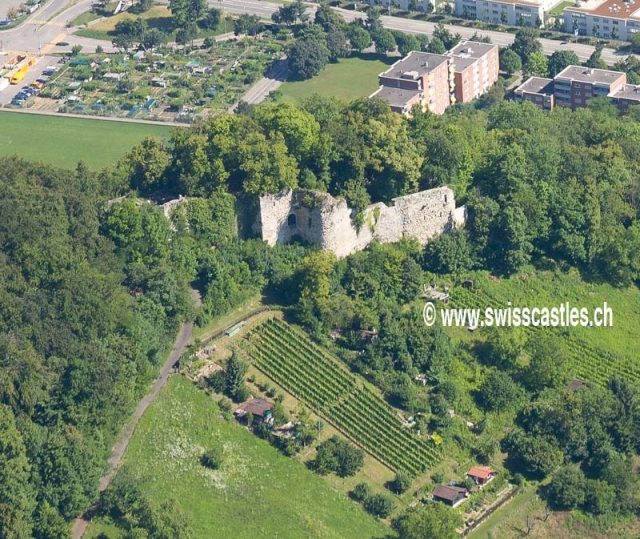
The remains of the Castle can be visited
Front Wartenberg Castle (Ruin)

The Wartenberg is a striking landmark of the Basel-Landschaft municipality of Muttenz. On the mountain stand the ruins of three medieval castles, which also bear the name Wartenberg.
The Wartenberg is an elevation southeast of the municipality, is part of the Tabular Jura and an offshoot of the Gempen plateau. Its highest point is at an altitude and towers over the village by a good 200 meters.
The height and design of the Wartenberg were excellently suited for representative and defensive purposes, and a Bronze Age complex, which had been used as a refuge, was discovered at the highest point. Arrowheads, a spear, knives and sickles, various ornaments, thousands of sling stones, and various stone tools were found. No remains of the complex itself were found due to the construction of the subsequent castles.
The three castle ruins of Wartenberg+
All three castles were 'cleared out' (loss of many archaeological findings) and 'restored' (loss and falsification of historical building fabric) during the castle romantic phase in the 1930s to 1950s. This should not be lamented here, however, as castle romanticism at least led to broad public interest in the Middle Ages. The fortifications built during the Second World War also disturbed the historical building fabric.
Until the end of the 13th century, the three castles were a single unit. The Cathedral Chapter of Strasbourg appears as the first historically traceable owner of the three Wartenberg castles and the village of Muttenz. How the Strasbourgers came into possession of these lands can no longer be ascertained. Presumably, the three castles were already passed on as fiefs by the Strasbourg archbishops to the Counts of Homberg in the 11th century. The castles were inhabited not only by the Hombergers or, after 1250, by their successors from the House of Frohburg, the Neu-Hombergers, but also by their vassals, the Marschalk von Frohburg, who after 1250 also called themselves Marschalk von Wartenberg.
The House of Habsburg-Austria took over all three castles in 1306 and gave them as sub-fiefs first to the Basler zer Sunnen and then to Johann I von Habsburg-Laufenburg.
Vordere Burg (Front Castle)+
The Vordere Wartenberg was the most significant of the three Wartenberg castles. The remains lie on a broad rock spur in the north of the Wartenberg and are separated from it by a neck ditch. The material that accumulated during the excavation of the neck ditch and the quarry on the south side of the neck ditch would (as usual) have served directly as building material for the castle.
Access to the castle today is through the neck ditch and a path on the SW side of the complex.
Complex
The castle has an extent of a good 100 meters in length and over 30 meters in width. The enceinte in the north is destroyed by quarrying activity, but in the east the wall is still very clearly visible, and the south wall is particularly impressive. In the east wall, the (reconstructed) castle gate is visible, which today lies several meters above the ground. How access from the outside occurred is unclear: publications on the 'restorations' suggest that the gate was reached from the south along the wall (via an embankment or a wooden ramp). This is, by the way, another example that refutes the assumption that access to the gate always occurred in such a way that a rider had to expose the right side, unprotected by a shield, to the defenders.
The use of stone material from the north and northeast sides, as well as the construction of military installations, have severely disfigured the northern part of the castle. In the center of the complex, remains of the filter cistern of the keep (interpretation by Häring and Eglin) as well as the eastern enceinte and the (reconstructed) castle gate are still present. Only the southern part of the fortress is somewhat less disturbed, and the enceinte, a tower built against the enceinte on the inside in the SW corner, and masonry inside the castle are still preserved.
Unfortunately, the existing finds can no longer be assigned to the construction phases. However, they date back to the late Carolingian period. Meyer even suspects that it could originally have been a High Burgundian royal castle.
The fortress – whose remains are visible today – was built in the middle of the 12th century and was continuously expanded over the next century. The Münch von Münchenstein – as relatives of the zer Sunnen – took over the fief of the Vordere (and Mittlere) Wartenberg in 1371. After a long back and forth, the city of Basel was finally able to acquire the Vordere and Mittlere castles on the Wartenberg from the Münch on May 2, 1515. At this time – already in 1470 Konrad Münch only wrote of a castle site – both castles were no longer inhabited and were falling into disrepair. The motivation for buying such ruins lay in the goods and rights associated with the castles (right to levy taxes, rights to jurisdiction – fines could be quite lucrative – etc.).
Image source: www.swisscastles.ch
Take Mobile History with you
You are reading this text for free. Premium adds what matters on the road: descriptions read aloud, sites found through your camera, whole regions taken offline.
- Every description, including the ~17,700 Premium sites
- Audio guide: have descriptions read to you on location
- AR finder: see sites through your camera, with distance and bearing
- Unlimited saved sites
14 days free, then from €2.99 a month. Cancel anytime.
Source: Wikipedia · Licence: CC BY-SA 4.0
This description draws on the facts documented in the linked Wikipedia article; Wikipedia content is licensed under CC BY-SA 4.0. Wording and editing: Mobile History.
Location: 47.5214, 7.6578