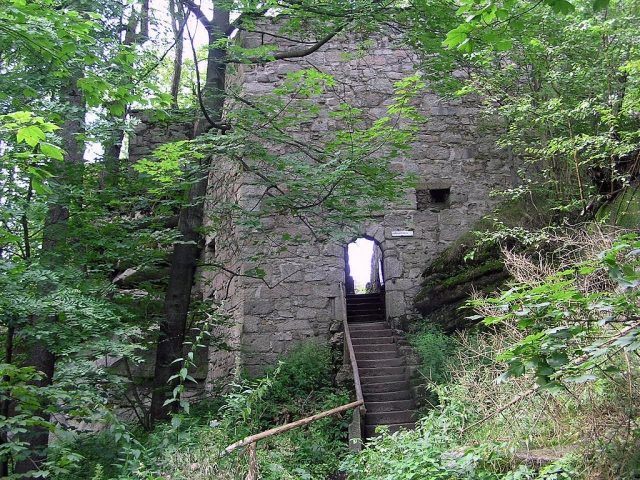
The remains of the Castle can be visited
Waldsteinburg Castle (Ruin)

The Waldstein Castle on the Großer Waldstein, also known as the Red Castle, is a castle complex in the Fichtel Mountains. It is also referred to as the West Castle in distinction to the older East Castle.
The West Castle, first mentioned in 1350, was built to replace the older East Castle, which no longer met the requirements of a defensible structure. The builders and owners were the Knights of Sparneck.
The Ministerial Family of the Sparnecks
The Lords of Sparneck ruled for centuries over an area roughly corresponding to the former district of Münchberg. Waldstein Castle was an integral part of the possessions of this once powerful family. Their most famous representative on the Waldstein is Rüdiger von Sparneck (c. 1300–1364/68), who was named Palatine Count in Eger in 1336. When the Bohemian king was crowned Emperor Charles IV, the center of power of the Holy Roman Empire moved within immediate reach of the Sparnecks; Waldstein Castle thus played an important role in the power structure of the western Egerland and neighboring regions. This period is considered the heyday of the Lords of Sparneck, and thus the increasingly powerful Rüdiger granted Münchberg the Nuremberg city rights on July 13, 1364. His son Hans I von Sparneck was admitted to the Bamberg Cathedral Chapter on April 28, 1352. Among other things, he pledged the Waldstein to Konrad von Neuberg. However, together with his brothers Erhard (1364-1417), Friedrich I (1364–1415), and Pabo II (1364–1373), he succeeded in subordinating the Waldstein to the Emperor as a fief.
Destruction of the Castle by the Swabian League in 1523
In the middle of the 15th century, many once powerful lords engaged in activities later described as robber knighthood, in order to preserve and, if possible, expand their possessions. Hans Thomas von Absberg particularly distinguished himself in this, terrorizing all of Franconia around 1500. He repeatedly kidnapped merchants and demanded a high ransom for their release. On June 24, 1520, he ambushed a group of travelers at Hahnenkamm. Count Joachim von Oettingen, who was traveling with the group, was so severely wounded in the skirmish that he succumbed to his injuries on July 6. This event was also reported to the Swabian League and Charles V, who had just been crowned "elected" German Emperor. He then imposed the Imperial Ban on Absberg. In May 1521, Absberg ambushed a group of returnees from the Imperial Diet in Worms in the Knittlinger Steige. Hans Lamparter von Greiffenstein (the Emperor's spokesman) and Johann Lucas, who handled financial transactions on behalf of the Emperor, fell into his hands. After several stops, the prisoners were brought to Waldstein, the safest castle in the entire Fichtel Mountains, which belonged to Wolf and Christoph von Sparneck.
In January 1523, after a year and 38 days of captivity, they managed to escape with "God's help" and in Nuremberg, they named the Sparnecks as Absberg's helpers. On June 1, a formidable army, consisting of 10,000 foot soldiers and 1,000 horsemen, carrying 100 arquebuses, 33 cannons, and 900 pounds of gunpowder, was assembled. On July 11, the troops reached Waldstein Castle and burned it to the ground. The castle fell into disrepair and was not rebuilt by the Sparnecks, whose end was thus sealed. The last of the family died in Wunsiedel in 1744.
The Woodcut by Hans Wandereisen
In the woodcut by war reporter Hans Wandereisen, the castle is depicted as towering over its surroundings. Measured by the number of floors, it is shown exaggeratedly tall, yet the ruin still impressively rises on a rocky plateau today.
Around the mountain spur, the forest has been cleared, allowing a view of the League's troops. In the original documents published by Baron von Reitzenstein, there is mention of a Schaffhausen. The wooden hut can be identified as such.
Following the path upwards, on which a rider with powder kegs is depicted, one reaches the outer bailey, of which one side of the castle gate is still preserved. This outer bailey is well protected from all sides, and only on the back side can a simple palisade fence be seen, utilizing the natural rock formation. In the left half of the outer bailey, a stone hut is visible, which, according to Schwarz, was used as a storage facility.
The main castle consisted of a palas, a gatehouse, a battlement with turrets (depicted oversized in the center of the castle in the woodcut), and a square keep. Access to the main castle was secured by a drawbridge, which is not visible in the woodcut. Various investigations, including those by Karl Dietel, support this thesis.
The War Records of 1523
Transcription: Waldstein, a castle of the Sparnecks, where the prisoners lay, who themselves escaped with the help of the Almighty: On the same day, by Christoph von Freyburg, a nobleman appointed captain by the city of Augsburg, Waldstein Castle, which belonged to the brothers Christoph and Jörg von Sparneck, where the prisoners, namely Johann Lamparter and Baumgärtner, had been held and escaped, was burned, and the prison was blown up and torn apart with powder. This castle is a den of murderers and built in a wild place in a forest. Nothing more was found within it. (The Sparnecks fled before the approaching troops and took what they could carry)
Watchtower in the War of the Spanish Succession
After its destruction in 1523, the castle fell into oblivion. It was only during the War of the Spanish Succession (1701–1714) that it was again used as a camp and the gatehouse was roofed over as a watchtower. The red bricks used for this earned it the name Red Castle, which the Hof Gymnasium director Helfrecht first used for the castle in his work published in 1795.
The Castle Today+
Only the foundation walls remain of the once proud rock castle. In 2007, a small part of the wall collapsed. The State Office for Monument Preservation is considering ways to save the complex.
The Waldstein Festival
The Waldstein Festival was first staged in 1923, 400 years after the destruction of Waldstein Fortress, by the Fichtelgebirgsverein Münchberg. In 1995, the Felsenbühne Waldstein e.V. association was founded, which currently has 150 members and has performed four historical plays, three of which were written in-house, on the stage at the foot of Waldstein Castle since its founding.
Take Mobile History with you
You are reading this text for free. Premium adds what matters on the road: descriptions read aloud, sites found through your camera, whole regions taken offline.
- Every description, including the ~17,700 Premium sites
- Audio guide: have descriptions read to you on location
- AR finder: see sites through your camera, with distance and bearing
- Unlimited saved sites
14 days free, then from €2.99 a month. Cancel anytime.
Source: Wikipedia · Licence: CC BY-SA 4.0
This description draws on the facts documented in the linked Wikipedia article; Wikipedia content is licensed under CC BY-SA 4.0. Wording and editing: Mobile History.
Location: 50.1296, 11.8528