The origins of the complex date back to the Middle Ages, possibly even to the 10th century, with the first documented mention from 1269. Originally conceived as a moated castle at a Wipper crossing, ownership changed frequently. In 1532, the castle returned to the possession of the Princes of Anhalt. After the division of the country in 1546, Prince Georg III of Anhalt-Plötzkau took over the complex and had it converted into a residential palace in the mid-16th century. During a plague epidemic in 1552, the palace briefly served as a princely court. In 1619, the educator Wolfgang Ratke was imprisoned here for nine months. In the 18th century, the complex underwent Baroque alterations. After being used as a domain in the 19th century and as a state-owned farm during the GDR era, the palace increasingly fell into disrepair. The medieval keep was demolished in the 1960s, and the north wing, the Georgsbau, remained as a ruin. A support association has been working to preserve the ruin since 2007.
CastleWarmsdorf
Ruin Warmsdorf
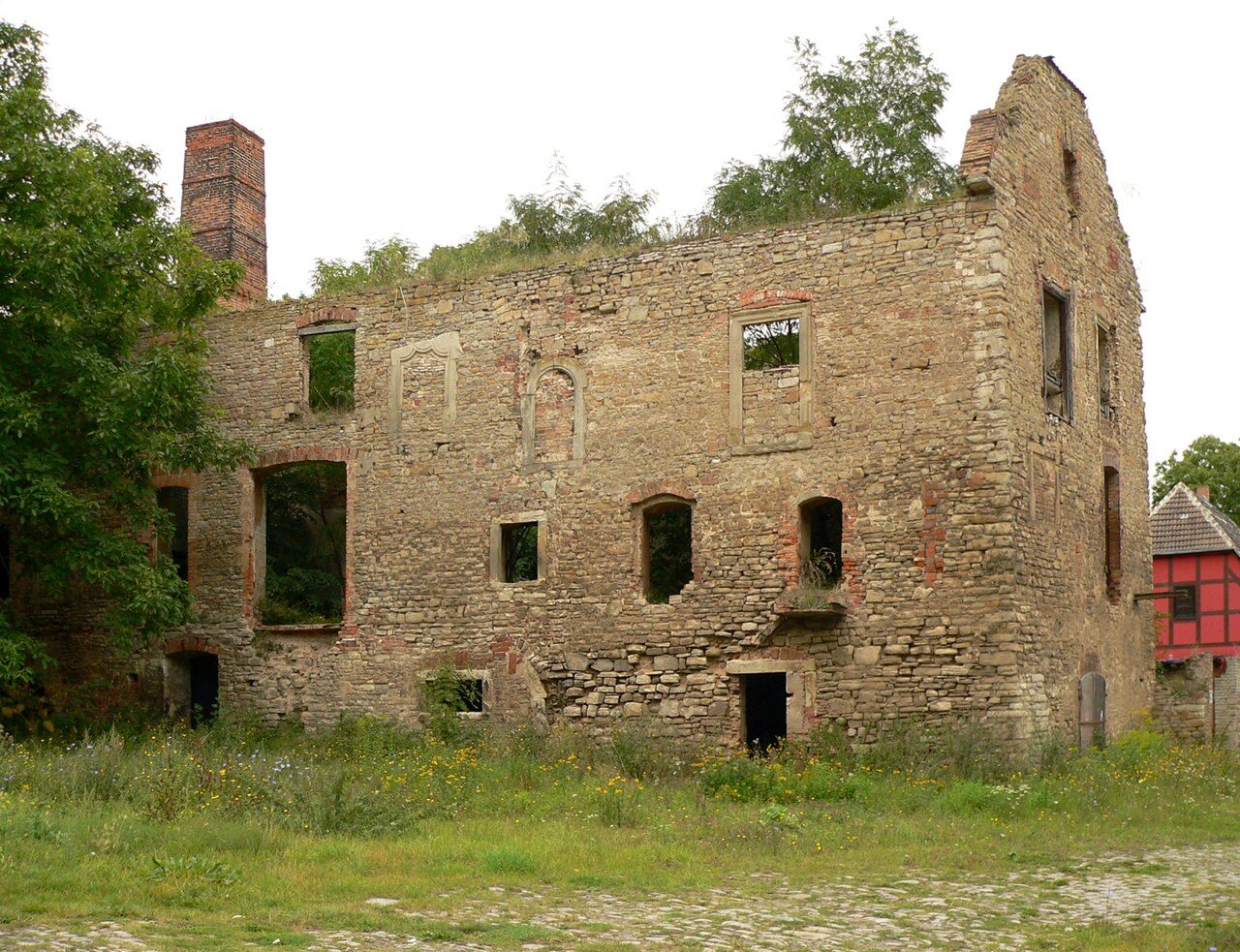
The Warmsdorf Ruin in Saxony-Anhalt, a medieval moated castle and an early modern residential palace, includes the Georgsbau as the oldest preserved part of the complex.
History+
Image: Axel Hindemith / CC BY-SA 3.0 via Wikimedia Commons
Location: 51.7789, 11.5814