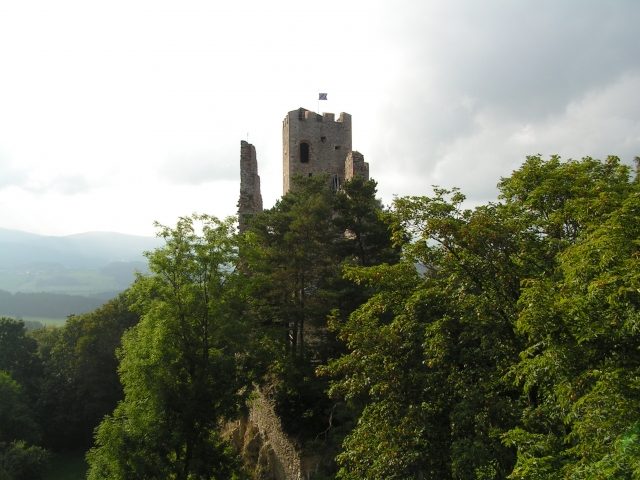
RuinWeißenstein

Weißenstein Castle (Ruin)

Weißenstein Castle (Ruin)

The remains of the Castle can be visited

The castle ruin Weißenstein is located in the Bavarian Forest on a 758-meter high quartz rock, the Pfahl ("Castle Hill") in the Weißenstein district of the city of Regen in the district of Regen in Bavaria.

The rock castle was built by the Counts of Bogen around 1100. After the extinction of this noble family in 1242, the castle fell to the Bavarian dukes. In 1308, the Bavarian dukes Otto and Stephan of Lower Bavaria enfeoffed the knight Eberwein von Degenberg with the lordship of the castle. In 1339/40, the castle became the property of the Degenbergers.

When the Degenbergers rose against Duke Albrecht IV in the Böckler War, ducal troops under Georg von Lerchenfeld appeared before the castle on December 9, 1468. Shortly before Christmas, Weißenstein Castle was captured and burned down. However, the Degenbergers rebuilt the castle and remained here until their extinction in 1602 with the death of Hans Sigmund von Degenberg.

The castle fell to Elector Maximilian I, who established the seat of the electoral administrator here. In the Thirty Years' War, the castle was devastated by the Swedes in 1633. In 1740, the south side of the castle collapsed, and in 1742, Franz von der Trenck with his Pandurs finally destroyed the castle.

The castle has since fallen into disrepair, while the official residence and outbuildings were restored. In 1762, a tower-like building, the so-called granary, was built for this purpose, because this structure also served as a grain storage for the tithes of the subjects. In 1918, the writer Siegfried von Vegesack bought the house and made it his home. Due to the high costs incurred, he called it "Das fressende Haus" (The Devouring House). He also titled his novel published in 1932 with this name.

Description+

The ruin, an elongated complex on a rock terrace, is separated from the outbuildings. In addition to some masonry, the square residential tower is particularly well preserved. Weißenstein Castle Ruin has been owned by the city of Regen since 1996. From 1991 to 1995, the castle ruin was renovated. It is accessible.

Since 1985, the "Fressendes Haus" has housed a museum and literary archive about the poet Siegfried von Vegesack. In addition, sacred art, tools for flax and linen production, and a large collection of snuff are exhibited here. Occasionally, poetry readings and other events take place here.

Below the castle ruin is a chapel from 1836 with a Baroque altar and numerous votive tablets.

Nature Reserve+

The Pfahl nature reserve near the Weißenstein ruin was established by VA. of the Government of Lower Bavaria and the Upper Palatinate on April 18, 1940, RegAnz. Issue 112/114. It is 6 hectares in size and extends over the rocky area with the ruin. This measure primarily prohibits quartz mining on the Pfahl. The castle hill is more heavily overgrown with trees due to centuries of fertilization with waste than the rest of the Pfahl. Sycamore maples, elderberries, birches, and ash trees thrive here.

The Legend of Weißenstein Castle+

According to a legend, a knight's wife wanted to have her newborn septuplets drowned. The returning knight prevented this, had his children raised in Rinchnach Monastery, but told his wife nothing. As adult men, the children returned to the castle. When asked by the lord of the castle what should happen to a person who has their own children killed, his wife replied that the person should be walled up alive. Thereupon she was walled up and is said to still be seen today as the "white lady" in the ruin.

Take Mobile History with you

You are reading this text for free. Premium adds what matters on the road: descriptions read aloud, sites found through your camera, whole regions taken offline.

  • Every description, including the ~17,700 Premium sites
  • Audio guide: have descriptions read to you on location
  • AR finder: see sites through your camera, with distance and bearing
  • Unlimited saved sites

14 days free, then from €2.99 a month. Cancel anytime.

Source: Wikipedia · Licence: CC BY-SA 4.0

This description draws on the facts documented in the linked Wikipedia article; Wikipedia content is licensed under CC BY-SA 4.0. Wording and editing: Mobile History.

Location: 48.9510, 13.1415