RuinWehr

Werrach Castle (Ruin)

Werrach Castle (Ruin)

The remains of the Castle can be visited

The Werrach ruin, also known as Wehr, is the ruin of a hilltop castle on a hill, about 50 meters above the valley floor of the Wehra at the exit of the Wehratal above the town of Wehr in the district of Waldshut in Baden-Württemberg.

Layout+

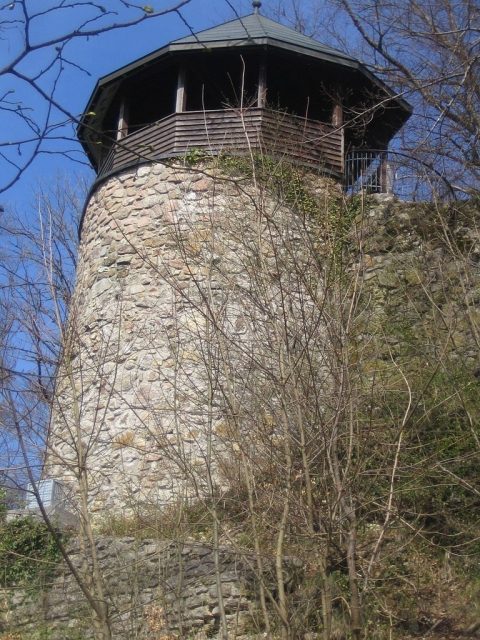
The main castle has a rectangular shape measuring approximately fifty by twenty-five meters. The corners in the south of the complex were equipped with round towers, of which remnants of the round tower located at the south-west corner have been preserved. The palas was located adjacent to the round tower in the south-east. The walls of the main castle are in places up to six meters high and have a wall thickness of up to 2.5 meters. A second wall ring, with the exception of the southern part, surrounded the main castle, whose original access from the south-east was secured with an outer gate. The access to the main castle, which was additionally provided with an inner gate, was located in the east.

Outlying defensive work

The hill on which the castle was built, and which slopes steeply on three sides, offered natural protection against attackers. Additionally, the castle was reinforced with a neck ditch in the north and south. Today, impressive remains of the outer walls of the castle courtyard are still preserved from the former castle complex.

The Lords of Wehr / Werrach

Metz presumes the Lords of Wehr as the builders of the castle, which was probably built in the 12th century. Between 1092 and 1132, an Adalgoz von Werrach, together with members of the high nobility, attested to various property transfers.

Before 1100, the Bishop of Basel, Burkhard von Fenis, had transferred the Vogtship over the monastery of St. Blasien (Black Forest) to Adalgoz. His conduct in office led to the revocation of the Basel Vogtship rights over the monastery in 1125. St. Blasien instead chose the Zähringer Duke Konrad as its protective Vogt.

The Lords of Klingen

Thereafter, the complex was in the possession of Ulrich von Klingen, who bequeathed it, along with the lordship of Wehr, to his son, the famous Minnesinger Walther von Klingen, after his death in 1250. In the feud between Rudolf von Habsburg and the Bishop of Basel, in whose hands the castle was, the complex was besieged and subsequently destroyed in 1256. The Bishop of Basel, Heinrich von Neuenburg (1263-1274), had the castle rebuilt, but shortly after its completion, the castle was again taken by Rudolf von Habsburg in 1272, though not destroyed again. Thus, the castle, lordship, and village of Wehr came into the possession of the House of Habsburg.

The House of Habsburg

From the conquest in 1272 until the transfer to the Grand Duchy of Baden in 1805, the sovereignty over Wehr remained with the Habsburgs, who, however, passed Wehr on as a fief.

Pledged several times in the 13th and 14th centuries, the rising patrician family Vasolt appeared as Vogts of the lordship of Wehr at the beginning of the 14th century. In 1346, Knight Johannes von Staufen received Wehr Castle as a lifelong fief. The Margraves of Rötteln acquired the right of pledge over the castle in 1363.

The Lords of Schönau

In 1365, Rudolf von Schönau, known as Hürus, who fell in the Battle of Sempach in 1386, acquired the castle and lordship of Wehr for 1800 Flemish guilders, which then remained in their hands until 1805.

The Lords of Schönau, elevated to the rank of Freiherr in 1668, later built a castle, the Old Castle Wehr, below the existing castle. From the 16th century onwards, the castle fell into disrepair and was used as a quarry.

Take Mobile History with you

You are reading this text for free. Premium adds what matters on the road: descriptions read aloud, sites found through your camera, whole regions taken offline.

  • Every description, including the ~17,700 Premium sites
  • Audio guide: have descriptions read to you on location
  • AR finder: see sites through your camera, with distance and bearing
  • Unlimited saved sites

14 days free, then from €2.99 a month. Cancel anytime.

Source: Wikipedia · Licence: CC BY-SA 4.0

This description draws on the facts documented in the linked Wikipedia article; Wikipedia content is licensed under CC BY-SA 4.0. Wording and editing: Mobile History.

Location: 47.6278, 7.9108