RuinPreuschen

Wildenberg Castle (Ruin)

Wildenberg Castle (Ruin)

The remains of the Castle can be visited

Wildenberg Castle, also known as Wildenburg, is a Staufer-era castle ruin in the Odenwald and belongs to the village of Preunschen, a district of Kirchzell, in the Lower Franconian district of Miltenberg in Bavaria. The ruin of the hilltop castle is located on a mountain spur of the Schlossberg, projecting to the northeast, above the Mud valley.

The Lords of Dürn, loyal followers of the Staufer emperors and protectors of Amorbach Monastery, are considered the builders of the castle, whose construction is dated between 1180 and around 1200. However, according to the Amorbach monastery chronicle, his grandson Konrad von Dürn (died 1258) only began construction around 1216. This probably refers only to the construction of the gate tower.

In 1271 and 1272, after financial difficulties of the Dürners, the castle was partially sold to the Archbishopric of Mainz and later became the official seat of the Mainz administration, after the Walldürn lordship was completely acquired by Mainz in 1292. Administration was initially carried out by officials, later by a Vogt or Burgrave. In 1291, a Heinrich was an official, around 1320 it was Konrad Rüdt von Collenberg. In 1337, Archbishop Heinrich reconciled with his cathedral chapter and briefly entrusted Wildenberg Castle to the canons. In 1350, the office of the castle was pledged to Eberhard von Rosenberg, in 1354 Konrad Rüdt von Collenberg redeemed the pledge. By increasing his loans to the Archbishopric of Mainz, Konrad also received the offices of Walldürn and Buchen. In 1356, an earthquake is said to have severely damaged the castle. In January of the same year, Archbishop Gerlach pledged Wildenburg Castle, the town of Amorbach, and a rent in Miltenberg to Engelhard von Hirschhorn, without the consent of his cathedral chapter. A year later, he borrowed money from his Wildenburg Burgrave Konrad Rüdt von Collenberg.

From 1368, Wiprecht von Dürn, Eberhardt Rüdt von Bödigheim, Fritz von Dürn, and Eberhard von Fechenbach were Mainz castlemen. In the following period until the 15th century, representatives of these families are mostly mentioned as officials.

Between 1400 and 1511, the castle was expanded again. The west tower and the barrier wall through the castle courtyard were built, and the chapel was renovated. The castle remained the seat of a Mainz official of the Amorbach office until 1525.

During the Peasants' War, peasants from the "bright troop" of Knight Götz von Berlichingen burned down Wildenberg Castle on May 4, 1525. It has been a ruin ever since.

In 1803, it came to the Principality of Leiningen through secularization. In 1806, the Principality of Leiningen was mediatized by the Grand Duchy of Baden. In 1810, the area around Amorbach came to the Grand Duchy of Hesse-Darmstadt and in 1816 to the Kingdom of Bavaria. Today, the castle ruin is a popular hiking destination and is occasionally used for cultural events.

Description+

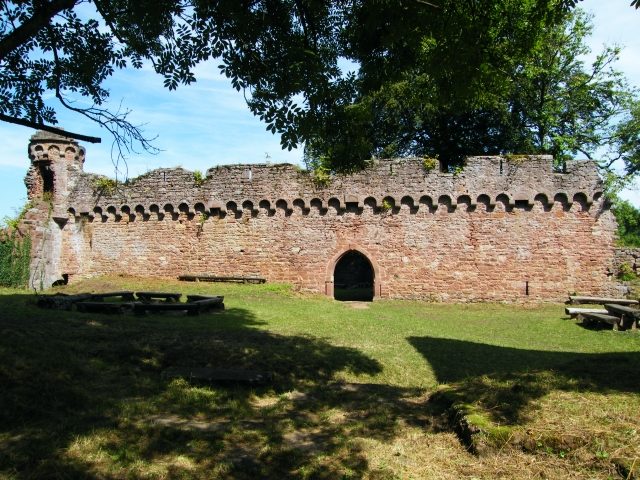
Essentially, the almost rectangular, approximately 80-meter-long Staufer-era core castle, which was hardly altered later, has been preserved. Against the mountain side stands a diagonally placed keep. On the south side is a gate tower with a stepped portal and a chapel with an apse bay window on the upper floor. The spacious palas leans against the valley side. Of high artistic value are the window arcades on the upper floor, which are comparable to those of the Imperial Palace of Gelnhausen and Girbaden Castle in Alsace.

As a post-Staufer addition, a dividing wall in the middle of the castle courtyard is to be noted. Beyond that, there was hardly any further structural change, which is why Wildenberg, despite its ruinous state, can be considered one of the best-preserved Staufer-era castles in Southern Germany.

The castle is rich in various stonemason marks (at least 50 different ones have been identified), some of which can also be found on other castles in the Rhine-Main-Neckar region, e.g., Stolzeneck Castle on the Neckar (and also in the Imperial Palace of Gelnhausen).

Miscellaneous+

Wildenberg Castle is believed to be one of the castles mentioned as Montsalvaesch in Wolfram von Eschenbach's Arthurian romance Parzival, and is interpreted as Heilsberg (Holy Mountain) or wild mountain depending on its linguistic origin.

Take Mobile History with you

You are reading this text for free. Premium adds what matters on the road: descriptions read aloud, sites found through your camera, whole regions taken offline.

  • Every description, including the ~17,700 Premium sites
  • Audio guide: have descriptions read to you on location
  • AR finder: see sites through your camera, with distance and bearing
  • Unlimited saved sites

14 days free, then from €2.99 a month. Cancel anytime.

Source: Wikipedia · Licence: CC BY-SA 4.0

This description draws on the facts documented in the linked Wikipedia article; Wikipedia content is licensed under CC BY-SA 4.0. Wording and editing: Mobile History.

Location: 49.5963, 9.1954