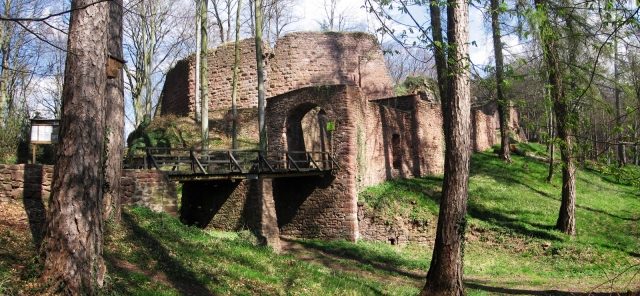
The remains of the Castle can be visited
Wildenstein Castle (Ruin)

The Wildenstein castle ruin belongs to the hamlet of Wildenstein, a district of Eschau in the Lower Franconian district of Miltenberg in Bavaria. The ruin of the hilltop castle is located on the narrow, wooded ridge of the Sommerberg, which extends in an east-west direction from the massif of the Heckberg towards the Elsava valley, between the narrow valleys of the Rechbach (sometimes also called Brunnfloßgraben) and the Aalenbach (which originates in the Hollergrund). The ruin lies on a steep slope to the north and south. The path leads from the hamlet of Wildenstein in winding turns steeply up the southern slope of the ridge and opens at the section of the ring ditch that surrounds the advanced gatehouse. It is the only preserved castle complex in the inner Spessart.
The castle was built around the beginning of the 13th century by the Counts of Rieneck, presumably to protect the Rieneck possessions against the neighboring Mainz electoral towns. It was first mentioned in a document in 1260. In a feud between the Counts and Electoral Mainz and Reinhard I of Hanau, the castle had been taken. A settlement was reached. The Counts of Rieneck were forced to recognize the rights of Mainz and had to promise not to build any more castles in the Spessart area. Nevertheless, they immediately began the construction of castrum Esche (Eschau Castle), against which Mainz protested again. In 1261, a new settlement was reached, in which the brothers Ludwig, Gerhard, and Heinrich of Rieneck pledged not to erect any "Burglichbu" on Mainz territory, after Bishop Wernher of Mainz had destroyed Esche Castle. When the Archbishop then began to build a castle near Eschau himself, the Rieneckers protested. At the same time, they set about restoring Wildenstein Castle. In 1266, another settlement was reached. The Counts of Rieneck promised Archbishop Wernher to pay 500 marks of silver and pledged themselves to the mediator, Count Hermann of Henneberg, for 300 marks with castrum Wildenstein. They also committed to hand over castrum Ronnenbach for demolition. In January 1271, the Counts had to unconditionally submit to the Archbishop of Mainz at a meeting in Aschaffenburg.
To secure themselves against Mainz later, they offered Wildenstein Castle, the villages of Eschau and Kleinheubach, to the Count Palatine of the Rhine as a fief. The castle remained in Rieneck possession until the extinction of the family. It was the seat of the Rieneck bailiff. In 1340, Johann Gundelwin is named as bailiff of Wildenstein, in 1382 a Lord of Fechenbach as noble squire, in 1420 Eberhard Rüed of Kollenberg as castellan. In 1319, the castle was partially pledged. When Count Philipp, who was married to Margareta of Erbach, the last Rienecker, remained childless, Eberhard Schenk of Erbach secured the right of reversion to the Palatine fiefs of the Rieneckers in 1520. In 1559, after Count Philipp's death, the Counts Palatine of the Rhine took possession of Wildenstein Castle as an escheated fief and handed it over to the Counts of Erbach in 1560 as free allodial property. The castle remained the seat of the bailiff under the Counts of Erbach for a time, then was abandoned and left to decay.
Of the Romanesque castle built in the 13th century, the ring wall still stands, its old substance characterized by the large bossed ashlar stones with clamp holes. The gatehouse and the keep are additions from the Gothic period, during which the ring wall was also partially altered. The old, Romanesque castle was a simple complex, protected only by the ring ditch and the mighty ring wall.
Description+
Large parts of the ring wall, the gate, the rectangular keep, as well as a cellar vault and parts of the residential building are preserved from the complex, partly in a dilapidated state. Since 1997, an interest group, which founded the "Burgfreunde Wildenstein e.V." association in 2002, has been working to preserve the castle ruin.
As part of the renovation of the palas, the Archaeological Spessart Project, commissioned by the castle association and with its support, as well as in coordination with the Bavarian State Office for Monument Preservation, carried out construction-accompanying documentation and excavations from April to June 2011. These could also be continued in 2012. One of the results is the finding that the walls of the building were founded directly on the natural rock.
Take Mobile History with you
You are reading this text for free. Premium adds what matters on the road: descriptions read aloud, sites found through your camera, whole regions taken offline.
- Every description, including the ~17,700 Premium sites
- Audio guide: have descriptions read to you on location
- AR finder: see sites through your camera, with distance and bearing
- Unlimited saved sites
14 days free, then from €2.99 a month. Cancel anytime.
Source: Wikipedia · Licence: CC BY-SA 4.0
This description draws on the facts documented in the linked Wikipedia article; Wikipedia content is licensed under CC BY-SA 4.0. Wording and editing: Mobile History.
Location: 49.8286, 9.2928