The Castle can be visited
CastleWeißensee
Runneburg Castle
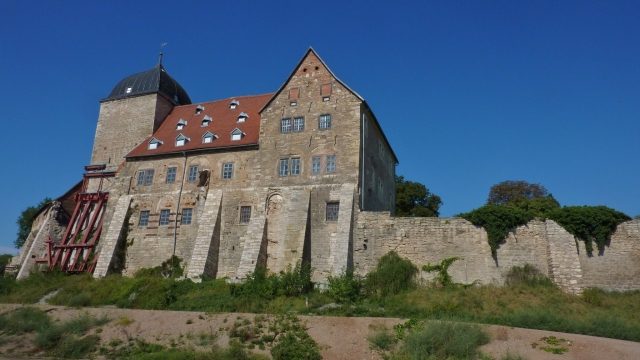
Runneburg Castle in Weißensee, Thuringia, once served as a residence for the Landgraves of Thuringia.
History+
The origins of Runneburg Castle date back to the 12th century. From 1168, Landgravine Jutta Claricia of Thuringia, a half-sister of Emperor Frederick Barbarossa, had the complex expanded into a residence, complete with a two-story palas, a five-story residential tower, a castle gate, and a curtain wall. The castle was first mentioned in a document in 1174 as “Wyssense”. In 1180, the castle was the site of the Battle of Weißensee, where Henry the Lion defeated the Thuringian Landgrave Ludwig III. Later, unsuccessful sieges followed by King Philip of Swabia (1204) and Emperor Otto IV. (1212), who even used a trebuchet. Around 1220, the palas was extended with a festive hall. Landgrave Ludwig IV, the Saint, held a court day at Runneburg in 1225. After the extinction of the Ludowinger dynasty in 1247 and the Hessian-Thuringian War of Succession, the castle fell to Margrave Heinrich III of Meissen. The Wettins frequently used the castle. In 1440, the last Landgrave of Thuringia, Frederick IV, died at Runneburg, which then passed to the Dukes of Saxony. During the German Peasants' War in 1525, the castle denied entry to the rebellious peasants. From 1554, it served as a widow's residence for the Saxon Electors, and in the following centuries, further buildings such as new residential houses (1580/81), a gatehouse (around 1600), and a coach house (1738) were erected. The Romanesque keep had to be demolished around 1750 due to dilapidation.
Source: Wikipedia · Licence: CC BY-SA 4.0 · Image: Joachim Schneeleopard
This description draws on the facts documented in the linked Wikipedia article; Wikipedia content is licensed under CC BY-SA 4.0. Wording and editing: Mobile History.
Location: 51.2003, 11.0622