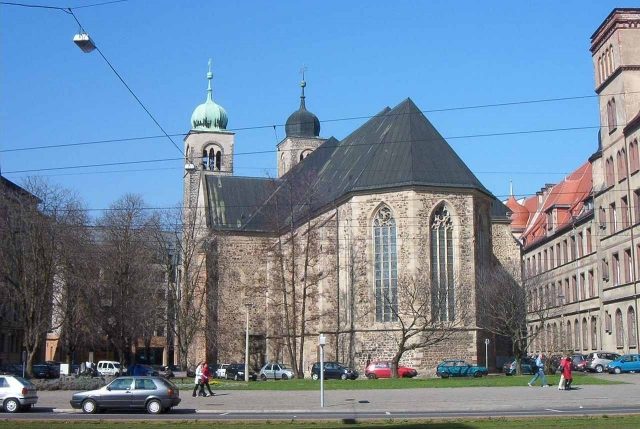
CathedralMagdeburg

Sankt-Sebastian-Church

Sankt-Sebastian-Church

The church can be visited

The Saint Sebastian Church (Cathedral of St. Sebastian) in Magdeburg is a Roman Catholic cathedral church dedicated to Saint Sebastian in Magdeburg's Old Town. It is part of the Romanesque Road.

Foundation

The cornerstone was laid around 1015 by Archbishop Gero, who was buried in the church after his death in 1022. It was founded as a collegiate church. In addition to Saint Sebastian, the collegiate church was originally also dedicated to John the Evangelist and Saint Fabian. After acquiring the head relic of Saint Sebastian, the other patrons lost significance. On the occasion of the approach of Henry IV's army, the relic was carried along the border of the Archdiocese of Magdeburg. In later years, a procession with the relic from the Cathedral to St. Sebastian's Church took place every year on January 20. After several structural extensions, the Romanesque church building burned down in 1188 and 1207.

Gothic Reconstruction

In the first half of the 14th century, the church was rebuilt in the Gothic style. The old choir, probably dating from Gero's time, was demolished and replaced by a new, larger one. At the beginning of the 15th century, the nave was redesigned with the aim of creating a late Gothic hall church. The Romanesque floor plan was retained. On May 17, 1489, the church was re-consecrated by Archbishop Ernst after the completion of the renovations.

During the siege of the city of Magdeburg by Maurice of Saxony in 1550, cannons were placed on the church towers for defense.

Reformation

In the course of the Reformation, the canons of St. Sebastian renounced the Catholic faith in 1558. St. Sebastian became Protestant. In 1573, the collegiate church was converted into a Protestant foundation. On the first Sunday of Advent 1573, the cathedral preacher Siegfried Sack held the first Protestant service. From 1573 to 1609, Georg Rollenhagen held the office of preacher at St. Sebastian.

Destruction in the Thirty Years' War

During the storming of Magdeburg in the Thirty Years' War on May 10, 1631, the church burned down. As late as 1642, it was listed as a ruin. In 1663, the choir was rebuilt and a wooden ceiling in the form of a vault was installed. It was not until 61 years after the destruction that the first service took place in 1692. A cloister originally located north of the church fell into disrepair and was then used as a cemetery. This is evidenced by the street name Friedhof (Cemetery), which existed until after the Second World War.

Burials of respected citizens also took place inside the church.

Use as a Magazine

From 1756, no more services took place. The church served as a magazine. At the end of the 18th century, Gero's tombstone disappeared from the choir. During the French occupation, the collegiate church was dissolved in 1810. The building served the French military as a field forge and a warehouse for beer, brandy, and salt. From 1823, the church was owned by the city of Magdeburg and was used as a wool warehouse.

Renewed Religious Use

The choir of the church found religious use again between 1845 and 1854 by the German Catholics. In 1873, St. Sebastian became the parish church of the Roman Catholic community. A renovation and the construction of new stone vaults took place.

After World War II

During World War II, the church was damaged in an air raid. By 1946, the damage to the nave had been repaired. Since the other inner-city churches were heavily damaged, there was initially a shared use by the various denominations. Later, the towers were repaired.

From 1949, St. Sebastian served as the bishop's church of the auxiliary bishop of the Archdiocese of Paderborn. Extensive restorations took place in the years 1953 to 1959 and 1982 to 1991. A bishop's crypt was newly built.

In 1994, Magdeburg again became an independent Catholic diocese. St. Sebastian became the cathedral of the newly established Diocese of Magdeburg and the seat of the Magdeburg Cathedral Chapter. In 2005, further construction measures at the cathedral were completed.

The interior was redesigned, a covered cloister was added, as well as a new sacristy building and a chapter cemetery. The altar island was partly redesigned, a new folk altar was erected, in which there is a tooth relic of St. Sebastian, which comes from the skull relic of the Vienna Schottenabtei of the Benedictines and was sent for the altar consecration. During the construction measures, a youth room was built above the existing flower sacristy and confession chapel. In 2007, Cathedral Canon Ulrich Lieb consecrated a room in the west portal, which serves for silent remembrance of deceased children.

Interior Furnishings+

Organ

In 2005, the Eule company built a new organ as Opus 637. The instrument was largely designed in a Central German classical and Central German romantic style, supplemented by some registers in a French symphonic style. It has 56 stops on three manuals and pedal.

Bishops and Clergy+

Since the re-establishment of the Diocese of Magdeburg in 1994, St. Sebastian's Cathedral has been the home of Bishop Leo Nowak, who retired in 2005, and since 2005, Bishop Gerhard Feige. The head of the parish and the Magdeburg-Mitte parish cluster is Provost Josef Kuschel, Cathedral Canon, supported by the auxiliaries (cooperators) and a deacon.

On May 2, 2010, the Cathedral Parish of St. Sebastian was established from the Magdeburg Mitte parish cluster. At the same time, the existing parishes of Provostry St. Sebastian, Parish St. Norbert, Magdeburg-Bucka, Parish St. Adalbert, Magdeburg-Reform and Parish St. Johannes-Baptist, Magdeburg-Südost were dissolved and integrated as sub-parishes into the new parish. On August 1, 2010, the leadership of the parish was transferred to Cathedral Provost Reinhold Pfafferodt, who is thus also the Cathedral Parish Priest. For the pastoral care of the parish, Vicar (Chr.Kobert), community assistant (Sr.Teresa), cooperators, auxiliaries and deacons are active.

Take Mobile History with you

You are reading this text for free. Premium adds what matters on the road: descriptions read aloud, sites found through your camera, whole regions taken offline.

  • Every description, including the ~17,700 Premium sites
  • Audio guide: have descriptions read to you on location
  • AR finder: see sites through your camera, with distance and bearing
  • Unlimited saved sites

14 days free, then from €2.99 a month. Cancel anytime.

Source: Wikipedia · Licence: CC BY-SA 4.0 · Image: http://commons.wikimedia.org/wiki/File:Sankt_Sebastian_Magdeburg.jpg?uselang=de

This description draws on the facts documented in the linked Wikipedia article; Wikipedia content is licensed under CC BY-SA 4.0. Wording and editing: Mobile History.

Location: 52.1264, 11.6315