School
Schelmenburg Castle (Bergen-Enkheim)

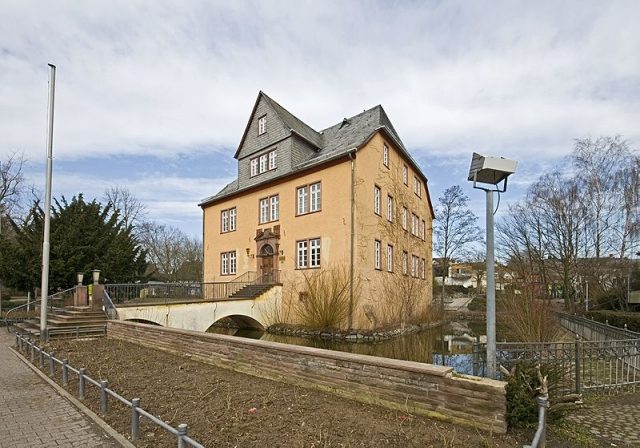
The Schelmenburg, also known as Schelmenschloss or Gruckau, was a medieval moated castle in what is now Frankfurt-Bergen-Enkheim in Hesse. For several centuries, it was the ancestral seat of the Schelme von Bergen family. Today, a Baroque moated castle, built in 1700 on the foundations of the former core castle, remains of the Schelmenburg.
Formerly located on the northwestern edge of the medieval village center of Bergen, the Schelmenburg is now in the center between the streets "Am Weißen Turm" and "Marktstraße" west of the town hall, inaugurated in 1978. On the southern slope below the Berger Warte and not far from a crossroads of the Hohe Straße that has existed since Roman times, the site had strategic importance in the High Middle Ages. In the absence of a natural elevation for defense, the castle was secured by a moat, which seems unusual at about 80 m above the level of the Main. Several springs above provided water, which was drained in a covered canal to the south towards Marktstraße.
Origin
Due to centuries of later overbuilding, there are few architectural-historical or archaeological sources regarding the origin of the Schelmenburg. A terminus ante quem results from the first mention of a Schelm von Bergen in 1194.
Particularly in older and local history works, a Roman fort and a Frankish fortification were suspected as predecessors. However, several recent archaeological investigations could not confirm this, so the existence of a fort is no longer recognized in archaeological research due to a lack of fort findings. Finds of early legionary bricks are attributed as secondary use to several Roman villae rusticae proven in the Bergen area, including especially the extensively excavated complex "Auf dem Keller" north of Bergen. An archaeological investigation in the area of two un-basemented rooms in the main building of the Schelmenburg in 2001 provided evidence of a wooden motte castle from the 12th or 13th century as the earliest verifiable complex.
The Schelmenburg probably originated, like numerous castles in the Frankfurt area, during the time of Emperor Barbarossa. In addition to larger imperial castles such as Friedberg or Münzenberg, smaller complexes such as Burg Vilbel, Burg Dorfelden, Burg Wachenbuchen, or the Schelmenburg also secured the land.
High Middle Ages
Although located outside the fortifications of Bergen, the history of the castle is closely linked to that of the village. In 1272, Werner Schelm von Bergen received part of the tithe in Bergen as a fief from the Lords of Eppstein, and in 1274 another part from the Bartholomäusstift.
The resident noble family of the Schelme von Bergen initially appeared as imperial vassals or imperial knights. However, the village of Bergen, along with the Bornheimerberg district, increasingly came under the control of the Lords and Counts of Hanau, who had rights in Bergen since 1269. In 1354, the Schelmen von Bergen were forced to enter the service of Ulrich III von Hanau as vassals and receive the castle as a fief. Presumably, a stone extension is related to this change of ownership, as the castle is subsequently referred to as a "fortified house". In 1357, the village of Bergen finally came to Hanau as an imperial pledge.
The decline in power of the noble family subsequently led to robbery, as was the case with so many members of the knightly class. Victims were often merchants traveling on the nearby trade route to or from Frankfurt am Main. Therefore, the Schelme increasingly came into conflict with the city of Frankfurt. In the course of a feud, Frankfurt occupied the castle in the winter of 1381/82 without significant resistance, as the moat was frozen, and again in 1389 at the instigation of the Rhenish League of Cities. Sibold and Gerlach Schelm had to swear an oath of fealty and serve the city for two months annually. In addition, the city reserved the right of access. However, with the Kronberg Feud in 1389, Ulrich IV von Hanau succeeded in freeing his vassals from their obligations.
Between 1500 and 1520, Adam Schelm von Bergen had an outer moat built, which now also protected the castle's outbuildings. Their outer walls were reinforced and provided with loopholes. However, the defensive value of the complex is likely to have been low, especially since the owners could hardly afford a number of mercenaries appropriate to the new size. The safest refuge in the castle was still the stone residential building in the main moat.
Modern Era
With the loss of its military function, the Schelmenburg increasingly became a manor. The complex only underwent major changes again with Friedrich Adolph Schelm zu Bergen. He had served at the Heidelberg court in the service of the Elector Palatine. In 1672, Friedrich Wilhelm, the "Great Elector," requested quarters in Bergen during the Dutch War. Since the moated castle of Gruckau no longer met the expectations of that time, the Elector had to lodge in Bergen. This event may have given the impetus for Friedrich Adolph to have the main building demolished down to the cellar over a construction period of more than ten years and to have the Baroque castle that still exists today erected on it. The moat and the bridge remained.
Friedrich Adolph also had a sandstone relief placed at the entrance to the castle, showing the double-headed imperial eagle with the inscription "SVB VMBRA ALARVM TVARVM", probably an indication that he had not entered Hanau service and considered himself a free imperial knight.
With the extinction of the Schelme von Bergen in the 19th century, the Schelmenburg had finally become a larger farm, and the castle building a manor house. In 1830, Johann Georg Kalbhenn acquired the entire property. In 1850, Kalbhenn moved the courtyard gate from Siboldsgäßchen to its current location, the outbuildings in the castle courtyard were demolished or built over in the 19th and 20th centuries, and the outer moat was filled in as early as 1840. In the 20th century, the castle was also called Schillingshof or Bickelhof after its then owners. In 1942, the municipality of Bergen-Enkheim acquired the property for 100,000 Reichsmark, but continued to lease the building, and the farm was used for agriculture until 1962. After extensive renovation, the mayor's office and parts of the municipal administration moved in in 1967. After 1977, a social welfare office was located here, later the municipal library and club rooms. Today, the castle houses the youth music school and the club association. Part of the building is again in great need of renovation.
The surrounding area, including the former castle garden, was largely built over after the Second World War with new buildings, including larger residential buildings for refugees from the East (1951), the Bergen Town Hall (1978), and a savings bank.
In 2000, a renovation measure had to be carried out due to penetrating moisture in the core castle. It allowed the area to be archaeologically investigated, which provided further insights into the building history of the Schelmenburg.
Complex+
The presumed medieval ground plan of the Schelmenburg strongly resembles that of nearby fortified noble estates in the Frankfurt area, such as Hof Goldstein, Kühhornshof, or Holzhausenschlösschen. Archaeological evidence suggests a motte-and-bailey castle as its origin.
Main Building
The only remaining part of the Schelmenburg is the Baroque moated castle with a building inscription from 1700, which was built on the foundations of the former core castle. According to archaeological evidence, the footprint of the building has not changed since the construction of the fortified house. The northern part (about one third) is currently un-basemented and probably corresponded to the former motte. Between the two cellar rooms is a Romanesque round arch.
The current three-story building measures 16 (front and back) x 18 meters (sides). It has a hipped roof covered with slate and dormer windows centrally placed on the front and back. The current condition dates back to the alterations around 1700. Several construction phases have been proven to have existed before, starting with a motte-and-bailey castle, which was replaced by an at least partially two-story half-timbered building. With the change of feudal lordship in 1354, the complex was expanded by the financially stronger Lords of Hanau into a fortified house. Finds of stove tiles prove a representative design inside. Further alterations followed in the 16th century, until the complex acquired its current appearance around 1700.
Both the core castle and the subsequent building were accessible via a bridge from the castle courtyard, which initially only spanned half of the moat; the part directly adjacent to the building had an easily removable wooden plank construction. Today, the bridge has two arches.
The showpiece of the building is the Renaissance portal made of red sandstone, which may have been reused. It was opened upwards, creating a Baroque broken pediment. Inside is a cartouche with an inscription, to the left of it the coat of arms of the Schelme von Bergen with the two ribs, and to the right that of the Lords of Venningen with two crossed lilies.Castle Courtyard and Outbuildings
The castle courtyard, significantly larger in relation to the core castle, contained numerous outbuildings and was probably hardly fortified until the construction of the outer moat in the 16th century. In the event of armed conflicts, only the core castle offered protection to the inhabitants. Various stables, barns, gardens, and a brewery (demolished around 1820) were grouped around the courtyard located southwest of the core castle. The right to brew beer was associated with the Schelmenburg courtyard. The "Schelmenbräu" was brewed by later owners in Bergen until the First World War.
Moats
Striking at the elevated position, which slopes south towards the Main valley, is the conception of the Schelmenburg as a moated castle. The moats were fed by several strong springs north of the complex. The moat drained south in an underground canal to Marktstraße, where it reappeared as the Schelmenquelle before leading down through the Mühlbachschlucht. However, the water was undrinkable due to the swampy and muddy moat and contamination from the latrine bay. The castle's water supply was ensured by a well in the cellar of the core castle and two others in the outer bailey (brewery and stable).
With the renovation of the complex in the 1960s, the moat was then dredged, partially filled with gravel, and lined with basalt stones. During the work, a dagger, a crossbow bolt, and a rider's spur were found, which were handed over to the local history museum.
Take Mobile History with you
You are reading this text for free. Premium adds what matters on the road: descriptions read aloud, sites found through your camera, whole regions taken offline.
- Every description, including the ~17,700 Premium sites
- Audio guide: have descriptions read to you on location
- AR finder: see sites through your camera, with distance and bearing
- Unlimited saved sites
14 days free, then from €2.99 a month. Cancel anytime.
Source: Wikipedia · Licence: CC BY-SA 4.0
This description draws on the facts documented in the linked Wikipedia article; Wikipedia content is licensed under CC BY-SA 4.0. Wording and editing: Mobile History.
Location: 50.1559, 8.7516