CastleAgathenburg

Agathenburg Castle

Agathenburg Castle

Cultural Events
Conference center


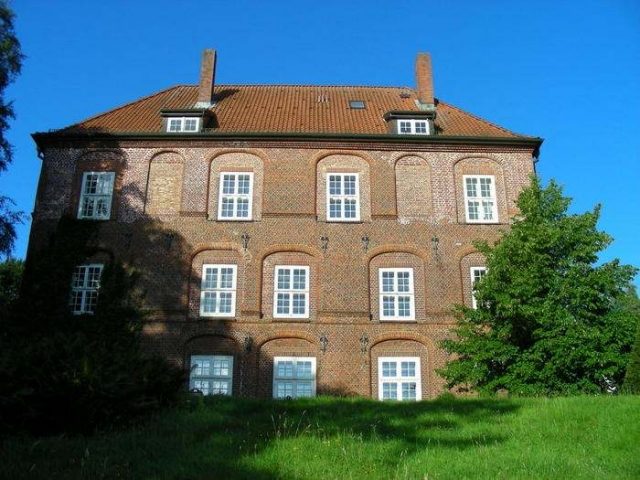
Agathenburg Castle in Agathenburg near Stade in northern Lower Saxony was the country seat of Count Hans Christoph von Königsmarck. The Renaissance castle now serves as a cultural center.

The History of Agathenburg Castle

Hans Christoph von Königsmarck was a successful military leader in the Thirty Years' War. In recognition of his successes, he was granted the title of Count by the Swedish Queen and appointed Governor-General of the Duchies of Bremen-Verden. He chose Stade as the administrative seat for this task, and in the neighboring village of Lieth, he built a small country castle. Agathenburg was named after Königsmarck's wife, Agathe von Leesten, and the name of the castle was transferred to the village. Those who ignored the new name of the village were allegedly punished with a riding whip, while those who used it correctly were said to have been rewarded with a thaler.

Construction work on the castle was completed in 1655, but the Count could only rarely inhabit the building. From 1656 to 1660, Königsmarck was imprisoned by Brandenburg-Prussia, and in 1663, he finally died of blood poisoning. The castle served as his wife's main residence. After her death in 1671, it remained in the possession of the Königsmarck family until 1694; Aurora von Königsmarck spent a large part of her childhood here. The first heir to the castle was Otto Wilhelm. His wife, Catharina Charlotta de la Gardie, used the castle as a widow's residence after his death, just like her mother-in-law. Her husband's nephew, Philipp Christoph, was the actual heir to the castle, but he was accused of an affair with Sophie Dorothea of Brunswick-Lüneburg and murdered in 1694. After Catharina's death, the inheritance question regarding the Agathenburg property remained unresolved. In 1740, the Electorate of Hanover acquired the castle and, from 1753 – after Swedish rule had ended – made it available to the respective bailiff as a seat for the administration of Stade.

In 1866, the Kingdom of Hanover became the Prussian province of Hanover, and the castle, along with its lands, was auctioned off. In 1881, farmer Hans Wilkens acquired the building after his farm was sacrificed for the construction of the Hamburg-Cuxhaven railway. The castle, which now became the center of an estate, remained in family ownership for almost 100 years. On April 26, 1921, a fire broke out and severely damaged the castle; only the heavy outer walls and the stair tower withstood the flames. The interiors burned out. In the following years, the damage was repaired, and the building was largely restored. Sophie zum Felde, the last owner of the castle, bequeathed the building to the Stade Local History and Heritage Association.

Current Use

In 1985, the district of Stade took over the estate. The restoration between 1990 and 1993 was significantly supported by the Lower Saxony Foundation. From 1991 to 2004, Agathenburg Castle was exclusively managed by the district of Stade. The Cultural Foundation was established by the district of Stade in 1992 and was responsible for the cultural program at the castle. It is now the patron of the entire castle complex.

In its meeting in June 2004, the District Council of Stade decided to make Agathenburg Castle independent. Since then, all castle-related tasks have been managed directly from here. This autonomous action is largely made possible by the district of Stade, which provides the funds previously allocated in the district's budget for the castle as a subsidy to the Cultural Foundation for its own budget management. Today, the castle is used as a cultural center. The Cultural Foundation offers an extraordinary program with exhibitions of contemporary art, concerts from classical to jazz, readings, and writing workshops. There is a café and a museum shop. The castle's rooms and the horse stable can be rented for conferences and celebrations.

Outlook

In 2010, the Agathenburg Castle Cultural Foundation, with funds from the European Regional Development Fund, will, in addition to the established innovative cultural program of the house, present an experience-oriented permanent exhibition to convey the history of the house and its inhabitants.

The Castle Area+

The Castle Building

The castle is built in the restrained forms of the Nordic Renaissance. The three-story, cuboid building is made entirely of brick, the courtyard side is emphasized in the middle by a polygonal stair tower, and the facades are decorated with blind arcades. The north side once had another tower extension serving as a latrine bay, but this was not restored after the fire. The most striking ornament of the building is the portal made of sandstone. The asymmetrical arrangement of the windows corresponds to the layout of the interior rooms; the symmetry of the approaching Baroque was not yet used in Agathenburg's facades. Due to the fire in 1921, the castle's furnishings are not completely original. The spire was also only added after the fire; originally, the tower only reached the third floor and had a balcony-like viewing platform here. Noteworthy features include the vaulted cellar supported by heavy columns, the 18th-century tiled stoves, and the lord's hall on the first floor. The preserved 17th-century cellar vault will be extensively renovated starting in 2010, and the addition of an elevator will make the entire castle barrier-free for the first time.

The courtyard side was originally surrounded by a gatehouse, a stable, and servants' quarters, which formed a kind of courtyard of honor. However, these buildings have been demolished over time. The large horse stable, which is now to the left of the castle, was only moved to this location in 1881 during the conversion work into a country estate.

The Castle Park

The castle stands above a steep geest slope, and from the terrace on the north side, there is a wide view over the Elbe marsh. It once had a large park. Below the complex was a four-part Baroque garden surrounded by moats. This was largely destroyed during the construction of the railway, and the remains were subsequently no longer maintained. On the slope below the east facade was a terraced garden laid out in several stages.

In front of the castle is a walled kitchen garden surrounded by hedges, which today recalls the former Baroque parterre. The further areas of the castle park were laid out as a landscape garden, where, among other things, the relics of the castle cemetery can be found. The landscape park almost completely dispenses with the usual sightlines and lawns and conveys an enchanted impression with its dense vegetation.

The Sculpture Park

Sculptures by contemporary artists are displayed throughout the park grounds. Since 1991, Kreissparkasse Stade has pursued the concept of building a sculpture collection in the park of Agathenburg Castle. Initially, one sculpture was selected from the annually organized solo or group exhibitions with renowned artists for permanent display in the castle park.

The background of all exhibitions and the remaining sculptures is to provide a forum for contemporary art in rural areas and to introduce a broad audience to the diverse and rich worlds of experience that art can open up through its presentation in a publicly accessible park. The aim is also to reach people who have not yet come to art. This goal is directed at both residents and visitors of the district of Stade and the Lower Elbe region.

The conceptual approach of the sculpture park consistently addresses the challenge of expanding the traditional boundaries of sculpture in an experimental project and opening up new spheres of activity for young artists.

Take Mobile History with you

You are reading this text for free. Premium adds what matters on the road: descriptions read aloud, sites found through your camera, whole regions taken offline.

  • Every description, including the ~17,700 Premium sites
  • Audio guide: have descriptions read to you on location
  • AR finder: see sites through your camera, with distance and bearing
  • Unlimited saved sites

14 days free, then from €2.99 a month. Cancel anytime.

Source: Wikipedia · Licence: CC BY-SA 4.0 · Image: http://www.wehrbauten.de/thread.php?threadid=609

This description draws on the facts documented in the linked Wikipedia article; Wikipedia content is licensed under CC BY-SA 4.0. Wording and editing: Mobile History.

Location: 53.5617, 9.5346