To be privately owned
Ainwalding Castle
Ainwalding Castle is located in the eponymous district of the municipality of Ungenach in the Vöcklabruck district of Upper Austria (Ainwalding 2).
The castle was first mentioned in 1355 with Gottschalk Aboltinger (Anwaltinger), a knight obligated to Starhemberg Castle. In 1375, Ulrich Ainwalding is mentioned, around 1400, a Wernhart is listed, later Seyfried and Konrad Ainwalding are named, and in 1443, the seat was owned by Leonhart Ainwalding. In 1467, Emperor Frederick III enfeoffed Tibold Aspan and his brother Siegmund Anwaldinger with the seat. In 1515, Hieronymus Anwaltinger followed. An Alexander Anwaltinger is considered the last of the family at Ainwalding; he still documented the sale of a farm in 1538. He was married to Amalia Ennenkl, who died as a widow in 1566.
In 1574, Ainwalding was owned by Hanns von Fuerttenbach. In 1648, Ainwalding then came into the possession of Tobias Nütz von Goisernburg, who also owned the lordship of Wartenburg. The free noble and unfeoffed seat was then sold to the administrator Matthias Adam Ramspeckh and his wife Maria Dorothea. The old castle had become dilapidated, was demolished, and then rebuilt.
In 1699, the noble estate passed to the administrator of Ort Castle, Wolfgang Moser. His daughter Maria Katharina, married to Karl Ehrmann von Falkenau, sold Ainwalding in 1722 to her brother Wolf Karl Moser, administrator at Waxenberg. In 1730, the new owner of the lordship of Wartenburg, Johann Albrecht Reichsgraf St. Julien, bought back the noble estate along with the manorial property. He was followed in 1754 by Johann Ignaz von Gehlen. In 1789, Johann Georg Grechtler, who had been the owner of the castle since 1766, sold the seat to Baron Thaddäus von Reischach, who was also the owner of Wolfsegg Castle at the time. In 1774, Ainwalding was inherited and removed from the land register. In 1847, Ludwig von Ratzenberg acquired the seat. In 1856, the castle partially burned down.
In 1866, the estate passed into peasant ownership. In 1880, under the Neumayr family, Ainwalding became an inn; the current owner is Adolf Neumayr.
Ainwalding Castle then and now+
In Georg Matthäus Vischer's engraving from 1674, Ainwalding appears as a three-story building with a tent roof and a mighty corner tower, covered by an onion dome with a lantern. A detached farmstead, along with the castle, is enclosed by a palisade fence. Within the enclosed area, fields lay behind the castle, while rows of trees stood in front of it.
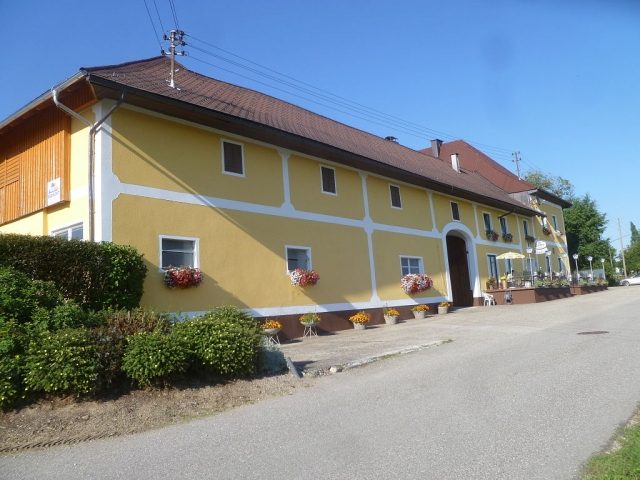
Today, the castle's tower and one floor have been removed. The wrought-iron window baskets that were previously present have disappeared. In the meantime, the castle and the detached farmstead have grown together into a single building complex. The front part of the building houses the Gasthof Neumayr; old vaults can still be found in the building. Next to the building is a newly built chapel from 1999.
Take Mobile History with you
You are reading this text for free. Premium adds what matters on the road: descriptions read aloud, sites found through your camera, whole regions taken offline.
- Every description, including the ~17,700 Premium sites
- Audio guide: have descriptions read to you on location
- AR finder: see sites through your camera, with distance and bearing
- Unlimited saved sites
14 days free, then from €2.99 a month. Cancel anytime.
Source: Wikipedia · Licence: CC BY-SA 4.0 · Image: http://commons.wikimedia.org/wiki/File:Ainwalding-1.JPG
This description draws on the facts documented in the linked Wikipedia article; Wikipedia content is licensed under CC BY-SA 4.0. Wording and editing: Mobile History.
Location: 48.0623, 13.6103