To be privately owned
CastleAistersheim
Aistersheim Castle
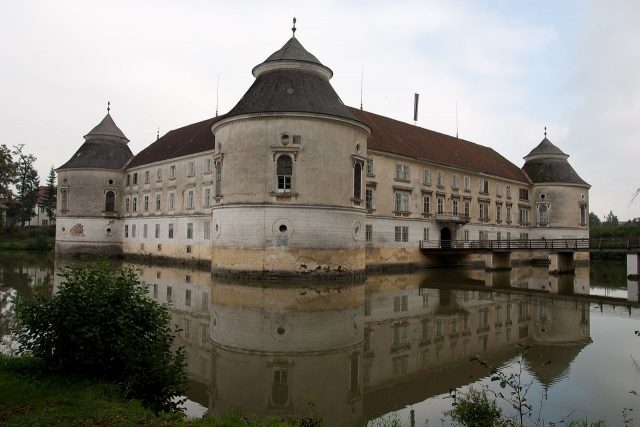
Aistersheim Castle, a late Renaissance moated castle, stands in the village of the same name in Upper Austria. Its history is marked by armed conflicts and the changing fortunes of noble families who shaped the building over centuries.
History+
The first documented mention of Aistersheim Castle dates back to 1159, when Dietmar von Aistersheim, a ministerialis of the Styrian Otakars, was named as its owner. The original castle served as a border fortress to Bavaria. It remained in the possession of the Lords of Aistersheim until 1426, when Heinrich von Aistersheim, the last of his lineage, died. In 1464, Hanns von Hohenfeld acquired the lordship, but just seven years later, the medieval moated castle was destroyed by modern gunpowder artillery during the Liechtenstein Feud. After makeshift repairs, a complete new construction took place in the second half of the 16th century. Achaz von Hohenfeld, a knightly estate representative, is considered the main builder of today's late Renaissance castle, which was completed around 1600. During the Counter-Reformation, Otto Achaz von Hohenfeld refused to pay homage to Emperor Ferdinand II in 1619, whereupon Tilly's troops besieged and captured the castle. During the Upper Austrian Peasant War, Aistersheim served as a center of resistance and, after Fadingers death, became the headquarters of Achaz Wiellinger von der Au.
Source: Wikipedia · Licence: CC BY-SA 4.0 · Image: http://commons.wikimedia.org/wiki/File:Wasserschloss_Aistersheim.jpg
This description draws on the facts documented in the linked Wikipedia article; Wikipedia content is licensed under CC BY-SA 4.0. Wording and editing: Mobile History.
Location: 48.1864, 13.7399