To be privately owned
Allach Castle

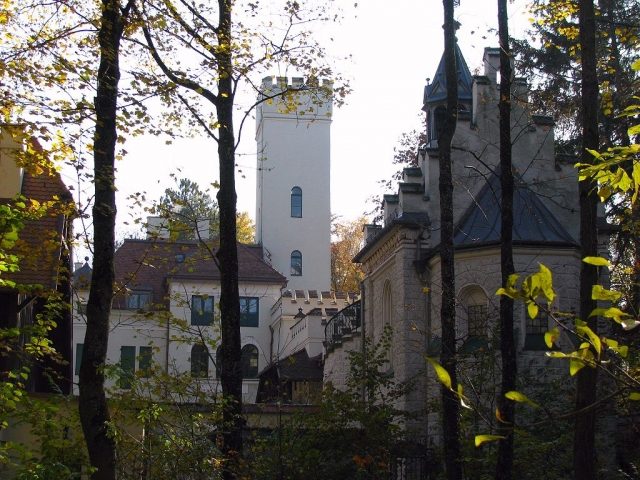
Allach Castle (also Gilmer Castle, Hauser Castle, Waldeck Castle, Karlsfeld Castle, popularly also Neuschwanstein in the Dachau Moor) is a castle complex with a gatehouse, main building, and chapel with a Romanesque-Gothic character and a turbulent history. The castle is surrounded on three sides by a park and its fourth side is directly on the bank of the Würm Canal. Lorenz Hauser, known as the "Millionaire Builder of Neuhausen," had it built in 1899/1900 on a 50,000 m² (five hectare) plot of land, which has been located in the Munich district of Allach, directly on the city limits of Karlsfeld, since 1938. It is not accessible to the public.
In January 1897, Lorenz Hauser submitted a building application for a "hunting lodge" to the responsible municipality of Allach. However, construction only began in 1899 according to plans by Max Knörnschild, after Hauser had submitted a new building application, this time for the "erection of a villa." What happened on the construction site in those two years is not known; it is said that the builder had the shell of the building torn down twice because it did not meet his ideas of a hunting lodge. The construction price, contrary to statements often made at the time, was not 1½ to 2 million Marks, but 500,000 Marks, which was still an extraordinarily high amount at that time.
After the completion of the main building, which was luxuriously furnished, Hauser had a Neo-Romanesque chapel with a connecting building to the manor house, a stable and servants' building with a tower, and a gatehouse built in 1900. These additional buildings were designed and built by the Rank brothers.
From March 1902 to July 1904, Lorenz Hauser had his main residence in the castle, in addition to another residence in Munich's Zweibrückenstraße. During this time, numerous and extravagant parties were held at the castle, which contributed to the somewhat disreputable reputation of the lord of the castle. From 1904 to 1908, he only stayed at his castle sporadically. On March 7, 1908, he sold the entire complex, with an area of 8.6 hectares, to the Imperial and Royal Chamberlain and Reserve Cavalry Captain Count Alexander von Boos zu Waldeck und Montfort and his wife. Hauser had already given it the name Waldeck, so the coincidence is accidental. The purchase price was 303,000 Marks.
In 1910, the Count had a living room extension built onto the gatehouse, but he already sold the property again in April 1911 for 336,000 Marks to the Munich master builder Michael Heizer. In January 1912, the latter sold it for 436,000 Marks to the Strasbourg merchant Josef Schweissheimer. For 340,000 Marks, a sacristan Abraham from Grabenstätt bought it in August of the same year. He became insolvent, so the castle was foreclosed. The new owner in August 1915 was again Lorenz Hauser, who received the bid for 111,000 Marks and who resold it in May 1916 for 190,000 Marks to the wholesale merchant Eduard Hagedorn. He intended to use the castle for himself and commissioned the renowned Munich architect Oswald Schiller with renovation work. The basement was restored, the attic and the former private rooms of Lorenz Hauser were redesigned. In the course of political upheavals in Bavaria in the spring of 1919, during which Prime Minister Kurt Eisner was murdered, violent clashes between warring factions occurred, during which the castle was also conquered and plundered. The Hagedorn family, who had previously fled, returned after the unrest. An official valuation of the castle and park in 1920 resulted in 180,000 Marks.
Merchant Hagedorn's economic situation steadily worsened from 1926, so that in 1931 the castle was to be foreclosed again. However, this only happened in July 1936. In the meantime, the grounds served as a backdrop for the film Schloß Vogelöd. For 80,000 Reichsmarks, the head of a surgical clinic in Munich's Herzog-Wilhelm-Straße, Ludwig Gilmer, acquired the castle and property, which had grown to 12.6 hectares due to additional purchases. An official estimate from October 1936 indicates a value of 130,000 Reichsmarks. At this time, the castle was in great need of renovation; Gilmer had these works carried out by the architect John H. Rosenthal. The mayor of Allach was bothered by the Jewish origin of the architect and asked the castle administrator to "immediately remedy this grievance." However, nothing is known about the success of this request. In 1938, Allach was incorporated into Munich. At this time, Gilmer Castle, as the name of the building has largely remained in Allach and Karlsfeld to this day, was added to the list of protected monuments.
When Bayerische Motorenwerke settled in the neighborhood, Ludwig Gilmer sold the property, which he had actually intended as his retirement home, to this company in 1942 for 119,500 Reichsmarks. During World War II, the castle was camouflaged and used for military purposes. Later, a military hospital was set up there. After the end of the war, US soldiers quartered themselves in the castle. Franz Schröther writes about this in his biography of Lorenz Hauser: "They founded a hunting and fishing club, shot the game, fished the lake empty, and held parties in the building. During a barbecue held in the castle's entrance hall, a fire broke out, which almost burned down the building." When the Americans left the castle in 1955, it was in a ruinous state.
The entire site was sold on April 28, 1955, to Maschinenfabrik Augsburg-Nürnberg (MAN), which still owns the castle today. The traces of the war were removed with great effort, and the building was completely renovated. Today, it serves MAN Nutzfahrzeuge AG as a reception venue and guesthouse for important personalities. The park is entirely part of the MAN company premises.
In 2008 and 2009, the original room layout on the first floor was restored, particularly affecting Lorenz Hauser's former private rooms. Externally, the castle had largely remained in its original condition.
Description+
The main building of the castle complex consists of a three-story main building adorned with coats of arms and knight figures, topped by a five-story crenellated tower. Furthermore, many symbolic attributes such as lion heads, Medusa heads, dragons, bats, or other flying animals can be found on the exterior. Lorenz Hauser also had himself depicted, for example, as a monk holding a money bag. A sundial, a sculpture of "Diana with the Stag," and two sphinxes are no longer present. The terrace is bordered by a wrought-iron three-part Art Nouveau railing.
In the representative, central staircase hall, which has remained unchanged to this day, there is a ceiling painting by Johann Schaschko titled "Phoebus in the Sun Chariot" as well as frescoes by Johann Schaschko and Walter Heubach, alongside many other motifs from Greek mythology. On the ground floor, there is an "Apostle Room," a music room, and a marble room with a fountain. The wine cellar is located in the basement, as was the castle kitchen, from where food could be transported to the ground floor via an elevator. The first floor housed Lorenz Hauser's private rooms, and the second floor contained the guest rooms, originally furnished in a rustic style, and the staff quarters. None of the castle's furnishings have been preserved.
The castle chapel, dedicated to Hauser's patron saint, Saint Lawrence, has an octagonal bell tower with the Lawrence and Mary bells. The chapel is characterized by an unusual room layout: the decoratively furnished church interior is on the first floor, while the sacristy is below. Previously, there was a bridge over the Würm Canal to allow neighboring residents to attend services without entering the rest of the castle grounds.
The stable and servants' building is a half-timbered structure with a tower. In a niche there is a figure of Saint George. The still preserved stalls for Hauser Lenz's horses, as Lorenz Hauser was commonly called, are equipped with Delft tiles. Slightly west of the castle is the small gatehouse with a round tower and battlements. Today, it no longer belongs to the actual castle grounds, as the access road is on the east side.
The castle park with mixed forest shields the castle in almost every direction, so that it is essentially only visible from the Würm Canal and from the air. In the park there is an artificial lake, fed by water from the canal, and it has two small islands. These could formerly be accessed via a wooden bridge.
Take Mobile History with you
You are reading this text for free. Premium adds what matters on the road: descriptions read aloud, sites found through your camera, whole regions taken offline.
- Every description, including the ~17,700 Premium sites
- Audio guide: have descriptions read to you on location
- AR finder: see sites through your camera, with distance and bearing
- Unlimited saved sites
14 days free, then from €2.99 a month. Cancel anytime.
Source: Wikipedia · Licence: CC BY-SA 4.0
This description draws on the facts documented in the linked Wikipedia article; Wikipedia content is licensed under CC BY-SA 4.0. Wording and editing: Mobile History.
Location: 48.2159, 11.4658