CastleSteinerkirchen an der Traun-Almegg

Almegg Castle
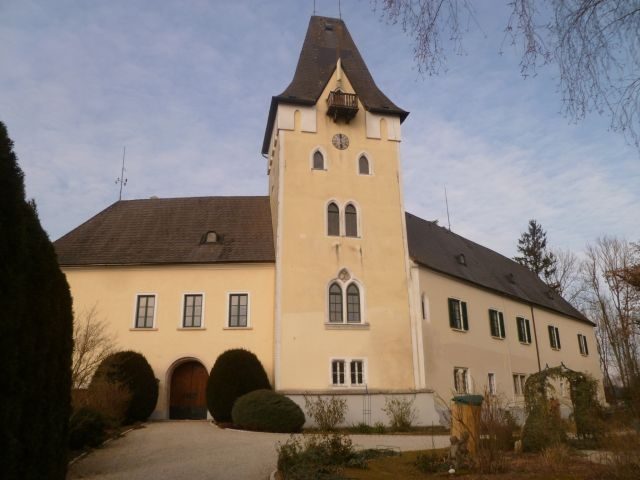
Almegg Castle

To be privately owned

Almegg Castle, in its current form, is a Renaissance castle. It was first mentioned in the 12th century and is located in the municipality of Steinerkirchen an der Traun in the district of Wels-Land. The complex is privately owned and cannot be publicly visited.

Almegg is already documented as property of Kremsmünster Abbey in 1183. The monastery granted the then castle as a fief to the ministerialis Otto de alben. In 1360, a Wolfgang Achleutner was named as a feudal tenant. The transfer of feudal sovereignty to the sovereign must have taken place in the 14th century. In 1380, Stephan der Sachs is recorded as a feudal tenant of Duke Albrecht III. The Sachs family remained in possession of Almegg until 1511. Afterwards, the ownership rights to Almegg were divided between the Barons of Ragendorf and Vinzenz Schaler. In 1530, the Aspans were again in undivided possession of the castle. In 1626, Almegg was plundered and set on fire by General Löbel and his soldiers. From the Aspans, the property passed to the Albrechtsheimers, who gave it as a dowry to Achaz Hohenfelder. It remained in his family's possession until 1808. Then Otto von Hohenfeld sold the castle to Franz Foret von Breitenfeld, who already sold it in 1811 to Ehrenreich von Schinnern. After further changes of ownership, the complex, along with the estate, came into the possession of Baron Franz von Handel and his wife Marie von Guaita in 1870. It remains in their family's possession today.

Present Day+

The horseshoe-shaped complex is situated on a rock plate. Towards the parking lot, which is now in front of the castle, a deep moat can still be seen. The massive castle tower was probably originally embedded in a ring wall, to which residential wings were later built. The tower has a wedge roof. The gate with heavy gate wings gives no hint of the atmospheric courtyard behind it. The side wings are built directly on the vertical rock face and are connected by a simple wall. Formerly, a chapel stood on a rock outcrop behind the left wing, but it collapsed in 1809 and has not been rebuilt. The complex includes several buildings that previously served economic purposes. The current building essentially dates from the 16th and 17th centuries. To the right of the entrance is the so-called Jägerhaus (Hunter's House). In the middle of the main facade, one can see the high Baroque fresco of a Schutzmantelmadonna (Madonna of Mercy) designed as a sundial. The building on the left is part of the former fortress outwork.

Take Mobile History with you

You are reading this text for free. Premium adds what matters on the road: descriptions read aloud, sites found through your camera, whole regions taken offline.

  • Every description, including the ~17,700 Premium sites
  • Audio guide: have descriptions read to you on location
  • AR finder: see sites through your camera, with distance and bearing
  • Unlimited saved sites

14 days free, then from €2.99 a month. Cancel anytime.

Source: Wikipedia · Licence: CC BY-SA 4.0 · Image: http://commons.wikimedia.org/wiki/File:Schloss_Almegg.jpg

This description draws on the facts documented in the linked Wikipedia article; Wikipedia content is licensed under CC BY-SA 4.0. Wording and editing: Mobile History.

Location: 48.0706, 13.9206