Cultural Meeting
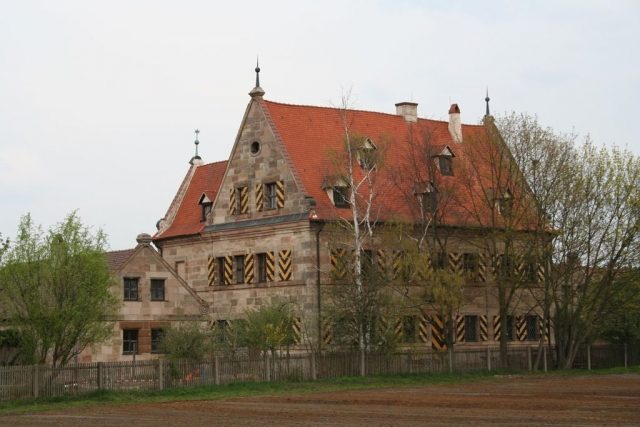
Almoshof Castle

Just a few years after the first mention of the place in 1352, the Nuremberg family of Holzschuher owned land here. Later they built a seat, over which they granted the imperial city the right of access in 1517. In case of war, the council would therefore have been allowed to occupy the seat with troops. The council scribe Johannes Müllner stated in his annals of the imperial city of Nuremberg from 1623 that there were "several burgher seats" in Almoshof, including "a very old one", the Holzschuher seat, which, however, had still been "in ruins" since its destruction in the Second Margrave War in 1552. According to the damage lists of the imperial city, it had been burned down on May 17, 1552, along with three other "beautiful noble houses" and the other Almoshof properties, a total of 93 buildings.
As late as 1642, Sigmund Gabriel Holzschuher listed the Almoshof "fire sites" in his will and urged his grandchildren to build a new manor house there. He reminded them that the seat had once been inhabited by his family for over 200 years. It was not until 1692 that Sigmund Elias Holzschuher took pity on the will and applied for the new building in May of that year. The new two-story manor house was then built in 1692/93 as a three-winged complex, south of the old castle site. Apparently, the building ground was not very stable, as the imperial city's forest office had to approve a larger quantity of timber for a pile foundation in 1692. The new building was then erected with sandstone ashlar walls. The forecourt to the north was flanked by outbuildings towards the entrance. South of the manor house stretched the garden area, which has long since been converted for agricultural use. The external appearance is mainly determined by the gables of the side wings: they feature gable crests and volutes as gable end finishes. The garden hall was set up on the ground floor of the Corps de Logis. On the upper floor there is another hall, here with a stuccoed ceiling, in other rooms, plank ceilings from the construction period have been preserved.
The Holzschuher von Harrlach family remained owners of the manor until 1941. In Almoshof, they had once exercised village and community rule. The patrimonial jurisdiction granted by the Kingdom of Bavaria had already been ceded to the state in 1834. Since 1941, the property has been owned by the city of Nuremberg. As late as 1957, the special state of preservation of the castle was praised, with particular emphasis on the bull's-eye pane glazing. Today, the manor is managed by the city's Office for Culture and Leisure and used as a cultural center.
Take Mobile History with you
You are reading this text for free. Premium adds what matters on the road: descriptions read aloud, sites found through your camera, whole regions taken offline.
- Every description, including the ~17,700 Premium sites
- Audio guide: have descriptions read to you on location
- AR finder: see sites through your camera, with distance and bearing
- Unlimited saved sites
14 days free, then from €2.99 a month. Cancel anytime.
Source: Wikipedia · Licence: CC BY-SA 4.0 · Image: http://commons.wikimedia.org/wiki/File:Almoshof_Schloss_f_sw_keichwa.jpg
This description draws on the facts documented in the linked Wikipedia article; Wikipedia content is licensed under CC BY-SA 4.0. Wording and editing: Mobile History.
Location: 49.4887, 11.0649