To be privately owned
Alst Castle (Horstmar)

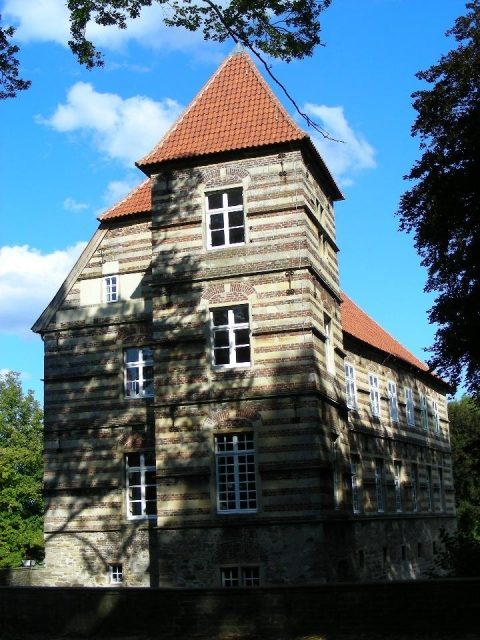
On a flat hill above a narrow stream, hidden among old trees, lies the small but remarkable moated castle. It is first mentioned in a document from 1217. As it belonged to the convent in Vreden near Ahaus, the owners changed very often. In 1569, it became the property of the Lords of Westerholt, who gave it its current appearance in 1624. In 1852, the owner became Burghard Freiherr von Schorlemer-Alst, who was called the "Westphalian Peasant King". He received this honorary title as the founder of the German Farmers' Association. Since 1935, the owners have again been the Counts Westerholt.
The small complex is remarkable for two rare peculiarities: the well-preserved ring wall and the "Speklagen" technique. If you walk along the long access avenue, you initially see little of the castle. It is largely hidden behind an almost 8 m high earthen wall, which lies behind the very deep moat. Both formerly surrounded the entire castle complex in a pentagon and formed its best protection. To the south, a bridge still serves as the only access over the wide moat. It is guarded by a gatehouse, which is to be regarded as protection for the former drawbridge. However, only the substructure of quarry stone is old. The upper floor with its Gothic windows, as well as the blind loopholes, is an addition from around 1870. From the passage, the entire complex can be easily surveyed. To the left is the outer bailey, on which today stand two simple farm buildings from the last century. They were formerly once again completely surrounded by an inner moat, which ran hard along the high earthen wall. The two steep crane houses with their flight holes for pigeons look amusing. – The main house deserves more attention. It still lies in its own house pond, which, however, is filled in on the north side. To the south, it shows its two-story show facade. It is structured by 8 windows each. Horizontal sandstone cornices connect them. Formerly, they ran through the windows, as can be seen at the top of the tower. All windows had stone crosses. However, the main effect of the entire building comes from the wall technique. Strips of light red bricks alternate with white sandstone layers. They run in an always emphasized horizontal line around the entire building, including the towers. They resemble a strongly marbled side of bacon; hence the name "Speklagen". This colorful wall formation is an exceptional phenomenon for Westphalia. Only Merfelder Hof in Horstmar and Haus Hamern in nearby Billerbeck still have the same system. However, the almost equally old town hall in Bocholt seems to have been the model. "Speklagen" are common in Holland and Belgium, so one might almost suspect a Dutch architect. Another Dutch peculiarity is also evident: flat relieving arches of bricks with sandstone blocks sit above all windows. This decorative motif is also not native to Westphalia. In contrast, the large, x-shaped iron anchors as wall decoration are quite common in this area. Their purpose is to clamp the ceiling beams of the interior into the outer wall. Dutch influence is also revealed by the "Speklagen" chimneys with their round helmet attachments. The fact that the eastern one is strongly curved further enhances the charm of the whole. On the north side, an octagonal stair tower stands as the only connection between the floors. Its door, the main portal of the castle, is a very rich example of the Renaissance's love of ornamentation, which preferred to decorate such individual parts of its buildings.
Take Mobile History with you
You are reading this text for free. Premium adds what matters on the road: descriptions read aloud, sites found through your camera, whole regions taken offline.
- Every description, including the ~17,700 Premium sites
- Audio guide: have descriptions read to you on location
- AR finder: see sites through your camera, with distance and bearing
- Unlimited saved sites
14 days free, then from €2.99 a month. Cancel anytime.
Source: Wikipedia · Licence: CC BY-SA 4.0
This description draws on the facts documented in the linked Wikipedia article; Wikipedia content is licensed under CC BY-SA 4.0. Wording and editing: Mobile History.
Location: 52.0932, 7.3361