Hotel
Altenburg Castle

p3
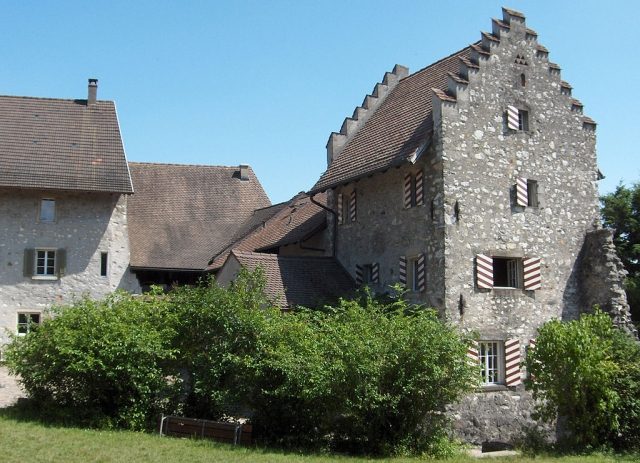
Altenburg Castle (also known as Schlössli in Swiss German) is a castle in the Swiss city of Brugg. It is located about 1 km west of the old town in the Altenburg district on the banks of the Aare. The castle originated from a Roman fort, which was built around 370 AD. At the end of the 10th century, it was the first verifiable residence of the Habsburgs. Today, the complex serves as a youth hostel.
The Roman fort of Altenburg, one of three river forts located on the Aare, was built around the year 370 under Emperor Valentinian I. It was erected on a steep rock outcrop at the river bend and was part of the Danube-Iller-Rhine Limes. However, some coin finds suggest that the fort may have been built as early as the beginning of the 4th century. It presumably protected a transshipment point, as the subsequent narrow stretch of river was difficult for barges to navigate due to numerous rocks. Furthermore, the river could be easily crossed at this point. Only a few years later, between 401 and 406, the structure was abandoned again.
In the late 10th century, a noble family settled here, possibly originally descended from the Alsatian Etichonids. Count Lanzelin commissioned the construction of a small castle, using the existing Roman walls. Around 1020, Lanzelin's son Radbot ordered the construction of Habsburg Castle on Wülpelsberg, three kilometers to the southwest. A few decades later, the family adopted the name of this castle. After the Habsburgs moved, they left Altenburg to loyal followers, first the Schenken von Habsburg, later the Effinger von Brugg family.
In 1397, Altenburg, along with the entire Eigenamt, was transferred to Königsfelden Monastery, founded by the Habsburgs. After the conquest of Aargau in 1415, the complex came into the possession of the city of Bern. The Pro Vindonissa Society and the Aargau Historical Society acquired the area in 1938.
Complex+
The late Roman fort had a bell-shaped layout, with an interior area of 28.3 ares. At least four semicircular towers and a no longer discernible moat protected the wall, which was up to five meters thick. The remains of the riverside wall were demolished in 1894 during the construction of an inlet canal for the Brugg hydropower plant. The preserved ancient ruins are integrated into the existing buildings today.
The most striking buildings are the tower house and the gable house, both built in 1570 in the late Gothic style. The west wall of the tower house consists of Roman masonry up to a height of seven meters (the highest preserved Roman wall in Switzerland). A youth hostel was established in the tower house in 1943. Within the fort walls, there are also some farmhouses dating back to the first half of the 16th century.
Take Mobile History with you
You are reading this text for free. Premium adds what matters on the road: descriptions read aloud, sites found through your camera, whole regions taken offline.
- Every description, including the ~17,700 Premium sites
- Audio guide: have descriptions read to you on location
- AR finder: see sites through your camera, with distance and bearing
- Unlimited saved sites
14 days free, then from €2.99 a month. Cancel anytime.
Source: Wikipedia · Licence: CC BY-SA 4.0 · Image: http://commons.wikimedia.org/wiki/File:Altenburg_Schloesschen.jpg
This description draws on the facts documented in the linked Wikipedia article; Wikipedia content is licensed under CC BY-SA 4.0. Wording and editing: Mobile History.
Location: 47.4820, 8.1943