CastleAltenburg

Altenburg Castle

Altenburg Castle

Cultural facilitie

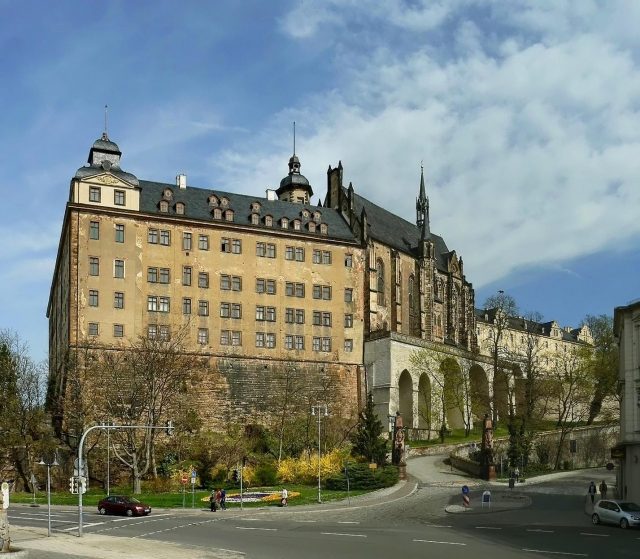
Altenburg Castle is a former residential castle of the Dukes of Saxe-Altenburg. It is located in the center of Altenburg in Thuringia and houses the Castle and Playing Card Museum, and is also a venue for a variety of cultural events. The castle is the original setting of the Altenburg Princely Abduction of 1455. It is probably the largest castle in Thuringia and one of the most worth seeing.

The castle was built on a porphyry rock, at that time still outside the city limits. Previously, there was a former Slavic rampart on the site. The Altenburg was first mentioned in 976 by Emperor Otto III. Occasionally, Emperors Lothar III, Konrad III, Heinrich VI, Otto IV, and Friedrich II were also present. Under Emperor Friedrich I (Barbarossa), the imperial palace had been expanded in the 12th century, and he stayed here six times between 1165 and 1185.

In 1307, the Wettins took over the rule in Altenburg. In 1455, the abduction of Princes Ernst and Albrecht by the knight Kunz von Kauffungen (Altenburg Princely Abduction) caused a stir. In the 17th century, Altenburg became the residence of the Dukes of Saxe-Gotha-Altenburg. Between 1706 and 1744, the castle was expanded into a palace by Dukes Friedrich II and Friedrich III. In 1868, a severe fire broke out at the castle, burning down the Prinzenpalais and the Kornhaus. Six firefighters also lost their lives.

The castle had been used by the city of Altenburg since the end of 1918, and on April 10, 1943, it was formally transferred to the city by the former Duke Ernst II.

Buildings+

Corps de Logis

In addition to the magnificent residential rooms, the Corps de Logis also houses the Bachsaal, the baroque ballroom, and the classical Goldsaal. Due to local conditions, the baroque building is not the central building of the castle complex as is usually the case, but represents the western part of the castle. A magnificent tower was planned for the roof above the main entrance, but it was never realized. However, it was already depicted in some paintings and drawings.

Ballroom

The ballroom is an approximately 8-meter-high two-story room, which was built between 1730 and 1745. After a fire, the hall was rebuilt in 1865. The hall is characterized by marble columns, above which the gallery is located. In addition, a large ceiling painting depicting the mythical figures of Cupid and Psyche adorns the hall.

Church Hall

The Church Hall, also known as the Bachsaal, was restored in Neo-Renaissance forms after a fire in 1905/1906 according to a design by Bodo Ebhardt.

Prinzenpalais and Hofmarschallamt

The Prinzenpalais and the Hofmarschallamt were built between 1868 and 1871, after the great fire had destroyed the previously standing buildings. The Altenburg building councilor Julius-Robert Enger was responsible for the construction. The Hofmarschallamt, which stands on the site of the former late Gothic granary, is a palace-like building in the Neo-Renaissance style. In the 19th and 20th centuries, the Prinzenpalais housed the apartments of the members of the ducal family.

Castle Church

The Castle Church of St. George was built in Gothic style by the new Wettin lords between 1404 and 1414. Due to a fire in 1444, the church vault collapsed and was rebuilt in late Gothic style as a cross-ribbed vault. Since the castle stands on a rock, the church is built on a balcony. Since 1413, the castle church was also the collegiate church of the Georgenstift, or the Collegiate Chapter of St. George until 1533.

In the north aisle there is a secco painting from 1488, showing Christ before Pontius Pilate. The choir stalls date from around 1500. The pulpit from 1595, adorned with numerous figures, is located at the apex between the choir and the northern side aisle. The church received some baroque new furnishings from Christoph Richter between 1644 and 1649, including the two-story altar, the prayer stalls, galleries, and the princely box.

Since the second half of the 17th century, the church has been the burial place for the ducal family; the princely crypt is located in the north aisle. Furthermore, the tomb of Electress Margaretha of Saxony, daughter of Archduke Ernst I of Austria and mother of Princes Ernst and Albrecht, from 1486 is located in front of the altar steps. The Electress owned the mint and the right to mint coins in Colditz.

Organ

Johann Sebastian Bach and Johann Ludwig Krebs, among others, played on the organ built by Heinrich Gottfried Trost between 1735 and 1739. 

Hausmannsturm

The Hausmannsturm, built in the 12th century, is one of two surviving towers of the originally seven towers. At 32 meters, it is the tallest structure in the castle complex. The shell tower originally had only a battlement and the red brickwork was not covered with white lime wash. When exactly it got its current roof hood is unknown. Inside there are no floors, but only a step-free spiral staircase leading to the tower room. This facilitated the transport of cannons.

Flasche

The so-called Flasche is a keep in Romanesque architectural style, built in the year 1000. The tower has walls up to 4 meters thick in sections and served various purposes over the centuries, such as a residential tower, dungeon, granary, or for storing weapons. The tower received its pointed slate roof in 1561.

Junkerei

The Junkerei was built as a horse stable in the 16th century. Only later did the pages and squires live in the building. The Josephterrasse is located on the city-facing side. The Junkerei was almost completely destroyed by a fire in 1987. Only the outer walls remained. The Junkerei was rebuilt only after the reunification. Today, the Thuringian State Archive Altenburg is located here.

Gatehouse

Built during the Renaissance, it formed the only access to the castle until 1640.

Washhouse

The washhouse, which adjoins the Flasche, was built in 1864. The building in Neo-Gothic style replaced its predecessor. Inside there is a cistern, which was primarily responsible for the water supply of the castle. Currently, the building is used as a residential house.

Castle and Playing Card Museum+

The first public exhibition took place as early as 1919. It showcased the former ducal armory and antiquity chamber. Four years later, the playing card museum was added. The so-called Skatheimat began its exhibition with donations from the Altenburg playing card factory, which provided the museum with playing cards, printing plates, and tools. The design of the Skatheimat room was carried out by Otto Pech. By the beginning of the war, the collection had grown to 6,000 exhibits. The collection consisted of a variety of different playing cards from all over the world. In 1946, almost everything from the castle was transported to Russia. Many museum pieces have disappeared without a trace to this day. Over time, the museum's collection filled up again, so that today the museum houses a large number of playing cards from various centuries. Furthermore, the permanent exhibitions include a porcelain collection by Bernhard von Lindenau, handicrafts and furniture from the 17th/18th centuries, sacred sculpture, a military-historical collection, a clock collection, and rural cultural heritage. In addition, changing special exhibitions are shown.

Take Mobile History with you

You are reading this text for free. Premium adds what matters on the road: descriptions read aloud, sites found through your camera, whole regions taken offline.

  • Every description, including the ~17,700 Premium sites
  • Audio guide: have descriptions read to you on location
  • AR finder: see sites through your camera, with distance and bearing
  • Unlimited saved sites

14 days free, then from €2.99 a month. Cancel anytime.

Source: Wikipedia · Licence: CC BY-SA 4.0 · Image: Thomas Eichler

This description draws on the facts documented in the linked Wikipedia article; Wikipedia content is licensed under CC BY-SA 4.0. Wording and editing: Mobile History.

Location: 50.9885, 12.4395