To be privately owned
Altenhain Castle
The first documented form of the place name dates from 1358 as Aldinhayne. The village of Altenhain probably originated in the 11th and 12th centuries with the High Medieval land development (earlier German Ostsiedlung). In 1330, the manor was acquired by the von Grosse family. Later, it was divided within the family for some time, which is suggested by the documented mention of two knightly estates in 1606. In 1742, Theodor August Freiherr von Hohenthal acquired it and bequeathed it in 1777 to his daughter Getraude Gräfin von Brühl, who died in 1783. The estate returned to her father, who, however, died in the same year. The new owner was Friedrich Leopold von Bißing, who was succeeded by his son in 1790.
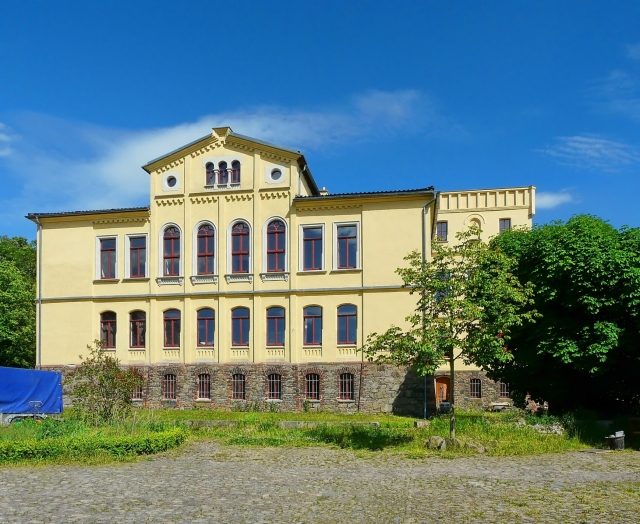
In 1802, Christian Gottlob Vetter acquired the knightly estate. After his death in 1822, it passed to a son-in-law named Seyfert and remained there until 1848. The new owner was Friedrich Wilhelm Kabitzsch, who in 1858 had the manor house built according to plans by the Leipzig architect Mothes in the Early Renaissance style. In 1871, a tower-like annex was erected.
After the Kabitzsch family owned the knightly estate, it was last owned by Dietrich von Gontard, who had acquired it in 1931 and was dispossessed and expelled by the communists in 1945. The inventory fell victim to looting after the expropriation, with many historical values being lost. In 1946, 12 new farming families from Silesia moved into the knightly estate; meetings were held in the large hall of the manor house.
The Grimma District Building Authority ordered the demolition of the buildings in 1948 – building materials for the new farmers' buildings were to be obtained from the demolition material. The then mayor Kurt Gey was able to prevent the demolition by delaying it. Afterwards, Soviet non-commissioned officers and their families, who were stationed in Altenhain, lived here. In early 1982, the Soviets left the house. Since then, it has been left to decay and deteriorated, among other things, due to illegal waste dumping. In this condition, the Dresden restorer Thomas Lauth bought the manor house with its associated park in 1996.
After 14 years of renovation work on the manor house of the knightly estate, these works were completed in 2010. Various events and changing exhibitions are now accessible to the public.
Take Mobile History with you
You are reading this text for free. Premium adds what matters on the road: descriptions read aloud, sites found through your camera, whole regions taken offline.
- Every description, including the ~17,700 Premium sites
- Audio guide: have descriptions read to you on location
- AR finder: see sites through your camera, with distance and bearing
- Unlimited saved sites
14 days free, then from €2.99 a month. Cancel anytime.
Location: 51.2912, 12.7014