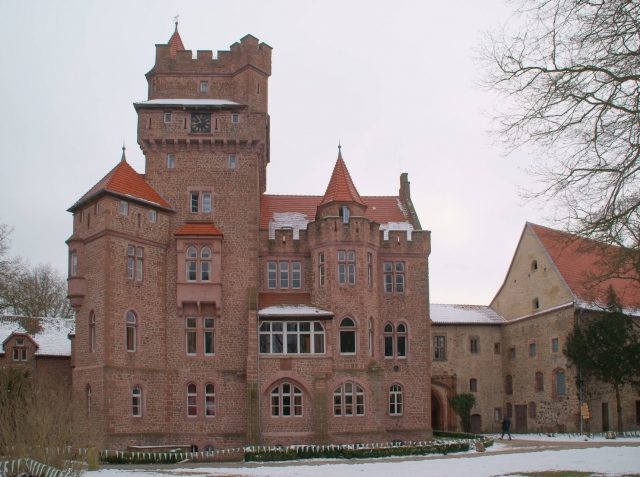
CastleAltenhausen

Altenhausen Castle

Altenhausen Castle

Youth hostel
Cultural Events

Altenhausen Castle is located in the northern part of the village of Altenhausen. To the north and west, a castle park extends. The castle itself consists of a round core castle with a Renaissance-style residential building, to which a large, Neo-Gothic keep is attached. To the west, in front of the core castle, lies an economic courtyard with buildings from the Late Gothic, Baroque, and Historicist periods. The buildings stand on the medieval ring wall.

Today's castle emerged from a lowland castle that was built as early as the 11th or 12th century and may itself have been based on earlier structures. The first documented mention of the castle occurred in 1303. By the mid-13th century, the family of the Counts of Altenhausen, originally residing in the castle, had died out. Both the Dukes of Braunschweig and the Archbishops of Magdeburg sought to take possession of the castle complex. Initially, the Braunschweiger were successful.

In 1351, the castle was conquered and completely destroyed by Magdeburg troops during a knightly feud between the city of Magdeburg and the archiepiscopal nobility. The castle was rebuilt by the Braunschweig side. After its reconstruction and the death of the Duke of Braunschweig, the Magdeburg Archbishop demanded the surrender of the castle complex in 1368, but this was refused. In 1370, a violent confrontation occurred, as a result of which the Magdeburg Archbishop took possession of the castle. However, the Archbishop then mortgaged Altenhausen Castle for 12,000 marks of silver to a Braunschweig knightly family. From here, however, the knights undertook raids against the archdiocese. As early as 1371, they had to return the castle as compensation. The Archbishop then ceded the complex to Emperor Charles IV in 1377. 13 years later, it fell back to the Archbishop. In quick succession, various enfeoffments and mortgages to Braunschweig or Magdeburg nobility followed.

From 1485, the castle belonged to the von Schulenburg family. The oldest parts of the building still preserved today date from the 15th and 16th centuries. During the Thirty Years' War, the complex was severely damaged by a major fire in 1625. Looting and the plague led to the extensive destruction of the complex. The destroyed buildings in the economic courtyard were then rebuilt by Alexander von der Schulenburg at the end of the 17th, beginning of the 18th century. After another fire at the beginning of the 19th century, the complex was renovated in 1834. The castle, which still appears castle-like today, received its current appearance with renovations at the end of the 19th century, which were completed in 1901. This renovation was carried out in the Historicist style using red sandstone by the architect Ferdinand Schorbach from Hanover. After the Second World War, the von Schulenburg family was expropriated in 1945.

The castle complex is now used as a youth hostel for school trips and as a hotel. Horse riding holidays and numerous leisure activities can be enjoyed here. Recently, numerous events have been held in the castle ambiance. There are not only knight games and magic schools but also an increasing number of evening events.

Architecture+

The main access to the complex is through the Alexander Gate, located in the south of the castle area, through which one enters the castle area from the village. The Alexander Gate is named after Alexander von der Schulenburg and was built, according to the dating on the gate, in 1671, thus during the period of reconstruction after the Thirty Years' War. The gate is built of brick and plastered. The archway is diamond-quarried. Above the gate are coats of arms and an inscription.

North of the Alexander Gate is the forecourt, at the northern end of which one reaches the economic courtyard through the gatehouse known as the Andreas Gate. At the Andreas Gate, the rebates of an originally existing drawbridge can still be seen. In addition to the actual passage, there is also a postern gate. A coat of arms tablet with an inscription is also present.

Take Mobile History with you

You are reading this text for free. Premium adds what matters on the road: descriptions read aloud, sites found through your camera, whole regions taken offline.

  • Every description, including the ~17,700 Premium sites
  • Audio guide: have descriptions read to you on location
  • AR finder: see sites through your camera, with distance and bearing
  • Unlimited saved sites

14 days free, then from €2.99 a month. Cancel anytime.

Source: Wikipedia · Licence: CC BY-SA 4.0 · Image: Jörg Dorowski

This description draws on the facts documented in the linked Wikipedia article; Wikipedia content is licensed under CC BY-SA 4.0. Wording and editing: Mobile History.

Location: 52.2628, 11.2541