To be privately owned
Altenmuhr Castle

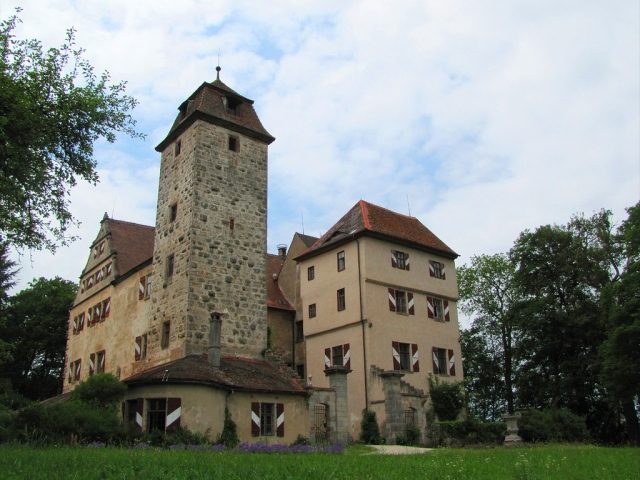
Altenmuhr Castle is a moated castle from the 12th century in the village of Altenmuhr, which has formed the unified municipality of Muhr am See with Neuenmuhr since 1976. The castle is considered one of the oldest and most interesting castle buildings in the upper Altmühl Valley, partly because it was immortalized in Schiller's Die Räuber in 1781 and was one of the filming locations for the movie Der Räuber Hotzenplotz.
According to some legends, the castle was built in the 10th century during the Hungarian invasions. In reality, Altenmuhr Castle was built in the 12th century by the Lords of Muhr, ministeriales of the Eichstätt bishops. A first comprehensive description of Altenmuhr Castle can be found in the Salbuch of 1551. In the 14th century, the Lords of Lentersheim acquired the castle. After their extinction, the villages of Alten- and Neuenmuhr, including the castles, came into the possession of the Principality of Ansbach. After Ansbach fell to Prussia, Frederick William III of Prussia transferred the castle to Minister Karl August von Hardenberg in 1799. The castle was rebuilt several times in the 16th, 17th, and 19th centuries. In 1837, the castle became the property of Wilhelm von Le Suire. To this day, the building and the castle complex remain in the private possession of the Le Suire family.
Architectural Description and Castle Complex+
The original moated castle with its keep was designed as a square enceinte with four round corner towers. In the 19th century, however, the enceinte walls and the moat were removed, leaving only the main building from the early 17th century visible. The still preserved keep has a height of 20 m and a wall thickness of approx. 1.6 m. The three-story west building with a volute gable houses rich stucco ceilings by Nuremberg's Hans Kuhn from the early 17th century on the second floor. In the four-story, almost tower-like east wing from the 14th or 15th century, a valuable grisaille wallpaper from around 1810/20 has been preserved in a hall, which was last renovated in 2006.
South of the actual castle is the former castle brewery, a listed building with a half-hipped roof from the early 18th century, and some barn and stable buildings with half-timbering. From the 19th century is the garden pavilion in the castle park, which was laid out in the late 18th century. Although the moat was leveled in the 19th century, a bridge from the 18th century has been preserved.
Take Mobile History with you
You are reading this text for free. Premium adds what matters on the road: descriptions read aloud, sites found through your camera, whole regions taken offline.
- Every description, including the ~17,700 Premium sites
- Audio guide: have descriptions read to you on location
- AR finder: see sites through your camera, with distance and bearing
- Unlimited saved sites
14 days free, then from €2.99 a month. Cancel anytime.
Source: Wikipedia · Licence: CC BY-SA 4.0
This description draws on the facts documented in the linked Wikipedia article; Wikipedia content is licensed under CC BY-SA 4.0. Wording and editing: Mobile History.
Location: 49.1555, 10.7051