CastleBarntrup - Alverdissen

Alverdissen Castle
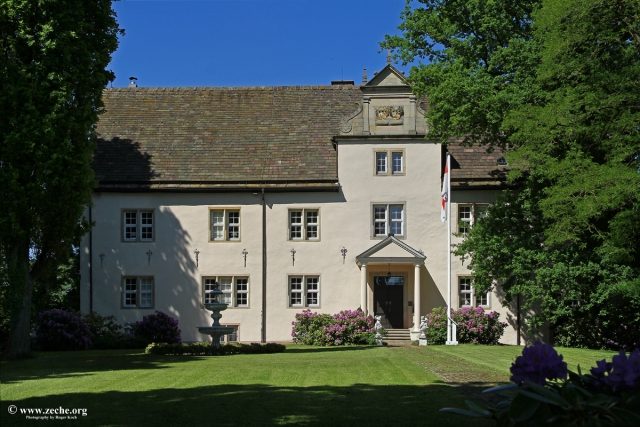
Alverdissen Castle

Cultural Events
To be privately owned

Alverdissen Castle is a castle in the Alverdissen district of Barntrup in the Lippe district. A castle of the County of Sternberg was already mentioned at this location in the 14th century. In 1812, Princess Pauline of Lippe bought the castle. Afterwards, the building served as the seat of the Sternberg office and from 1879 to 1969 as the seat of the Alverdissen district court. From 1979 to 2008, it was used as an archive building. The current building dates from the 17th century and has been structurally altered several times over time. It is registered as a monument with the number 1 in the municipal list of monuments.

The town of Alverdissen is mentioned in 1151 as a foundation of the Lords of Sternberg. In 1396, the castle of the same name is mentioned as the manorial seat of the County of Sternberg. In 1405, the castle came into the possession of the House of Lippe. In 1424, the town and the castle were destroyed but rebuilt by 1450.

From 1613, Philipp I, Count of Schaumburg-Lippe, received the castle, the office, and the town of Alverdissen as a paragium from the ruling Detmold line. Alverdissen became part of the County of Schaumburg-Lippe from 1640. Philipp's son Friedrich Christian laid the foundation stone for the present castle in 1662. Princess Pauline acquired the castle, the office, and the town of Alverdissen in 1812. The castle subsequently served as the seat of the Sternberg office. The Alverdissen district court was located in the castle from 1879 to 1969. After extensive modernizations between 1977 and 1979, the castle was used as a branch of the Detmold State Archives until 2008. Since 2009, the castle has been privately owned and not publicly accessible.

Architectural Description+

At the castle site, a three-story Baroque building with a half-hipped roof and a projecting stair tower with a curved roof was erected between 1662 and 1663. After the building was altered several times in the 19th and 20th centuries, it now consists of a simple, two-story rectangular building with a gabled roof. The curved northern outer wall reflects the alignment of two cellars, which presumably belonged to the medieval predecessor building. The northern outer wall possibly contains remnants of the old castle wall.

Castle Park+

To the east and north, the approximately 1.5-hectare castle park is bordered by the Exter river, and to the south and west by a rubble stone wall. The grounds feature a remarkable tree population from the 19th century. The area is now partly used as an easy-to-maintain green space and partly as an orchard meadow.

A copper engraving from 1626 shows an image of a regular Renaissance garden. Since the castle was not yet built at that time, it is probably a design. However, a gardener with assistants for the castle park is documented in the mid-18th century, which suggests a more elaborate garden.

Take Mobile History with you

You are reading this text for free. Premium adds what matters on the road: descriptions read aloud, sites found through your camera, whole regions taken offline.

  • Every description, including the ~17,700 Premium sites
  • Audio guide: have descriptions read to you on location
  • AR finder: see sites through your camera, with distance and bearing
  • Unlimited saved sites

14 days free, then from €2.99 a month. Cancel anytime.

Location: 52.0326, 9.1252