CastleBad Bocklet - Aschach

Aschach Castle
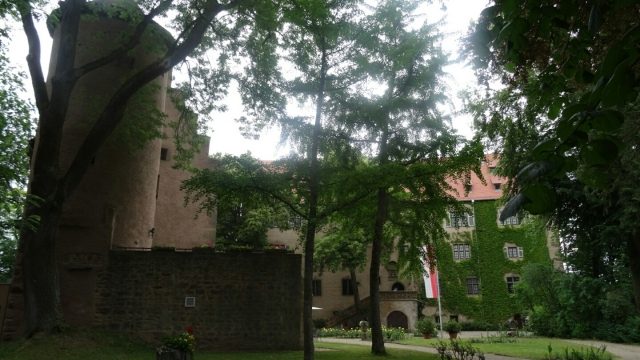
Aschach Castle

Museum

Aschach Castle is located in Aschach, a district of the market town of Bad Bocklet, in the Lower Franconian district of Bad Kissingen, Bavaria.

The construction of the castle, originally conceived as a fortress, began in 1165 under Poppo VI of Henneberg and was continued after his death by his son Poppo VII. After his death in 1245, the estate passed to his nephew Heinrich. After Heinrich's death in 1274, his three sons divided their inheritance into the lines of Aschach, Hartenburg, and Schleusingen.

In the 14th century, due to the financial distress of the Hennebergs, Aschach Castle was mortgaged for 20,000 guilders, and in 1391, when redemption failed, it was sold to the creditor Dietrich von Bibra. In 1401, the castle was acquired by the Würzburg Prince-Bishop Johann I von Egloffstein, who mortgaged it to Hildebrandt von Thüngen for three years starting in 1409. Under Johann's successor, the castle went to Count Georg von Henneberg for a purchase price of 24,000 guilders. Prince-Bishop Rudolf II von Scherenberg exercised the associated right of repurchase and brought Aschach Castle back into princely-episcopal possession, where it remained for the following 300 years.

Aschach Castle as Residence of the Würzburg Prince-Bishops

Destruction in the Peasants' Revolt of 1525

In 1525, Aschach Castle was occupied and set on fire by peasants during the Peasants' Revolt of 1525. The lord of the castle, Eiring von Rotenhan, the bailiff of Aschach, was abducted to Schweinfurt. After the suppression of the revolt, Prince-Bishop Konrad II von Thüngen carried out a punitive court throughout the entire Prince-Bishopric of Würzburg. More than 400 subjects of the Aschach office were fined, and the peasants of Trimberg were obliged to rebuild the castles of Aschach, Botenlaube, and Trimberg. In the case of Aschach Castle, the reconstruction was completed in 1527, as evidenced by a coat of arms from 1530 on the castle's courtyard facade.

Subsequently, Würzburg Prince-Bishops regularly stayed overnight at Aschach Castle during their travels. From 1542, the castle served as the official residence of Prince-Bishop Konrad III von Bibra for two years when he fled a mass dying in Würzburg.

Renewed Destruction in the Margrave War

In November 1553, Aschach Castle was destroyed by arson during the fighting in the Margrave War initiated by Albrecht II Alcibiades. After 20 years, the reconstruction of the castle was completed under Prince-Bishop Friedrich von Wirsberg. During the reconstruction, the castle acquired its present appearance.

Subsequently, the castle was regularly visited by Prince-Bishop Julius Echter von Mespelbrunn, who also spent his spa stays there. In 1575, he received a 180-pound sturgeon as a gift from a deputation of the Schweinfurt citizenry, which had been caught in the Main river shortly before, and the Prince-Bishop had a portrait made of it and placed above the door to the court kitchen. At the castle, Julius Echter also regularly met his brother Valentin Echter von Mespelbrunn, who managed the offices of Aschach and Kissingen, bestowed upon him by the Prince-Bishop, for 45 years.

Aschach Castle in the Thirty Years' War

In October 1631, the Prince-Bishopric of Würzburg was conquered by the Swedish King Gustav II Adolf during the Thirty Years' War, who gifted Aschach Castle to his colonel Count Brandenstein. In 1633, the Swedes lost the Prince-Bishopric of Würzburg and thus the castle back to the imperial troops. In the period after the war, the Prince-Bishops hosted various social events at the castle and carried out minor renovations. For example, the narrow and old spiral staircase at the portal was replaced by a spacious open staircase. Due to the summer palace Werneck, built by Balthasar Neumann under Prince-Bishop Friedrich Karl von Schönborn-Buchheim on the one hand, and the Europe-wide turmoil of the French Revolution on the other, Aschach Castle gradually lost its status as a princely-episcopal residence.

Aschach Castle under the Manufacturer Family Sattler

After the secularization of 1803 caused many buildings owned by the Bavarian king to lose their sacred function and subsequently be sold or demolished, Aschach Castle was sold in 1829 for 5,000 guilders to the Schweinfurt industrialist Wilhelm Sattler, who planned to establish a stoneware or English porcelain factory on the estate. The Ministry of Finance approved this project to promote Rhön industry and successfully asked King Ludwig I to sell the castle to Sattler. The art-savvy king only stipulated that the exterior of the castle should not be altered. Wilhelm Sattler was supported in the management of the porcelain factory by his wife, the trained painter Katharina Sattler, née Geiger, who kept the business books and artistically designed the porcelain products. In this context, she designed numerous vedutas of Aschach and its surroundings.

However, sales steadily declined due to competition from cheaper mass-produced goods from England, so that in 1860, one year after Sattler's death, operations ceased and the inventory was auctioned off. Initially, Fichtel from Schweinfurt, one of Sattler's sons-in-law and heirs, had wanted to set up a spinning mill in Aschach Castle, but then gave precedence to his brother-in-law Anton Sattler, who undertook a restoration of the castle in the "original style" and built up an extensive art collection. For unknown reasons, Anton Sattler auctioned off the art collection and the castle's inventory as early as 1868 and sold the castle three years later to his brother Ernst Sattler from Coburg for 32,000 guilders.

Aschach Castle under Friedrich von Luxburg

In the spring of 1873, Friedrich von Luxburg, the Royal Bavarian District President of Lower Franconia and Aschaffenburg, finally became the new owner of Aschach Castle for a purchase price of 72,000 Goldmark, plus another 56,000 Goldmark for renovation, restoration, and furnishing. With the support of Jens Sattler, a son of Walter Sattler, he committed to an artistic renewal of the castle, which was carried out by the Würzburg city architect Scherpf. Also under Count von Luxburg, an extensive art collection was established at Aschach Castle, supported by the Kissingen art collector Karl Streit. Chancellor Prince Otto von Bismarck visited Aschach Castle almost every year between 1876 and 1893 during his spa stays, which he spent in the Obere Saline in Hausen (today a district of Bad Kissingen), and took an occasional afternoon nap there. Bismarck found a good conversational partner in Count Luxburg, a former member of the Reichstag.

After the death of Count Luxburg in 1905, his second son, Karl von Luxburg, and his wife Carola took care of Aschach Castle and its art collection. During World War II – Karl Count von Luxburg and his wife were in the United States at the beginning of the war in 1939 and could only return in 1949 due to the war – the castle housed several hundred US soldiers and temporarily became the headquarters of Field Marshal Ewald von Kleist towards the end of the war. The castle's structure survived World War II without major damage.

The Aschach Castle Museums

Graf Luxburg Museum

In 1955, the now 84-year-old Karl Graf von Luxburg, who had no direct descendants, decided to donate Aschach Castle with all its inventory and properties to the District of Lower Franconia. With the change of ownership on November 14, 1955, the District of Lower Franconia committed to preserving the castle and its art collection for posterity and making it accessible to the public for cultural and representative purposes. After Luxburg's death in 1956, the castle was carefully converted into a castle museum under the direction of the then director of the Mainfränkisches Museum, Max Hermann von Freeden, which opened in June 1957. Since then, visitors have been presented with 36 rooms, furnished with furniture and art objects, whose familial character has been preserved. Outstanding exhibits include the East Asian collection and the paintings Judith with the Head of Holofernes by Lucas Cranach the Elder and Baptism of Christ by Michael Wohlgemut.

School Museum

Since 1982, the former forester's house on the castle grounds has housed the School Museum. The material for it had been collected since 1972, mainly by the former one-room school teacher and later rector Rudolf Erben. The main attraction is the schoolroom with its furnishings from the period between 1850 and 1900. In addition, there is an extensive collection of old wall charts and maps, as well as utensils for reading, writing, and arithmetic lessons. These and numerous other exhibits contribute to preserving the image of the old country school for posterity.

Folklore Museum

Since 1984, the grounds of Aschach Castle have also housed a Folklore Museum. It is located in the baroque tithe barn and in the museum barn, which is a new half-timbered building. In the entrance area of the tithe barn, visitors are greeted by the furniture and sales items of an old village shop. Afterwards, on the ground floor, they encounter agricultural equipment as it was used on farms throughout the year. On the upper floor, finally, one is confronted with the living situation of the rural population in earlier times. Last but not least, on the ground floor of the museum barn, one can learn about the development of modern agricultural technology in the recent past and visit special exhibitions on changing themes on the upper floor.

Owners and Possessors of the Castle+

Owners and possessors of Aschach Castle from 1165 to the present

  • 1165 – 1391 The Counts of Henneberg
  • 1391 – 1407 The Lords of Bibra
  • 1407 – 1409 The Bishops of Würzburg
  • 1409 – 1412 The Lords of Thüngen
  • 1412 – 1434 The Bishops of Würzburg
  • 1434 – 1491 The Counts of Henneberg
  • 1491 – 1631 The Bishops of Würzburg
  • 1631 – 1632 Gustav II Adolf, King of Sweden
  • 1632 – 1634 The Count of Brandenstein
  • 1634 – 1802 The Bishops of Würzburg
  • 1802 – 1805 The Elector of Electoral Palatinate-Bavaria
  • 1805 – 1814 The Elector, later Grand Duke of Würzburg
  • 1814 – 1829 The Kings of Bavaria
  • 1829 – 1873 The Sattler Family
  • 1873 – 1955 The Counts of Luxburg
  • Since 1955 The District of Lower Franconia

Take Mobile History with you

You are reading this text for free. Premium adds what matters on the road: descriptions read aloud, sites found through your camera, whole regions taken offline.

  • Every description, including the ~17,700 Premium sites
  • Audio guide: have descriptions read to you on location
  • AR finder: see sites through your camera, with distance and bearing
  • Unlimited saved sites

14 days free, then from €2.99 a month. Cancel anytime.

Source: Wikipedia · Licence: CC BY-SA 4.0 · Image: Jörg Heldt

This description draws on the facts documented in the linked Wikipedia article; Wikipedia content is licensed under CC BY-SA 4.0. Wording and editing: Mobile History.

Location: 50.2544, 10.0620